Question 16
If a quadrilateral has four equal sides and one angle of 90°, will it be a square? Find the answer using geometric reasoning as well as by construction and measurement.
We will show that a quadrilateral with four equal sides and one right angle must have all its angles as right angles, making it a square.
Step 1 — Set up the quadrilateral
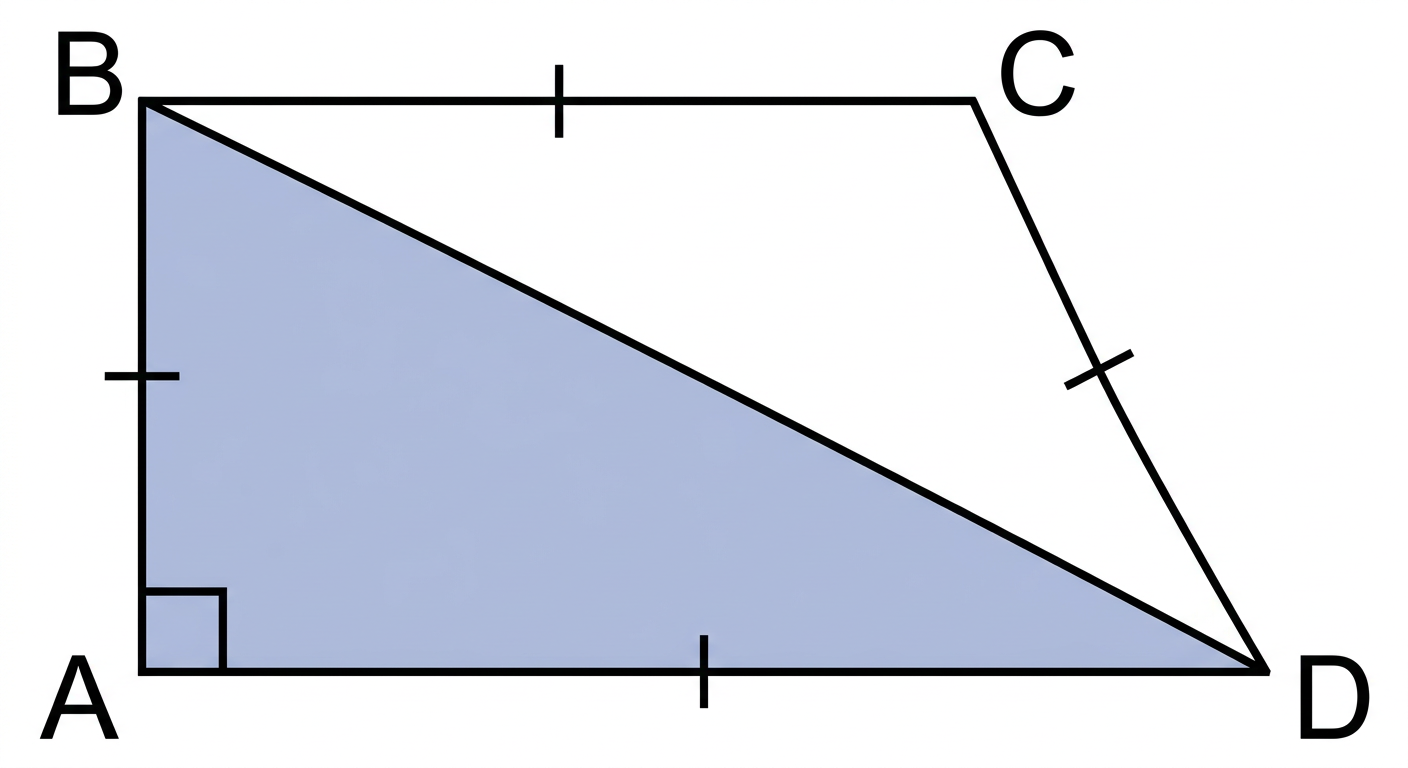
Let us consider a quadrilateral named ABCD. We are given that all its sides are equal in length. So, AB = BC = CD = DA. We are also given that one of its angles is 90 degrees. Let us assume .
Step 2 — Draw a diagonal and analyze triangles
Let us draw a diagonal from point B to point D. This diagonal divides the quadrilateral into two triangles. These triangles are and .
Step 3 — Examine triangle ABD
In , we know that side AB equals side AD. This is because all sides of the quadrilateral are equal. So, is an isosceles triangle. Also, we know that is 90 degrees. The sum of angles in any triangle is 180 degrees. So, . In an isosceles triangle, angles opposite to equal sides are equal. So, . Let us call this angle 'x'.
So, and .
Step 4 — Examine triangle CBD
Now, let us look at . We know that side CB equals side CD. This is because all sides of the quadrilateral are equal. So, is also an isosceles triangle. This means that .
Step 5 — Compare the two triangles
Let us compare and . We know that AB = CB (given equal sides). We know that AD = CD (given equal sides). The side BD is common to both triangles. So, by the SSS (Side-Side-Side) congruence rule, the two triangles are congruent. This means . When two triangles are congruent, their corresponding angles are equal. So, must be equal to . We know .
Also, must be equal to . We found . So, . And must be equal to . We found . So, .
Step 6 — Calculate all angles of the quadrilateral
Now we can find all the angles of the quadrilateral ABCD. We are given . We found . Let us find .
Let us find . So, all four angles of the quadrilateral ABCD are 90 degrees. Since all sides are equal and all angles are 90 degrees, ABCD is a square.
Construction and Measurement
Step 1 — Draw the first side and angle
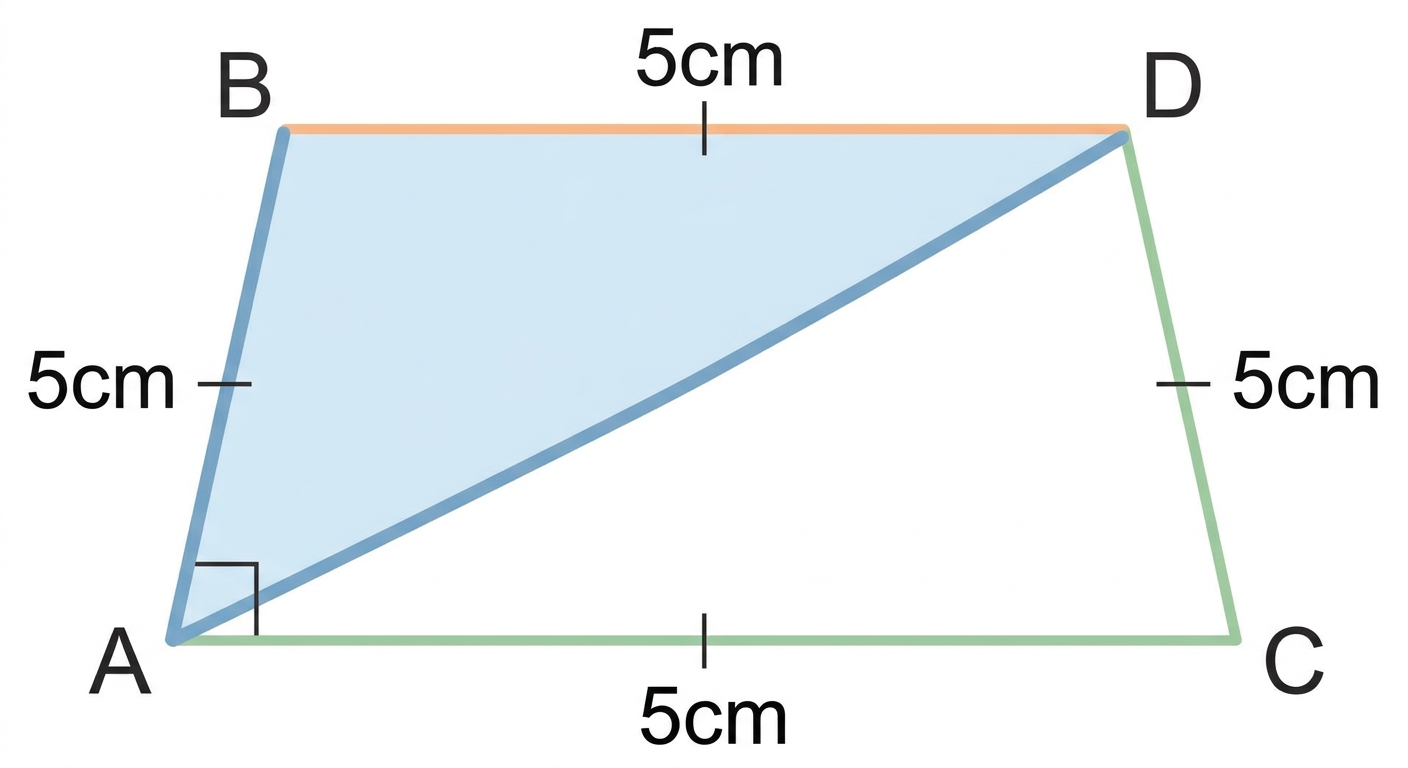
Let us draw a line segment AB. Let its length be 5 cm. At point A, we will construct an angle of 90 degrees. We can use a protractor or a compass for this.
Step 2 — Mark the other vertices
Along the 90-degree line from A, mark point D. Make sure the length AD is also 5 cm. Now, from point D, draw an arc with a radius of 5 cm. From point B, draw another arc with a radius of 5 cm. The point where these two arcs meet is point C.
Step 3 — Complete the quadrilateral
Join point B to C and point C to D. We now have quadrilateral ABCD.
Step 4 — Measure sides and angles
Let us measure all the sides of ABCD. We will find that AB = BC = CD = DA = 5 cm. Let us measure all the angles of ABCD using a protractor. We will find that (by construction). We will also find that . And . And .
Answer
Yes, a quadrilateral with four equal sides and one angle of 90° will be a square.
Geometric Reasoning: We proved that if a quadrilateral ABCD has four equal sides and one angle of 90°, then all its angles must be 90°. Since all sides are equal and all angles are 90°, it is a square.
Construction and Measurement: By constructing such a quadrilateral with sides of 5 cm and one angle of 90°, we measured the other angles and found them all to be 90°. This confirms that the figure is a square.
More questions in FIO
Find all the other angles inside the following rectangles.
Draw a quadrilateral whose diagonals have equal lengths of 8 cm that bisect each other, and intersect at an angle of
(i) 30° (ii) 40° (iii) 90° (iv) 140°
Consider a circle with centre O. Line segments PL and AM are two perpendicular diameters of the circle. What is the figure APML? Reason and/or experiment to figure this out.
We have seen how to get 90° using paper folding. Now, suppose we do not have any paper but two sticks of equal length, and a thread. How do we make an exact 90° using these?
We saw that one of the properties of a rectangle is that its opposite sides are parallel. Can this be chosen as a definition of a rectangle? In other words, is every quadrilateral that has opposite sides parallel and equal, a rectangle?
Find the remaining angles in the following quadrilaterals.
Using the diagonal properties, construct a parallelogram whose diagonals are of lengths 7 cm and 5 cm, and intersect at an angle of 140°.
Using the diagonal properties, construct a rhombus whose diagonals are of lengths 4 cm and 5 cm.
Find all the sides and the angles of the quadrilateral obtained by joining two equilateral triangles with sides 4 cm.
Construct a kite whose diagonals are of lengths 6 cm and 8 cm.
Find the remaining angles in the following trapeziums—
Draw a Venn diagram showing the set of parallelograms, kites, rhombuses, rectangles, and squares. Then, answer the following questions—
(i) What is the quadrilateral that is both a kite and a parallelogram? (ii) Can there be a quadrilateral that is both a kite and a rectangle? (iii) Is every kite a rhombus? If not, what is the correct relationship between these two types of quadrilaterals?
If PAIR and RODS are two rectangles, find .
Construct a square with diagonal 6 cm without using a protractor.
CASE is a square. The points U, V, W and X are the midpoints of the sides of the square. What type of quadrilateral is UVWX? Find this by using geometric reasoning, as well as by construction and measurement. Find other ways of constructing a square within a square such that the vertices of the inner square lie on the sides of the outer square, as shown in Figure (b).
If a quadrilateral has four equal sides and one angle of 90°, will it be a square? Find the answer using geometric reasoning as well as by construction and measurement.
What type of a quadrilateral is one in which the opposite sides are equal? Justify your answer.
Hint: Draw a diagonal and check for congruent triangles.
Will the sum of the angles in a quadrilateral such as the following one also be 360°? Find the answer using geometric reasoning as well as by constructing this figure and measuring.
State whether the following statements are true or false. Justify your answers.
(i) A quadrilateral whose diagonals are equal and bisect each other must be a square.
(ii) A quadrilateral having three right angles must be a rectangle.
(iii) A quadrilateral whose diagonals bisect each other must be a parallelogram.
(iv) A quadrilateral whose diagonals are perpendicular to each other must be a rhombus.
(v) A quadrilateral in which the opposite angles are equal must be a parallelogram.
(vi) A quadrilateral in which all the angles are equal is a rectangle.
(vii) Isosceles trapeziums are parallelograms.