Question 1
Are squares the only quadrilaterals that have equal sidelengths? Let us explore this question through construction.
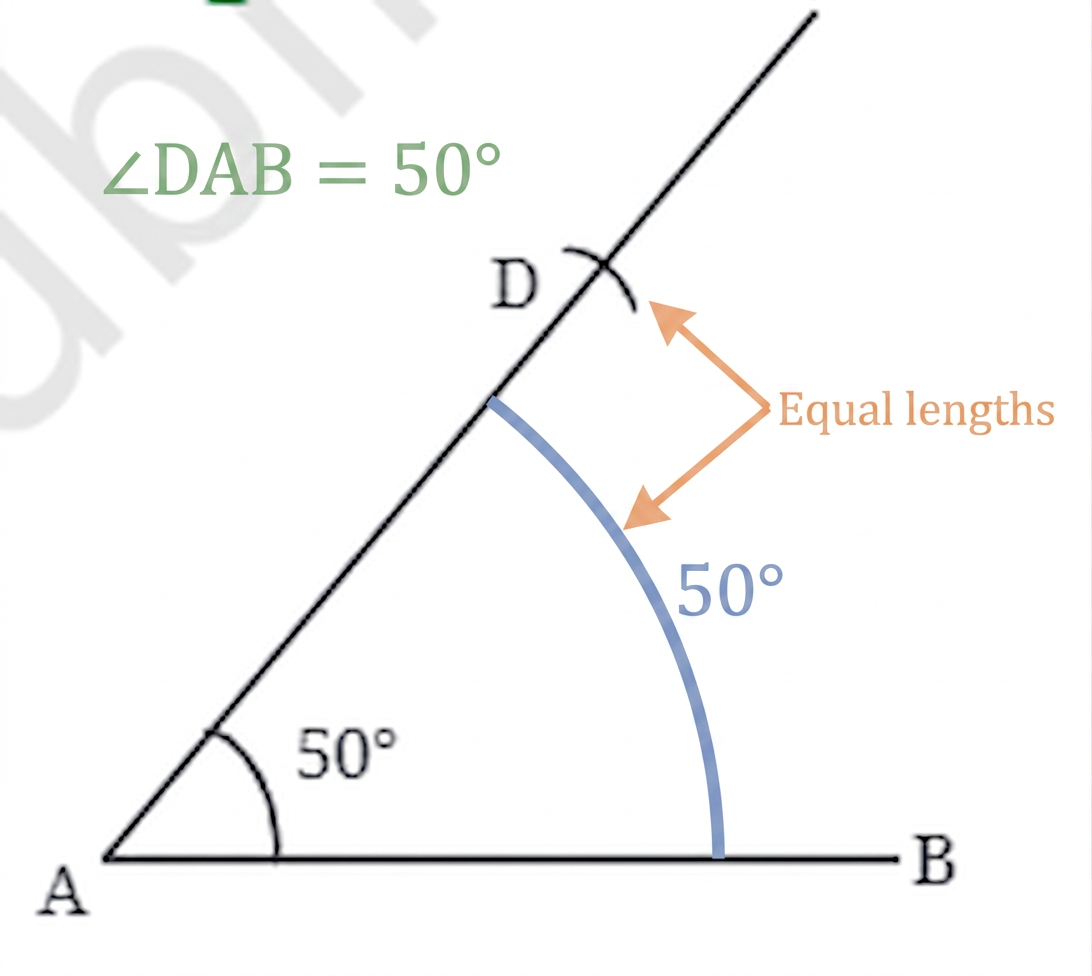
Draw two equal sides AD and AB, that are not perpendicular to each other.
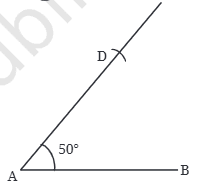
We will construct a quadrilateral with four equal sides to see if it must be a square.
Step 1 — Starting with two equal sides
The problem asks us to start with two equal sides, AD and AB, that are not perpendicular. The given diagram shows these sides forming an angle of at vertex A. We will use these as the first two sides of our quadrilateral.
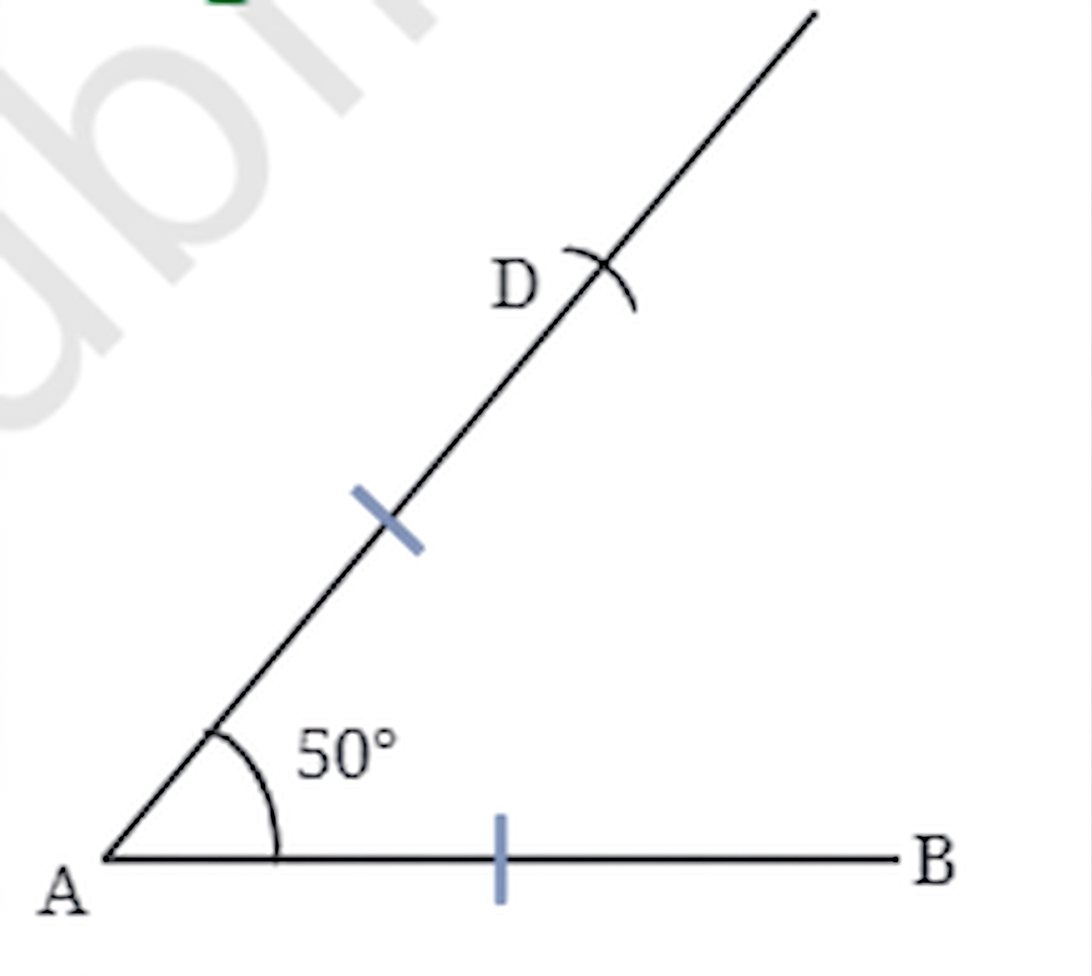
Step 2 — Constructing the third side
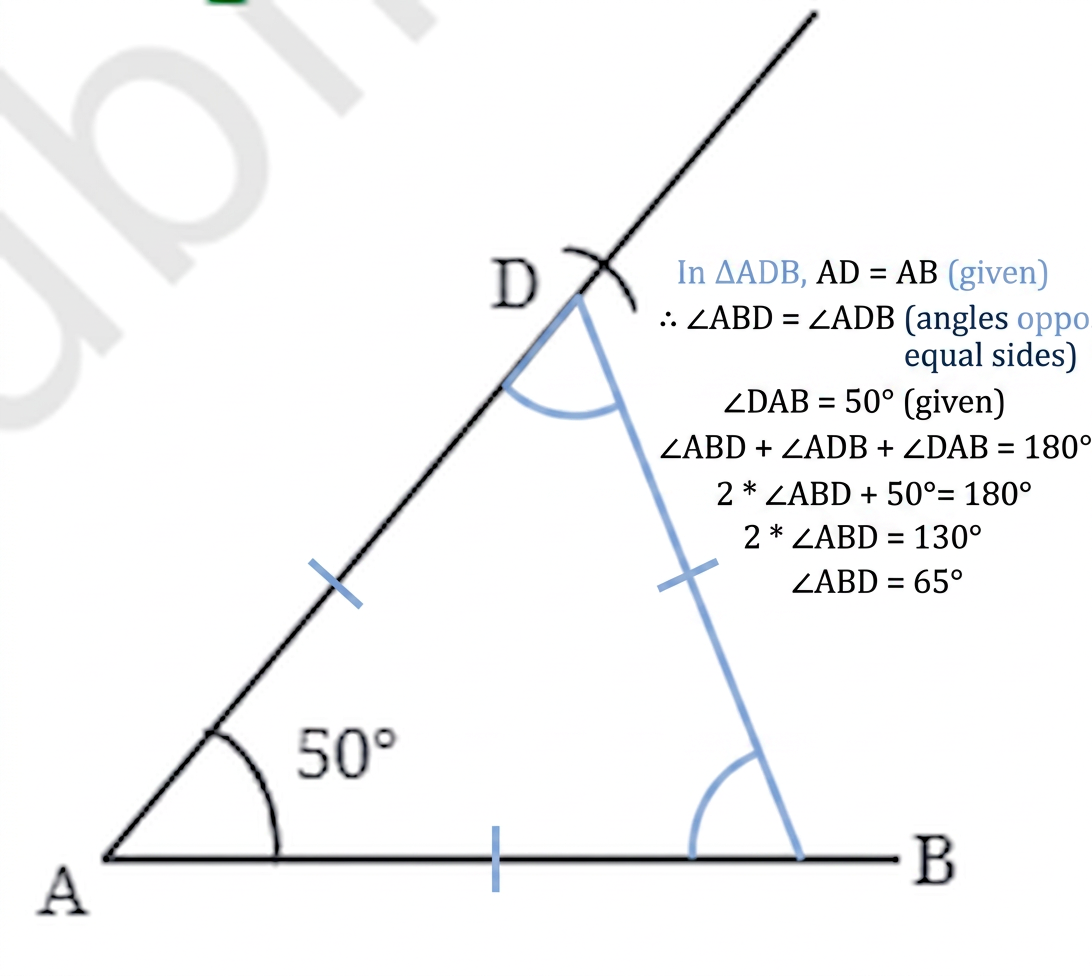
To make all four sides of our quadrilateral equal, the side DC must have the same length as AD and AB. We use a compass for this. We place the compass point at D and set its radius to the length of AD. Then, we draw an arc. This arc shows all possible positions for vertex C such that DC is equal to AD.
Step 3 — Constructing the fourth vertex
The fourth side, BC, must also be equal to AB and AD. We place the compass point at B and set its radius to the length of AB. We then draw a second arc. The point where this arc intersects the arc from Step 2 is our fourth vertex, C. This ensures that BC = AB and DC = AD.
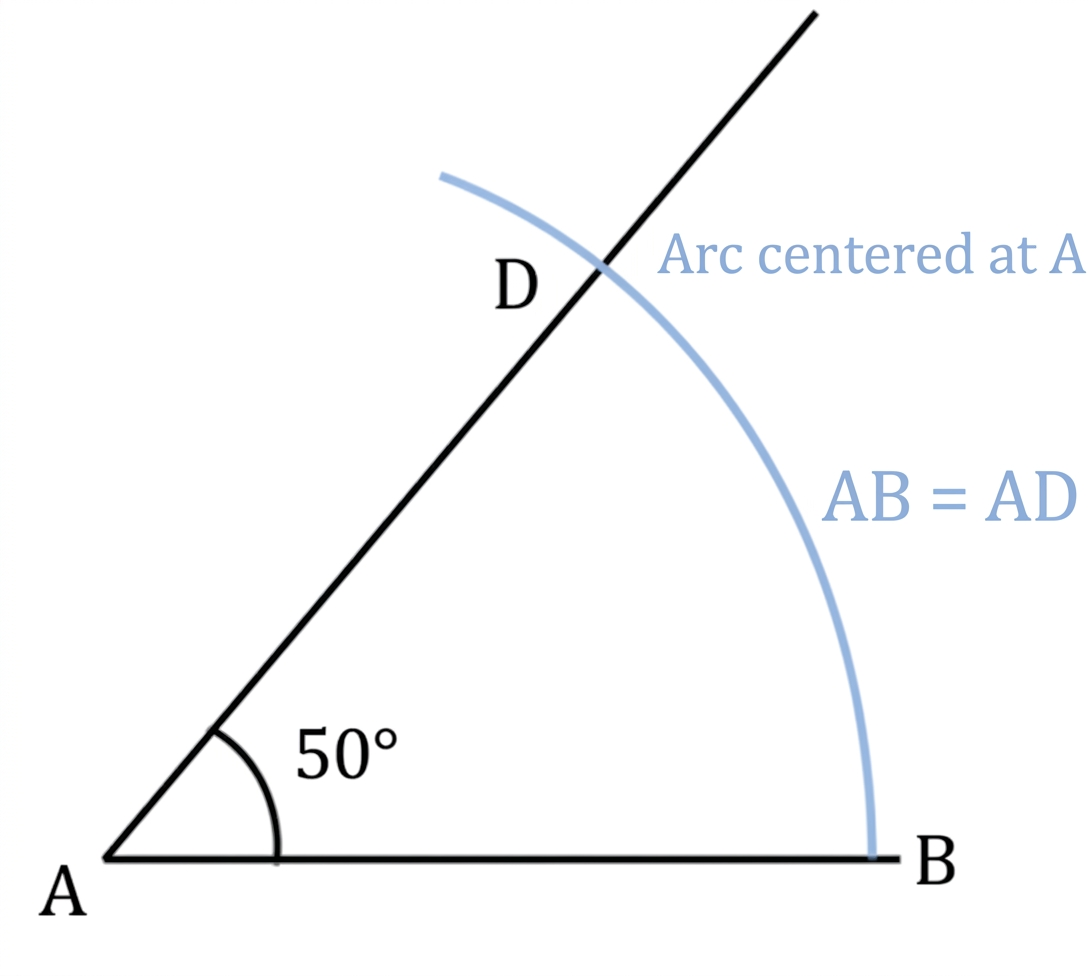
Step 4 — Completing the quadrilateral
Now, we connect point C to point D and point C to point B using straight lines. This completes our quadrilateral, which we can call ABCD.
Step 5 — Analyzing the constructed quadrilateral
By our construction, all four sides of the quadrilateral ABCD are equal in length (AB = BC = CD = DA). However, the angle at vertex A is , which is not a right angle (). A quadrilateral with all four sides equal is called a rhombus. A square is a special type of rhombus where all angles are . Since our constructed quadrilateral has equal sides but an angle of , it is a rhombus but not a square.
Answer
No, squares are not the only quadrilaterals that have equal side lengths. We constructed a rhombus (a quadrilateral with all four sides equal) where the angle between two adjacent sides is . Since is not , this rhombus is not a square. This construction shows that other quadrilaterals, like rhombuses, can also have equal side lengths without being squares.
More questions in A
Are squares the only quadrilaterals that have equal sidelengths? Let us explore this question through construction.
Draw two equal sides AD and AB, that are not perpendicular to each other.
Can we complete this quadrilateral so that all its sides are of the same length?
Mark a point C whose distance from B and D is equal to AB (or AD). To do this, measure AB using a compass. Keeping this length as the radius, cut arcs from B and D.
Place two rubber bands perpendicular to each other, forming diagonals of equal length. Join the ends.
What is the quadrilateral that you get? Justify your answer.
Extend one of the diagonals on both sides by 2 cm.
What quadrilateral will you get now? Justify your answer.
Take two cardboard cutouts of an equilateral triangle of sidelength 8 cm.
- Can you join them to get a quadrilateral?
- What type of a quadrilateral is this? Justify your answer.
Take two cardboard cutouts of an isosceles triangle with sidelengths 8 cm, 8 cm, and 6 cm.
- What are the different ways they can be joined to get a quadrilateral?
- What quadrilaterals are these? Justify your answers.
Take two cardboard cutouts of a scalene triangle with sides 6 cm, 9 cm, and 12 cm.
- What are the different ways they can be joined to get a quadrilateral?
- Are you able to identify the different quadrilaterals that are obtained by joining the triangles? Justify your answer whenever you identify a quadrilateral.
Which Quad?
Gameplay
- Fold a sheet into half.
- Now, fold it once more into a quarter.
- Make a triangular crease at the corner that is at the middle of the paper.
- Open the sheet. What is the shape formed by the creases?
- How would you fold the quarter paper to get the kinds of creases shown in the following image.
- How would you fold the quarter paper such that a square is formed?