Question 26
[Śulba-Sūtras] An isosceles triangle can be converted into a rectangle by dissection in a simpler way. Can you find out how to do it?
[Hint: Show that triangles ΔADB and ΔADC can be made into halves of a rectangle. Figure out how they should be assembled to get a rectangle. Use cut-outs if necessary.]
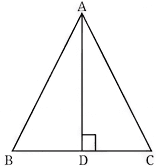
We can cut the isosceles triangle along its altitude to get two congruent right-angled triangles, then rearrange them to form a rectangle.
Step 1 — Dissecting the triangle
First, we identify the given triangle. The diagram shows an isosceles triangle ΔABC, where AB = AC. AD is the altitude from vertex A to the base BC. This means AD is perpendicular to BC, so ∠ADB = ∠ADC = 90°. In an isosceles triangle, the altitude to the base also bisects the base. So, D is the midpoint of BC, which means BD = DC. When we cut the triangle ΔABC along the line segment AD, we get two right-angled triangles: ΔADB and ΔADC. These two triangles are congruent because:
- AD is common to both triangles.
- ∠ADB = ∠ADC = 90°.
- AB = AC (given that ΔABC is isosceles). This is by the RHS (Right angle-Hypotenuse-Side) congruence rule.
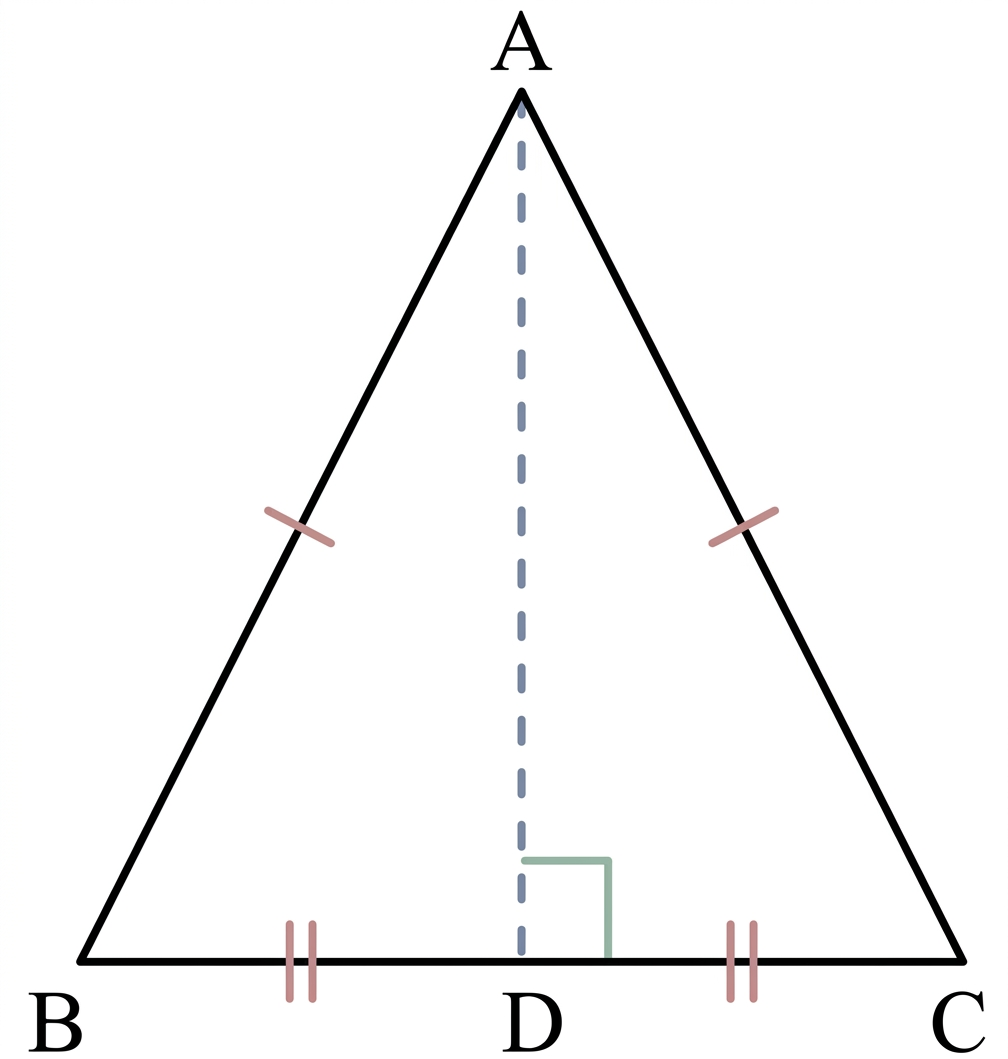
Step 2 — Rearranging the pieces to form a rectangle
Let us consider the two congruent right-angled triangles, ΔADB and ΔADC. Let the length of the altitude AD be . Let the length of the base segment DB be . Since BD = DC, the length of DC is also . The area of the original isosceles triangle ΔABC is:
So, the rectangle we form must have an area of . This means its sides should be and .
Now, let us take the triangle ΔADC. We will keep it in place. Its sides are AD (), DC (), and AC (hypotenuse). It has a right angle at D. Next, we take the other triangle, ΔADB. We can rotate ΔADB by 180 degrees around the midpoint of its hypotenuse AB. Alternatively, a simpler way for this specific problem is to take ΔADB and slide it. We can move ΔADB such that its side AD aligns with the side AD of ΔADC, but this time, we place point B at a new position, let's call it B', such that DB' is parallel to AD. This is not clear.
Let's follow the hint more directly: "ΔADB and ΔADC can be made into halves of a rectangle." Consider ΔADC. It has a right angle at D. We can place it such that D is at one corner of our desired rectangle. Let's place ΔADC so that D is at the bottom-left corner, DC lies along the bottom side, and AD lies along the left side. So, we have a shape with vertices A, D, C. Now, take ΔADB. We need to attach it to form a rectangle. We can rotate ΔADB by 180 degrees about the midpoint of the side AD. Let M be the midpoint of AD. Rotate ΔADB by 180 degrees about M. Point A will move to D. Point D will move to A. Point B will move to a new point, let's call it B'. The new triangle will be ΔDA'B', where A' is the original A, and D' is the original D. This means the triangle ΔADB, when rotated 180 degrees around the midpoint of AD, will have its vertex B at a point B' such that DB' is parallel to AC and equal in length. This forms a parallelogram.
Let's try a simpler rearrangement.
- Keep ΔADC as it is.
- Take ΔADB.
- Flip ΔADB over (reflect it across AD). This makes it overlap ΔADC. This is not forming a rectangle.
- Instead, let's take ΔADB and rotate it 180 degrees around point D. Point B will move to C. Point A will move to a new point, let's call it A', such that A, D, A' are collinear and AD = DA'. This forms a triangle ΔA'DC. This also doesn't form a rectangle.
The simplest way is to cut the triangle along its altitude AD. We now have two right-angled triangles: ΔADB and ΔADC. Let's keep ΔADC fixed. Now, take ΔADB. We can slide it. Imagine placing ΔADC. Now, take ΔADB. We can rotate ΔADB by 180 degrees about the midpoint of AC. No.
Let's consider the rectangle we want to form. It has sides and . We have two pieces, ΔADB and ΔADC. Let's place ΔADC. It has a right angle at D. Now, take ΔADB. We can place ΔADB such that its side BD is aligned with the side DC of ΔADC. This would just reconstruct the original triangle.
The simplest way to convert an isosceles triangle into a rectangle by dissection is as follows:
- Cut the isosceles triangle along its altitude AD. This divides it into two congruent right-angled triangles, ΔADB and ΔADC.
- Take one of these right-angled triangles, say ΔADB.
- Place ΔADC such that its base DC is along a straight line.
- Now, take ΔADB. Rotate it by 180 degrees about the midpoint of the side AD. This will place point A at D, point D at A, and point B at a new position B'. The new triangle is ΔDA'B'. This is not the simplest way.
Let's use the idea of "halves of a rectangle". A right-angled triangle is half of a rectangle if you duplicate it and reflect it across one of its legs. So, if we take ΔADB, we can form a rectangle by reflecting it across AD. This forms ΔABC. This is not helpful. If we reflect ΔADB across DB, we get a rectangle with sides AD and DB. Let's call the rectangle formed by reflecting ΔADB across DB as rectangle R1. Its vertices would be A, D, B, and a new point A' (reflection of A). Similarly, if we reflect ΔADC across DC, we get a rectangle with sides AD and DC. Let's call the rectangle formed by reflecting ΔADC across DC as rectangle R2. Its vertices would be A, D, C, and a new point A'' (reflection of A). Since DB = DC, R1 and R2 are congruent rectangles.
The question asks how to assemble ΔADB and ΔADC to get a rectangle. Let's place ΔADC. Its vertices are A, D, C. Now, take ΔADB. We need to move it. We can slide ΔADB such that point B coincides with point C, and side BD aligns with side CD. This just puts them back together.
The actual dissection is simpler:
- Cut the isosceles triangle along its altitude AD. We get two congruent right-angled triangles, ΔADB and ΔADC.
- Take ΔADC.
- Take ΔADB. Rotate ΔADB by 180 degrees about the midpoint of its hypotenuse AB. This is for a general triangle.
Let's consider the specific properties of an isosceles triangle. We have two congruent right triangles. Let AD = h and BD = DC = b. The area of the isosceles triangle is . We want to form a rectangle with sides and .
Let's take ΔADC. Its right angle is at D. Place it such that D is at the origin (0,0), C is at (b,0), and A is at (0,h). Now, take ΔADB. Its vertices are A(0,h), D(0,0), B(-b,0). We need to move ΔADB. Let's move ΔADB such that its vertex B aligns with C, and its side BD aligns with CD. This is not right.
The simplest way to convert an isosceles triangle into a rectangle by dissection:
- Cut the isosceles triangle ΔABC along its altitude AD. This divides it into two congruent right-angled triangles: ΔADB and ΔADC.
- Take ΔADB.
- Rotate ΔADB by 180 degrees around the midpoint of AD. This will place vertex A at D, vertex D at A, and vertex B at a new point B'. This is not forming a rectangle with ΔADC.
Let's try a different approach.
- Cut the isosceles triangle ΔABC along its altitude AD. We get ΔADB and ΔADC.
- Let's take ΔADC.
- Now, take ΔADB. We can place it such that the side AD of ΔADB is aligned with the side AD of ΔADC, but on the opposite side of AD. This just reconstructs the original triangle.
The hint "halves of a rectangle" means that if you take one of the right triangles, say ΔADB, and reflect it across its leg DB, you would get a rectangle with sides AD and DB. Let's call this rectangle R. Its dimensions are AD and DB. The area of R is . The area of ΔABC is . So, we need to form a rectangle with sides AD and DB.
Let's take ΔADC. Let's take ΔADB. We can place ΔADC as one part of the rectangle. Now, take ΔADB. We can move ΔADB such that its side AB is aligned with AC. No.
Let's try the standard method for an isosceles triangle:
- Cut the isosceles triangle ΔABC along its altitude AD. This gives two congruent right-angled triangles, ΔADB and ΔADC.
- Take ΔADB.
- Take ΔADC.
- Place ΔADC.
- Now, take ΔADB. We can slide it and place it next to ΔADC such that the side AD of ΔADB aligns with the side AD of ΔADC. This is not forming a rectangle.
Let's use the hint again: "Show that triangles ΔADB and ΔADC can be made into halves of a rectangle." This means that if we take ΔADB, it is half of a rectangle. If we take ΔADC, it is half of a rectangle. Since ΔADB and ΔADC are congruent, they are halves of the same rectangle. Let the rectangle have sides AD and DB. So, ΔADB is half of a rectangle with sides AD and DB. And ΔADC is half of a rectangle with sides AD and DC. Since DB = DC, both are halves of a rectangle with sides AD and DB.
Now, how to assemble them to get a rectangle? Let's place ΔADC. Its vertices are A, D, C. Now, take ΔADB. We can rotate ΔADB by 180 degrees about the midpoint of the hypotenuse AB. This is
More questions in FIO
Identify the missing sidelengths.
The figure shows a path (the shaded portion) laid around a rectangular park EFGH.
(i) What measurements do you need to find the area of the path? Once you identify the lengths to be measured, assign possible values of your choice to these measurements and find the area of the path. Give a formula for the area.
An example of a formula — .
[Hint: There is a relation between the areas of EFGH, the path, and ABCD.**]
(ii) If the width of the path along each side is given, can you find its area? If not, what other measurements do you need? Assign values of your choice to these measurements and find the area of the path. Give a formula for the area using these measurements.
[Hint: Break the path into rectangles.**]
(iii) Does the area of the path change when the outer rectangle is moved while keeping the inner rectangular park EFGH inside it, as shown?
The figure shows a plot with sides 14m and 12m, and with a crosspath. What other measurements do you need to find the area of the crosspath? Once you identify the lengths to be measured, assign some possible values of your choice and find the area of the path. Give a formula for the area based on the measurements you choose.
Find the area of the spiral tube shown in the figure. The tube has the same width throughout.
[Hint: There are different ways of finding the area. Here is one method.]
What should be the length of the straight tube if it is to have the same area as the bent tube on the left?
In this figure, if the sidelength of the square is doubled, what is the increase in the areas of the regions 1, 2 and 3? Give reasons.
Divide a square into 4 parts by drawing two perpendicular lines inside the square as shown in the figure.
Rearrange the pieces to get a larger square, with a hole inside.
You can try this activity by constructing the square using cardboard, thick chart paper, or similar materials.
Find the areas of the following triangles:
Find the length of the altitude BY.
Find the area of SUB, given that it is isosceles, SE is perpendicular to UB, and the area of SEB is 24 sq. units.
[Śulba-Sūtras] Give a method to transform a rectangle into a triangle of equal area.
[Śulba-Sūtras] Give a method to transform a triangle into a rectangle of equal area.
ABCD, BCEF, and BFGH are identical squares.
(i) If the area of the red region is 49 sq. units, then what is the area of the blue region?
(ii) In another version of this figure, if the total area enclosed by the blue and red regions is 180 sq. units, then what is the area of each square?
If M and N are the midpoints of XY and XZ, what fraction of the area of XYZ is the area of XMN? [Hint: Join NY]
Gopal needs to carry water from the river to his water tank. He starts from his house. What is the shortest path he can take from his house to the river and then to the water tank? Roughly recreate the map in your notebook and trace the shortest path.
Find the area of the quadrilateral ABCD given that AC = 22 cm, BM = 3 cm, DN = 3 cm, BM is perpendicular to AC, and DN is perpendicular to AC.
Find the area of the shaded region given that ABCD is a rectangle.
What measurements would you need to find the area of a regular hexagon?
What fraction of the total area of the rectangle is the area of the blue region?
Give a method to obtain a quadrilateral whose area is half that of a given quadrilateral.
Observe the parallelograms in the figure below.
(i) What can we say about the areas of all these parallelograms?
(ii) What can we say about their perimeters? Which figure appears to have the maximum perimeter, and which has the minimum perimeter?
Find the areas of the following parallelograms:
Find QN.
Consider a rectangle and a parallelogram of the same sidelengths: 5 cm and 4 cm. Which has the greater area? [Hint: Imagine constructing them on the same base.]
Give a method to obtain a rectangle whose area is twice that of a given triangle. What are the different methods that you can think of?
[Śulba-Sūtras] Give a method to obtain a rectangle of the same area as a given triangle.
[Śulba-Sūtras] An isosceles triangle can be converted into a rectangle by dissection in a simpler way. Can you find out how to do it?
[Hint: Show that triangles ΔADB and ΔADC can be made into halves of a rectangle. Figure out how they should be assembled to get a rectangle. Use cut-outs if necessary.]
[Śulba-Sūtras] Give a method to convert a rectangle into an isosceles triangle by dissection.
Which has greater area—an equilateral triangle or a square of the same sidelength as the triangle? Which has greater area—two identical equilateral triangles together or a square of the same sidelength as the triangle? Give reasons.
Find the area of a rhombus whose diagonals are 20 cm and 15 cm.
Give a method to convert a rectangle into a rhombus of equal area using dissection.
Find the areas of the following figures:
[Śulba-Sūtras] Give a method to convert an isosceles trapezium to a rectangle using dissection.
Here is one of the ways to convert trapezium ABCD into a rectangle EFGH of equal area —
Given the trapezium ABCD, how do we find the vertices of the rectangle EFGH?
[Hint: If ΔAHI ≅ ΔDGI and ΔBEJ ≅ ΔCFJ, then the trapezium and rectangle have equal areas.]
Using the idea of converting a trapezium into a rectangle of equal area, and vice versa, construct a trapezium of area .
A regular hexagon is divided into a trapezium, an equilateral triangle, and a rhombus, as shown. Find the ratio of their areas.
ZYXW is a trapezium with ZY || WX. A is the midpoint of XY. Show that the area of the trapezium ZYXW is equal to the area of .