Question 1
Context: The symbol on this signboard needs to be recreated on another board.
Q. How do we do it?
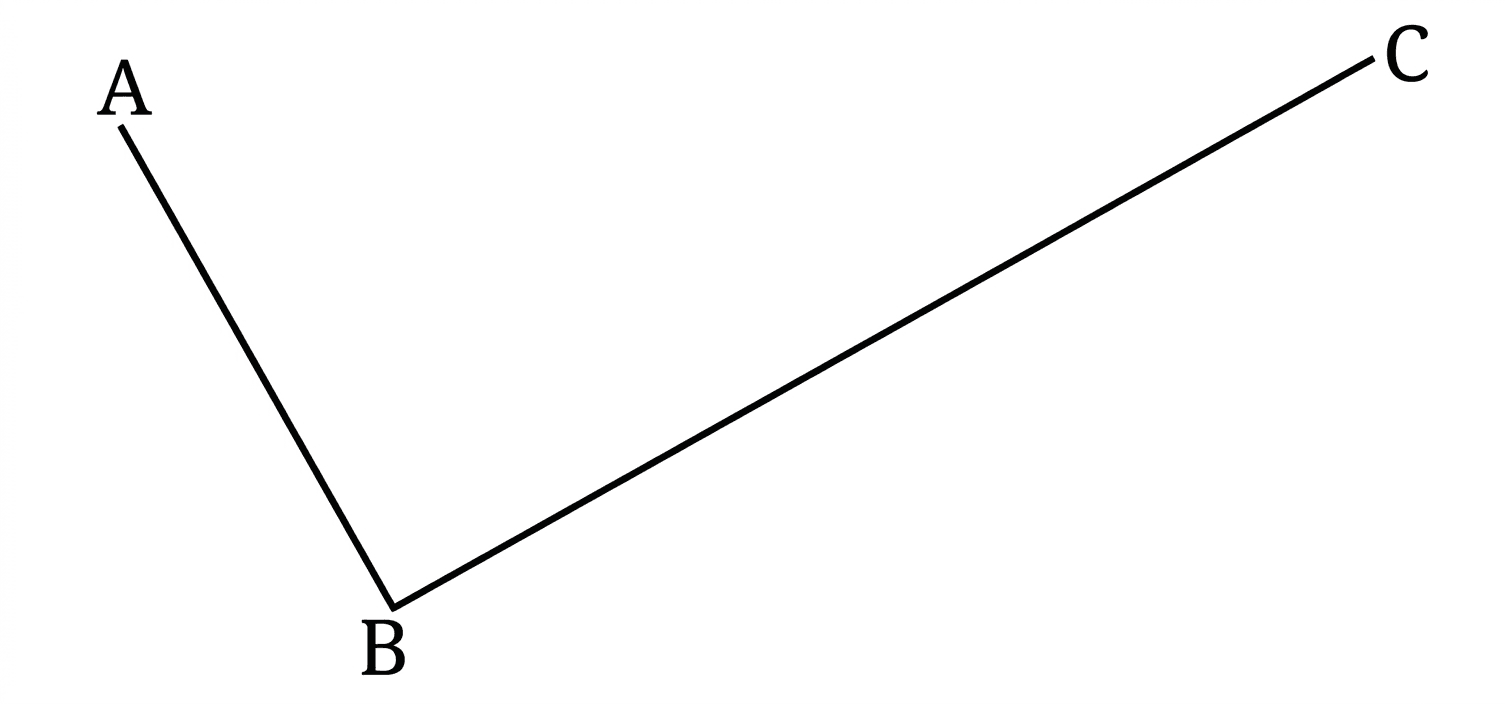
To recreate the symbol, we measure its parts and draw a congruent figure.
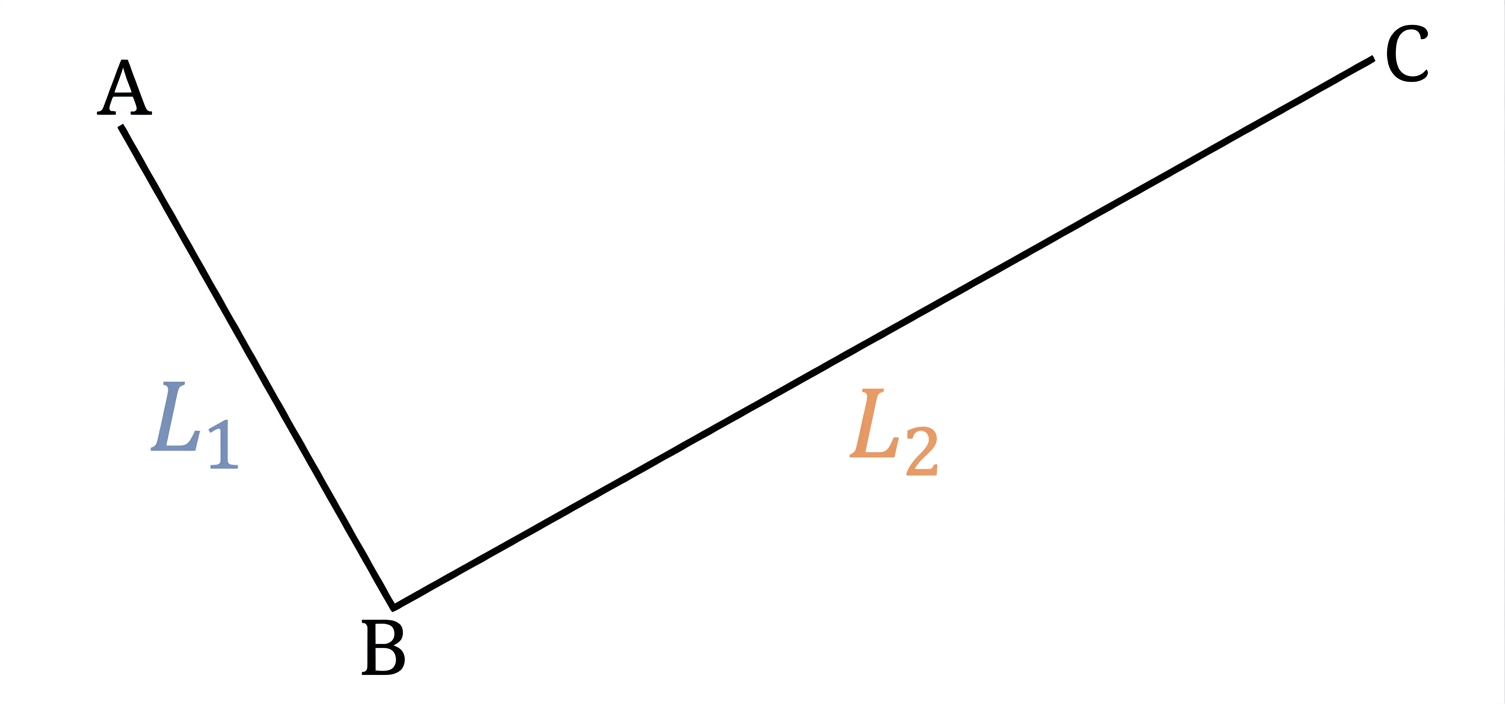
Step 1 — Measure segment lengths
We need to find how long each line segment is. Use a ruler to measure the length of segment AB. Let's call this length . Use a ruler to measure the length of segment BC. Let's call this length .
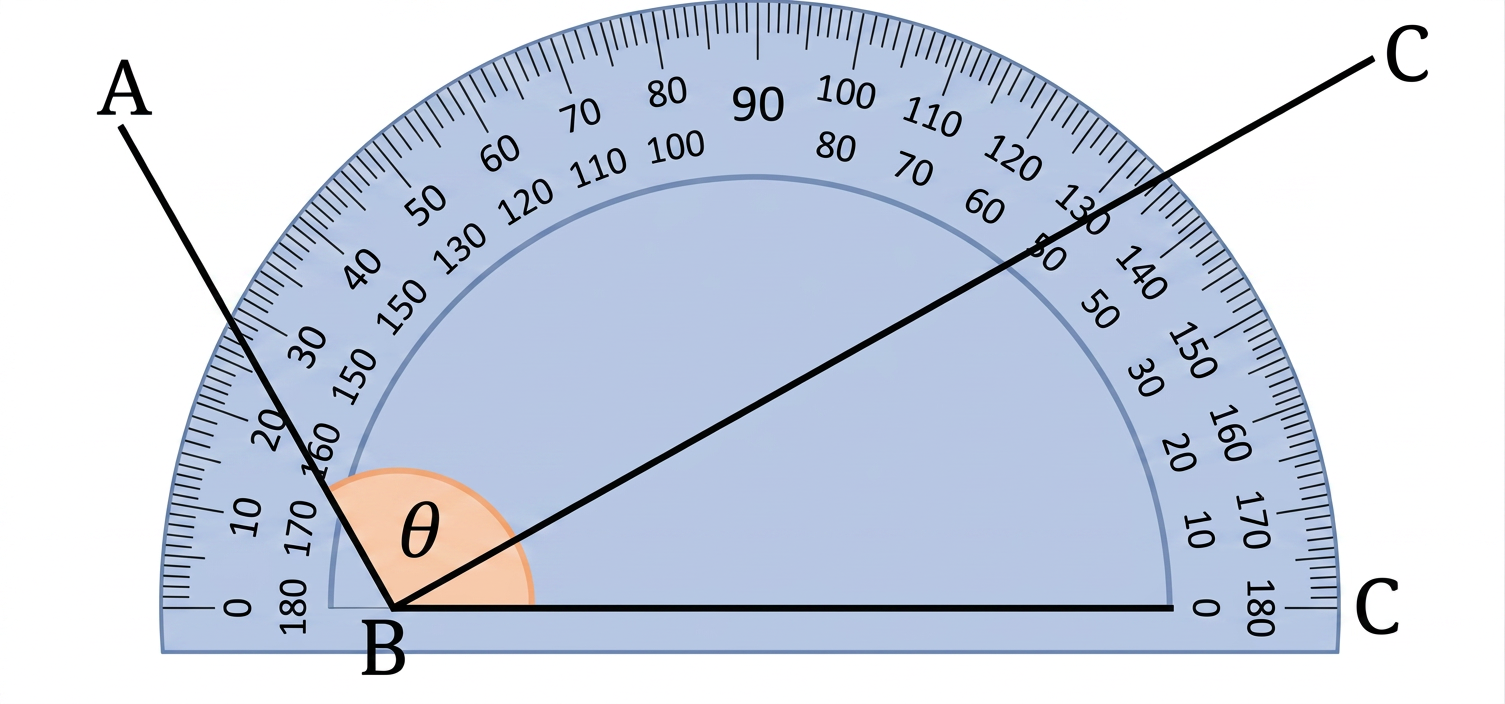
Step 2 — Measure the angle
We find the size of the angle at point B. Use a protractor to measure angle . Place the protractor's center on point B. Align one arm with segment BC. Read the measure where segment BA crosses the scale. Let's call this angle .
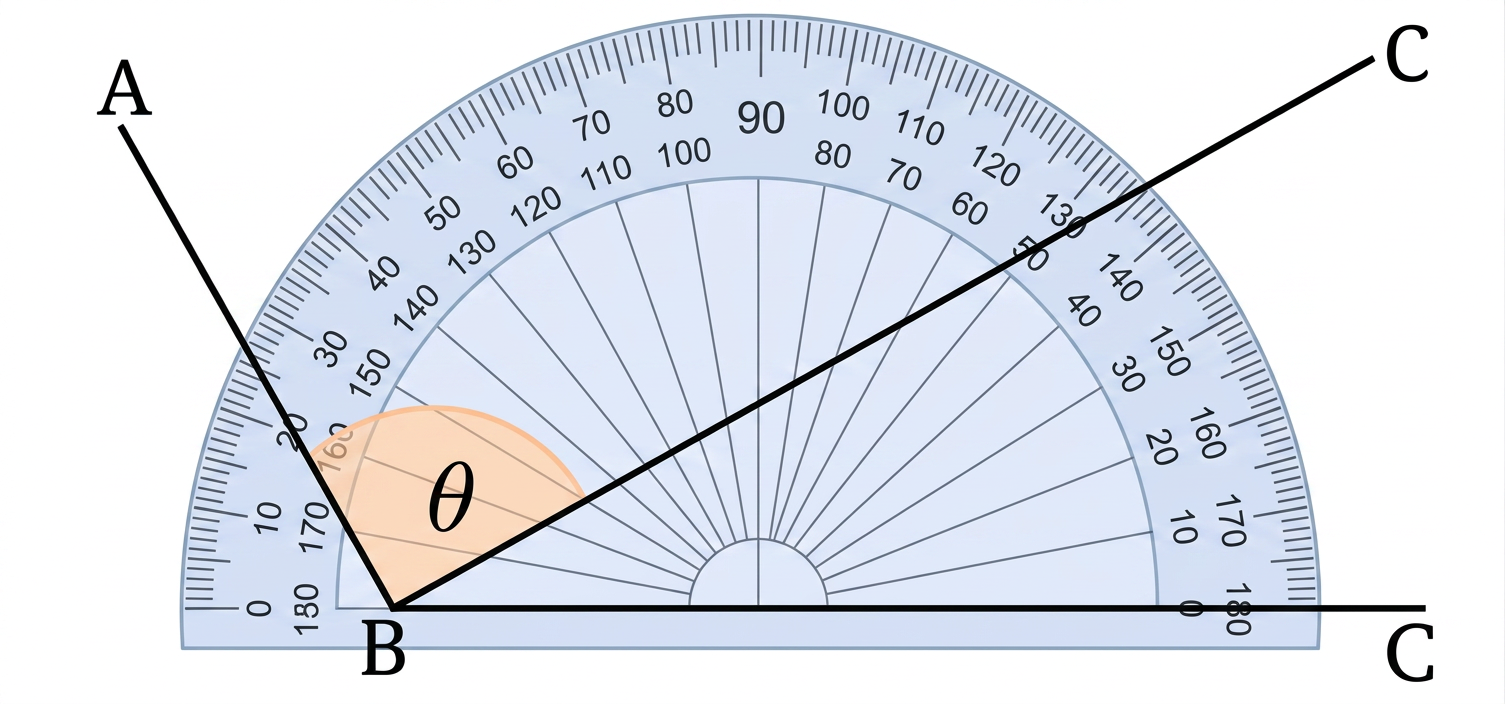
Step 3 — Draw the new symbol
First, draw a line segment on the new board. Make this segment equal to . Label its endpoints as A' and B'. Next, place the protractor's center on B'. Draw an angle equal to . Use B'A' as one arm of this angle. Along the other arm, measure a length equal to . Mark the endpoint as C'. Connect B' and C'. The new symbol A'B'C' is now created.
Answer
(i) Measure the length of segment AB. (ii) Measure the length of segment BC. (iii) Measure the angle . (iv) Draw a segment A'B' equal to AB. (v) At B', draw an angle equal to . (vi) On the new angle's arm, mark C' such that B'C' equals BC. (vii) The symbol A'B'C' is now recreated.
More questions in IT
Context: The symbol on this signboard needs to be recreated on another board.
Q. How do we do it?
Q. Can we take some measurements that would allow us to exactly recreate this figure? If yes, what measurements should we take?
Context: Let us name the corner points of this symbol as shown.
Q. Are the arm lengths AB and BC sufficient to exactly recreate this figure?
Context: Suppose the lengths of the arms of the symbol are AB = 4 cm and BC = 8 cm. Several such symbols can be constructed with the same lengths.
Q. To get the exact replica, would it help to take any other measurement?
Can you draw the symbol if it is known that AB = 4 cm, BC = 8 cm, and ∠ABC = 80°?
If it is known that both symbols have the same arm lengths, can it be concluded that the two symbols are congruent?
What do you think they can do?
Context: Meera says: "The angles of the triangle are not required! With the side lengths we have measured, we can create a triangle congruent to this one."
Q. Do you agree with Meera?
Instead of the lengths being 40 cm, 60 cm, and 80 cm, suppose the sidelengths had been 4 cm, 6 cm, 8 cm (this triangle can fit on our page).
Context: Sidelengths of a triangle are 4 cm, 6 cm, and 8 cm.
Q. Is this information sufficient to replicate the triangle with the same size and shape? If yes, can you do so?
Examine whether ABE and ABF are congruent.
How can these two triangles be superimposed? Which vertices of XYZ and ABC should we overlap? This has to be done so that the equal sides overlap. Figure out how.
Are there other ways of overlapping the vertices so that the triangles fit exactly over each other?
Can you identify a pair of congruent triangles below? Why are they congruent?
Consider and . Since ABCD is a rectangle, we have
If the remaining sides of and have the same length then the SSS condition is satisfied, confirming the congruence of the two triangles. Is this the case?
Verify this by superimposing paper cutouts of the triangles obtained from the rectangle ABCD (Fig. 1.1).
Identify the correct correspondence of vertices and express the congruence between the two triangles.
Suppose the angles are 30°, 70°, and 80°. Can we create an exact copy of the frame with this?
ΔABC and ΔXYZ are two triangles such that
AB = XY = 6 cm, AC = XZ = 5 cm, and ∠A = ∠X = 30°
Are they congruent?
Context: ΔABC and ΔXYZ are two triangles such that AB = XY = 6 cm, AC = XZ = 5 cm, and ∠A = ∠X = 30°.
Q. Construct a triangle having the above measurements.
Compare it with the triangles constructed by your classmates. Are the triangles all congruent? Explain why all such triangles with these measurements are congruent.
ΔABC and ΔXYZ are two triangles such that
AB = XY = 6 cm, AC = XZ = 4 cm, and ∠B = ∠Y = 30°
Are they congruent?
Context: ΔABC and ΔXYZ are two triangles such that AB = XY = 6 cm, AC = XZ = 4 cm, and ∠B = ∠Y = 30°.
Q. Can there exist non-congruent triangles having these measurements? Construct and find out.
and are two triangles with,
Are they congruent?
Context: and are two triangles with .
Q. Can there exist non-congruent triangles having these measurements? Construct and find out.
In the figure, Point O is the midpoint of AD and BC. What can one say about the lengths AB and CD?
The following triangles and are such that , , and . Are the triangles congruent? Give a reason.
ABC and XYZ are right-angled triangles such that BC = YZ = 4 cm, B = Y = 90° and AC = XZ = 5cm. Are they congruent?
Context: ABC and XYZ are right-angled triangles such that BC = YZ = 4 cm, B = Y = 90° and AC = XZ = 5cm.
Q. Can there exist non-congruent triangles having these measurements? Construct and find out.
Consider the downward extension of line below QR. Would the arc from R meet this line downwards as well (as in the case of triangle construction when the sidelengths are given)? If so, would this lead to a triangle whose size and shape are different from PQR, and yet has the given measurements?
ABC is isosceles with AB = AC, and A = 80. What can we say about B and C?
Construct the altitude from A to BC.
Context: In , and .
Q. Can you use this fact to find and ?
Context: All the three angles of an equilateral triangle are equal.
Q. What could be their measures?
Context: In an equilateral triangle, each angle is 60°.
Q. Verify this by construction.
Describe the congruent triangles you see in each picture.