Question 3
- Diagonals AC and BD of a trapezium ABCD with intersect each other at the point O. Using a similarity criterion for two triangles, show that .
We will use the following similarity criterion:
- AAA (Angle-Angle-Angle): If all three angles of one triangle are equal to the corresponding angles of another triangle, the triangles are similar.
We will use the properties of parallel lines and triangle similarity to prove the given ratio.
Step 1 — Identify Triangles
Let's consider the trapezium . We are given that is parallel to . The diagonals and meet at point . We will look at and .
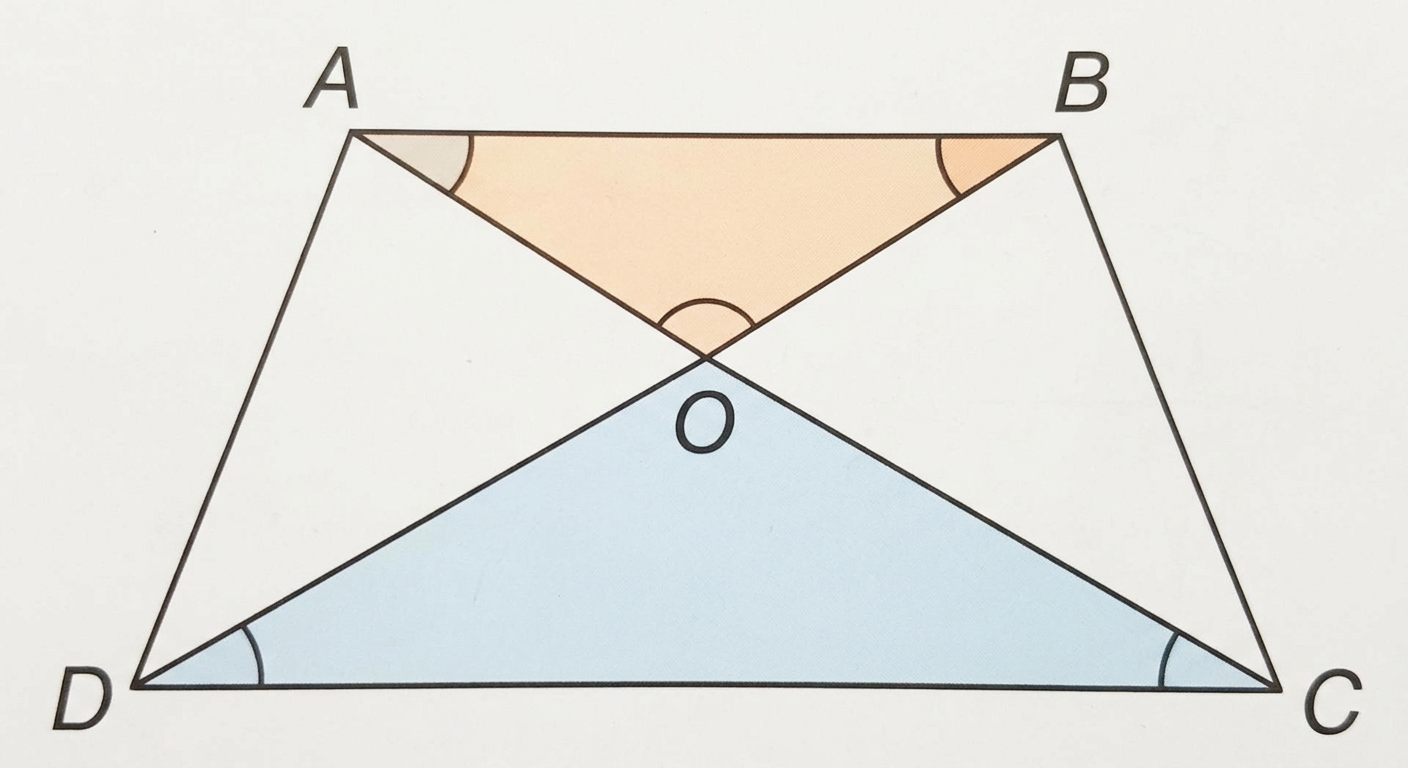
Step 2 — Find Equal Angles
We can find equal angles in these triangles. and are vertically opposite angles. Vertically opposite angles are always equal. So, . Since , is a transversal line. Alternate interior angles are equal. Thus, . Also, is another transversal line. So, .
Step 3 — Apply AAA Similarity
We have found three pairs of equal angles. (from Step 2). (from Step 2). (from Step 2). Therefore, is similar to . This is by the AAA similarity criterion.
Step 4 — Ratios of Corresponding Sides
For similar triangles, corresponding sides are proportional. So, the ratio of their sides will be equal. We can write this as:
Step 5 — Rearrange the Ratio
We need to show . Let's take the ratio from Step 4. We can invert both sides of this equation. This is the same as the required expression. We can write it as:
Answer
(i) We have shown that using AAA similarity.
More questions in Exercise 6.3
- State which pairs of triangles in Fig. 6.34 are similar. Write the similarity criterion used by you for answering the question and also write the pairs of similar triangles in the symbolic form :
- In Fig. 6.35, , and . Find , and .
- Diagonals AC and BD of a trapezium ABCD with intersect each other at the point O. Using a similarity criterion for two triangles, show that .
- In Fig. 6.36, and . Show that .
- S and T are points on sides PR and QR of such that . Show that .
- In Fig. 6.37, if , show that .
- In Fig. 6.38, altitudes AD and CE of intersect each other at the point P. Show that:
(i) (ii) (iii) (iv)
- E is a point on the side AD produced of a parallelogram ABCD and BE intersects CD at F. Show that .
- In Fig. 6.39, ABC and AMP are two right triangles, right angled at B and M respectively. Prove that:
(i) (ii)
- CD and GH are respectively the bisectors of and such that D and H lie on sides AB and FE of and respectively. If , show that:
(i) (ii) (iii)
In Fig. 6.40, E is a point on side CB produced of an isosceles triangle ABC with AB = AC. If AD BC and EF AC, prove that ABD ECF.
Sides AB and BC and median AD of a triangle ABC are respectively proportional to sides PQ and QR and median PM of PQR (see Fig. 6.41). Show that ABC PQR.
D is a point on the side BC of a triangle ABC such that ADC = BAC. Show that .
Sides AB and AC and median AD of a triangle ABC are respectively proportional to sides PQ and PR and median PM of another triangle PQR. Show that ABC PQR.
A vertical pole of length 6 m casts a shadow 4 m long on the ground and at the same time a tower casts a shadow 28 m long. Find the height of the tower.
If AD and PM are medians of triangles ABC and PQR, respectively where ABC PQR, prove that