Triangles | Exercise 6.3

Question 10

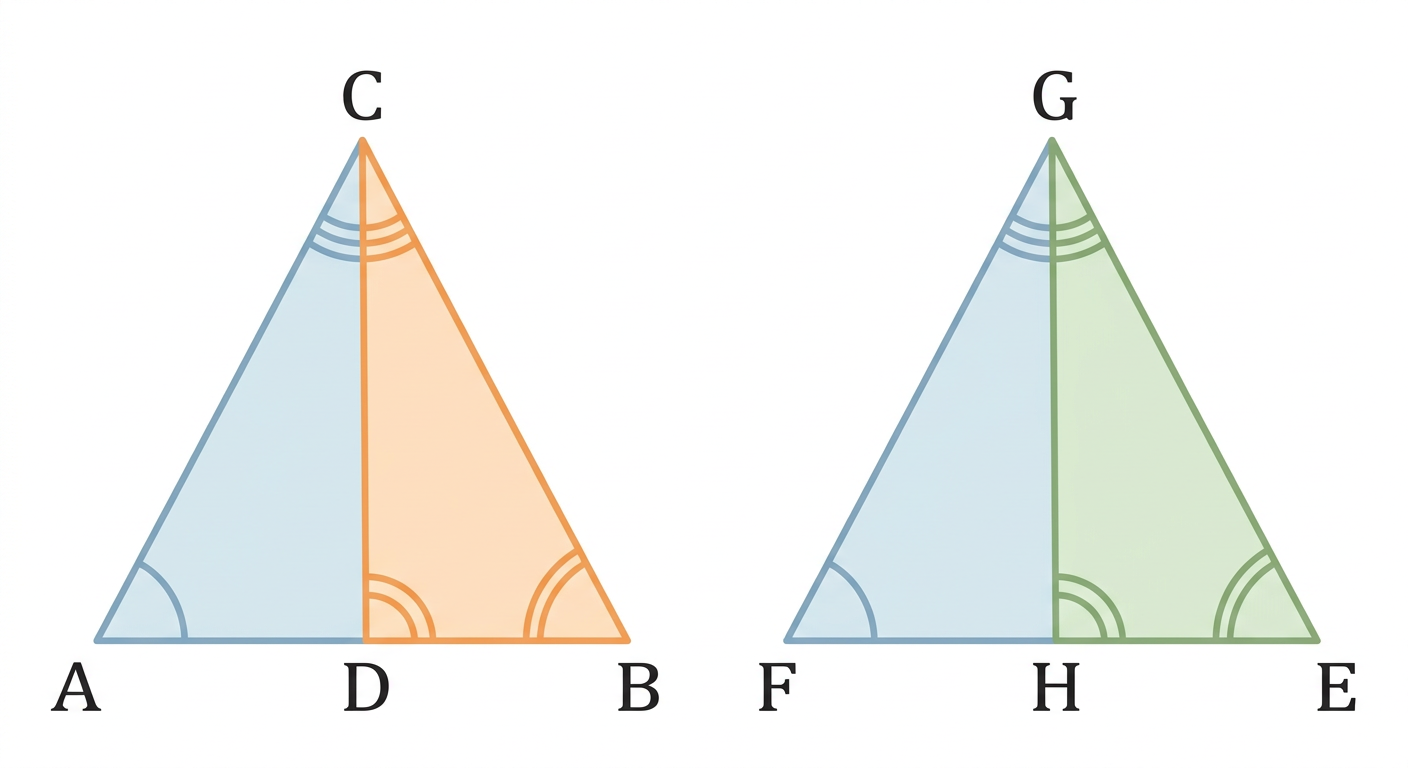
  1. CD and GH are respectively the bisectors of ACB\angle \text{ACB} and EGF\angle \text{EGF} such that D and H lie on sides AB and FE of ΔABC\Delta \text{ABC} and ΔEFG\Delta \text{EFG} respectively. If ΔABCΔFEG\Delta \text{ABC} \sim \Delta \text{FEG}, show that:

(i) CDGH=ACFG\frac{\text{CD}}{\text{GH}} = \frac{\text{AC}}{\text{FG}} (ii) ΔDCBΔHGE\Delta \text{DCB} \sim \Delta \text{HGE} (iii) ΔDCAΔHGF\Delta \text{DCA} \sim \Delta \text{HGF}

Check your answer with HomiSolve it yourself, then let Homi check your steps and spot mistakes.
Solution

We will use the properties of similar triangles and angle bisectors to prove each part.

Step 1 — Understand Given Information

We are given that ΔABC\Delta \text{ABC} is similar to ΔFEG\Delta \text{FEG}. This means their corresponding angles are equal.

A=F\angle \text{A} = \angle \text{F}

B=E\angle \text{B} = \angle \text{E}

ACB=FGE\angle \text{ACB} = \angle \text{FGE} Their corresponding sides are also proportional.

ABFE=BCEG=ACFG\frac{\text{AB}}{\text{FE}} = \frac{\text{BC}}{\text{EG}} = \frac{\text{AC}}{\text{FG}} CD bisects ACB\angle \text{ACB}. GH bisects FGE\angle \text{FGE}. This means the bisected angles are half of the original angles.

ACD=BCD=12ACB\angle \text{ACD} = \angle \text{BCD} = \frac{1}{2} \angle \text{ACB}

FGH=EGH=12FGE\angle \text{FGH} = \angle \text{EGH} = \frac{1}{2} \angle \text{FGE} Since ACB=FGE\angle \text{ACB} = \angle \text{FGE}, their halves are also equal.

12ACB=12FGE\frac{1}{2} \angle \text{ACB} = \frac{1}{2} \angle \text{FGE}

ACD=FGH\angle \text{ACD} = \angle \text{FGH}

BCD=EGH\angle \text{BCD} = \angle \text{EGH}

Diagram 1

Step 2 — Prove Part (iii)

Let's consider ΔDCA\Delta \text{DCA} and ΔHGF\Delta \text{HGF}. We need to show they are similar. We know A=F\angle \text{A} = \angle \text{F} from Step 1. We also know ACD=FGH\angle \text{ACD} = \angle \text{FGH} from Step 1. By Angle-Angle (AA) similarity criterion, the triangles are similar.

ΔDCAΔHGF\Delta \text{DCA} \sim \Delta \text{HGF}

ΔDCAΔHGF\boxed{\Delta \text{DCA} \sim \Delta \text{HGF}}

Step 3 — Prove Part (i)

Since ΔDCAΔHGF\Delta \text{DCA} \sim \Delta \text{HGF} (from Step 2), their corresponding sides are proportional. We can write the ratio of corresponding sides.

CDGH=ACFG=ADHF\frac{\text{CD}}{\text{GH}} = \frac{\text{AC}}{\text{FG}} = \frac{\text{AD}}{\text{HF}} This directly proves the required statement.

CDGH=ACFG\frac{\text{CD}}{\text{GH}} = \frac{\text{AC}}{\text{FG}}

CDGH=ACFG\boxed{\frac{\text{CD}}{\text{GH}} = \frac{\text{AC}}{\text{FG}}}

Step 4 — Prove Part (ii)

Let's consider ΔDCB\Delta \text{DCB} and ΔHGE\Delta \text{HGE}. We need to show they are similar. We know B=E\angle \text{B} = \angle \text{E} from Step 1. We also know BCD=EGH\angle \text{BCD} = \angle \text{EGH} from Step 1. By Angle-Angle (AA) similarity criterion, the triangles are similar.

ΔDCBΔHGE\Delta \text{DCB} \sim \Delta \text{HGE}

ΔDCBΔHGE\boxed{\Delta \text{DCB} \sim \Delta \text{HGE}}

Answer

(i) CDGH=ACFG\frac{\text{CD}}{\text{GH}} = \frac{\text{AC}}{\text{FG}} (ii) ΔDCBΔHGE\Delta \text{DCB} \sim \Delta \text{HGE} (iii) ΔDCAΔHGF\Delta \text{DCA} \sim \Delta \text{HGF}

More questions in Exercise 6.3

Q1
  1. State which pairs of triangles in Fig. 6.34 are similar. Write the similarity criterion used by you for answering the question and also write the pairs of similar triangles in the symbolic form :
Q2
  1. In Fig. 6.35, ΔODCΔOBA\Delta \text{ODC} \sim \Delta \text{OBA}, BOC=125\angle \text{BOC} = 125^\circ and CDO=70\angle \text{CDO} = 70^\circ. Find DOC\angle \text{DOC}, DCO\angle \text{DCO} and OAB\angle \text{OAB}.
Q3
  1. Diagonals AC and BD of a trapezium ABCD with ABDC\text{AB} \parallel \text{DC} intersect each other at the point O. Using a similarity criterion for two triangles, show that OAOC=OBOD\frac{\text{OA}}{\text{OC}} = \frac{\text{OB}}{\text{OD}}.
Q4
  1. In Fig. 6.36, QRQS=QTPR\frac{\text{QR}}{\text{QS}} = \frac{\text{QT}}{\text{PR}} and 1=2\angle 1 = \angle 2. Show that ΔPQSΔTQR\Delta \text{PQS} \sim \Delta \text{TQR}.
Q5
  1. S and T are points on sides PR and QR of ΔPQR\Delta \text{PQR} such that P=RTS\angle \text{P} = \angle \text{RTS}. Show that ΔRPQΔRTS\Delta \text{RPQ} \sim \Delta \text{RTS}.
Q6
  1. In Fig. 6.37, if ΔABEΔACD\Delta \text{ABE} \cong \Delta \text{ACD}, show that ΔADEΔABC\Delta \text{ADE} \sim \Delta \text{ABC}.
Q7
  1. In Fig. 6.38, altitudes AD and CE of ΔABC\Delta \text{ABC} intersect each other at the point P. Show that:

(i) ΔAEPΔCDP\Delta \text{AEP} \sim \Delta \text{CDP} (ii) ΔABDΔCBE\Delta \text{ABD} \sim \Delta \text{CBE} (iii) ΔAEPΔADB\Delta \text{AEP} \sim \Delta \text{ADB} (iv) ΔPDCΔBEC\Delta \text{PDC} \sim \Delta \text{BEC}

Q8
  1. E is a point on the side AD produced of a parallelogram ABCD and BE intersects CD at F. Show that ΔABEΔCFB\Delta \text{ABE} \sim \Delta \text{CFB}.
Q9
  1. In Fig. 6.39, ABC and AMP are two right triangles, right angled at B and M respectively. Prove that:

(i) ΔABCΔAMP\Delta \text{ABC} \sim \Delta \text{AMP} (ii) CAPA=BCMP\frac{\text{CA}}{\text{PA}} = \frac{\text{BC}}{\text{MP}}

Q10
  1. CD and GH are respectively the bisectors of ACB\angle \text{ACB} and EGF\angle \text{EGF} such that D and H lie on sides AB and FE of ΔABC\Delta \text{ABC} and ΔEFG\Delta \text{EFG} respectively. If ΔABCΔFEG\Delta \text{ABC} \sim \Delta \text{FEG}, show that:

(i) CDGH=ACFG\frac{\text{CD}}{\text{GH}} = \frac{\text{AC}}{\text{FG}} (ii) ΔDCBΔHGE\Delta \text{DCB} \sim \Delta \text{HGE} (iii) ΔDCAΔHGF\Delta \text{DCA} \sim \Delta \text{HGF}

Q11

In Fig. 6.40, E is a point on side CB produced of an isosceles triangle ABC with AB = AC. If AD \perp BC and EF \perp AC, prove that Δ\Delta ABD \sim Δ\Delta ECF.

Q12

Sides AB and BC and median AD of a triangle ABC are respectively proportional to sides PQ and QR and median PM of Δ\Delta PQR (see Fig. 6.41). Show that Δ\Delta ABC \sim Δ\Delta PQR.

Q13

D is a point on the side BC of a triangle ABC such that \angle ADC = \angle BAC. Show that CA2=CB.CD\text{CA}^2 = \text{CB.CD}.

Q14

Sides AB and AC and median AD of a triangle ABC are respectively proportional to sides PQ and PR and median PM of another triangle PQR. Show that Δ\Delta ABC \sim Δ\Delta PQR.

Q15

A vertical pole of length 6 m casts a shadow 4 m long on the ground and at the same time a tower casts a shadow 28 m long. Find the height of the tower.

Q16

If AD and PM are medians of triangles ABC and PQR, respectively where Δ\Delta ABC \sim Δ\Delta PQR, prove that

ABPQ=ADPM\frac{\text{AB}}{\text{PQ}} = \frac{\text{AD}}{\text{PM}}

← Back to Triangles