Question 7
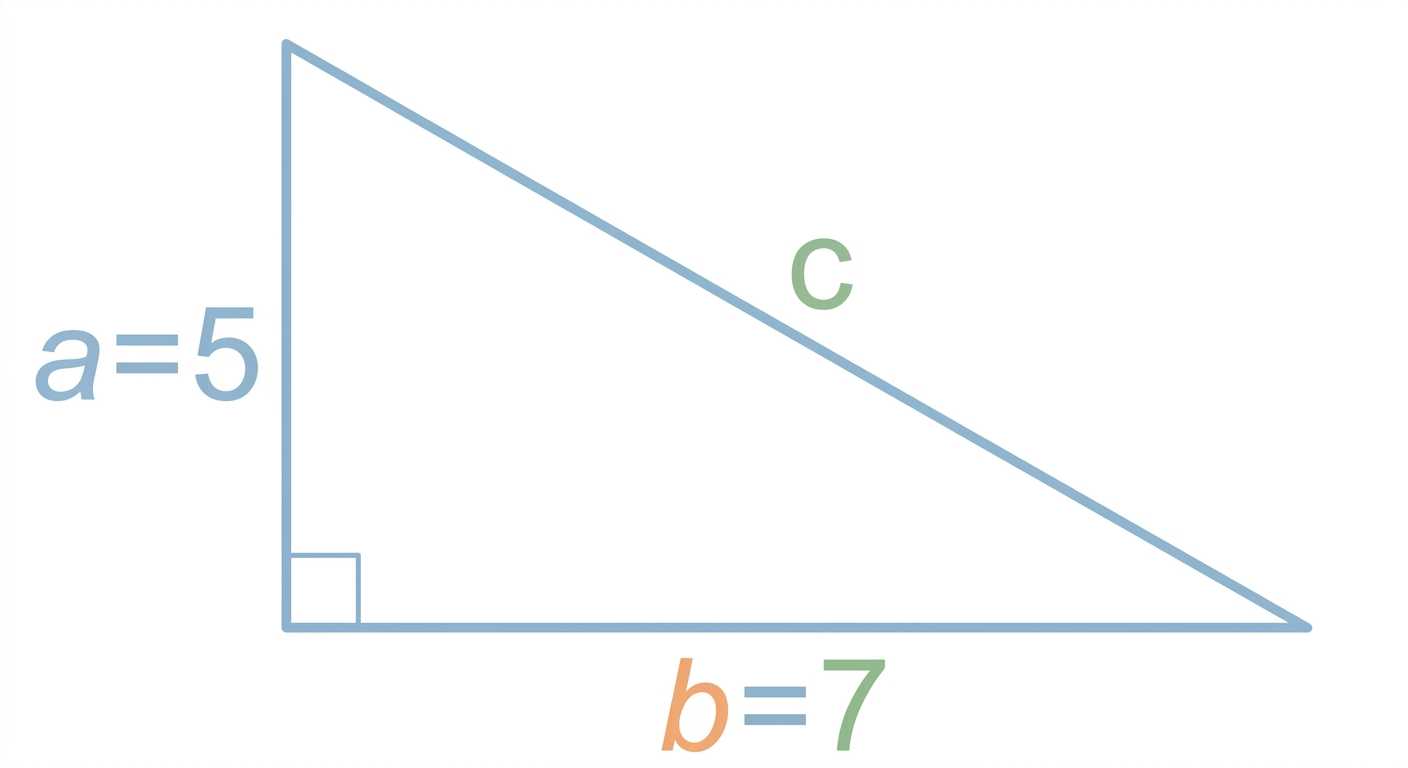
Let , and denote the length of the sides of a right triangle, with being the length of the hypotenuse. Find the missing sidelength in each of the following cases:
(i)
(ii)
(iii)
(iv)
(v)
We will use the Pythagorean theorem to find the missing side length. This theorem states that in a right-angled triangle, the square of the hypotenuse (the side opposite the right angle) is equal to the sum of the squares of the other two sides. If and are the lengths of the two shorter sides, and is the length of the hypotenuse, then .
**Step 1 — Finding when }
We are given the lengths of the two shorter sides. Let and . We need to find the length of the hypotenuse, . Let us apply the Pythagorean theorem.
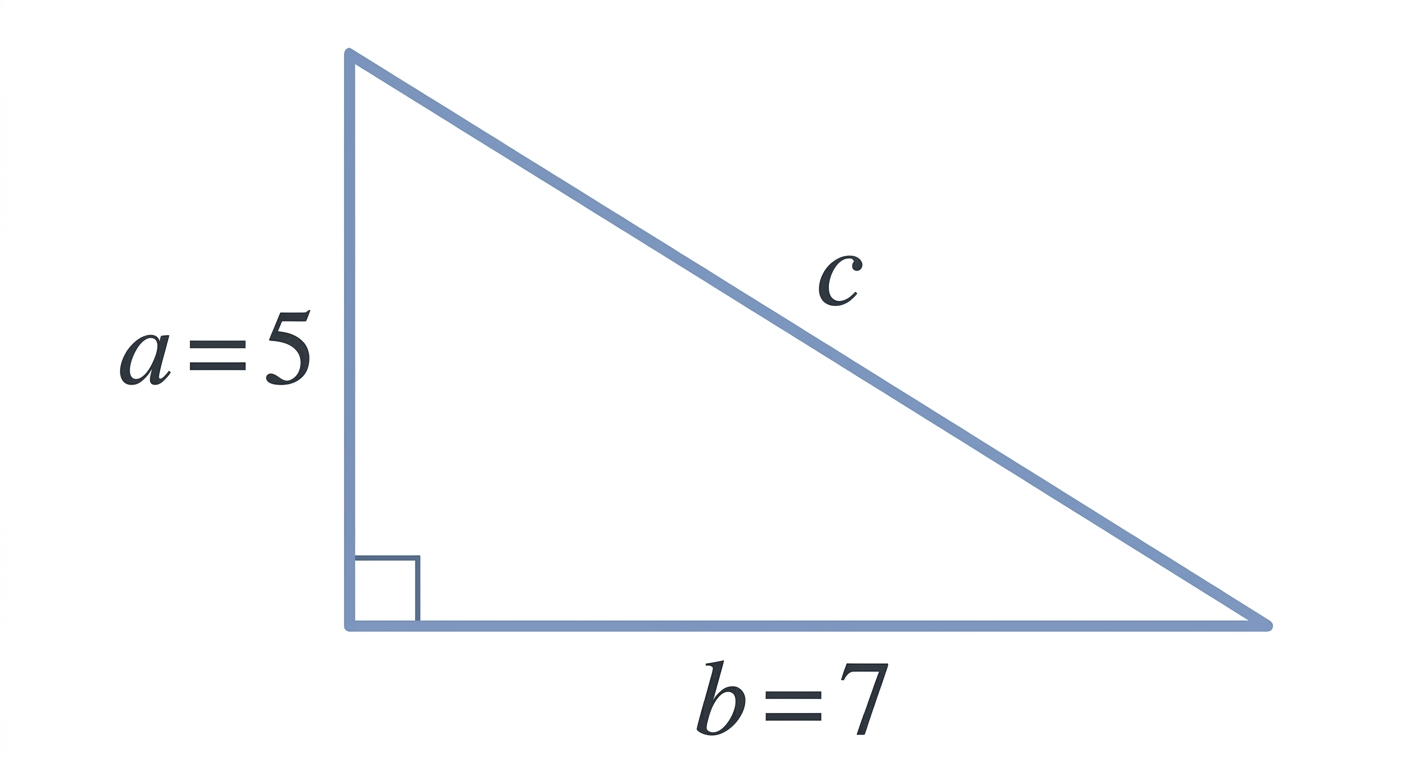
**Step 2 — Finding when }
Here, we have the shorter sides and . We need to find the hypotenuse, . Let us use the Pythagorean theorem.
We can simplify the square root of 208. Let us find the prime factors of 208. .
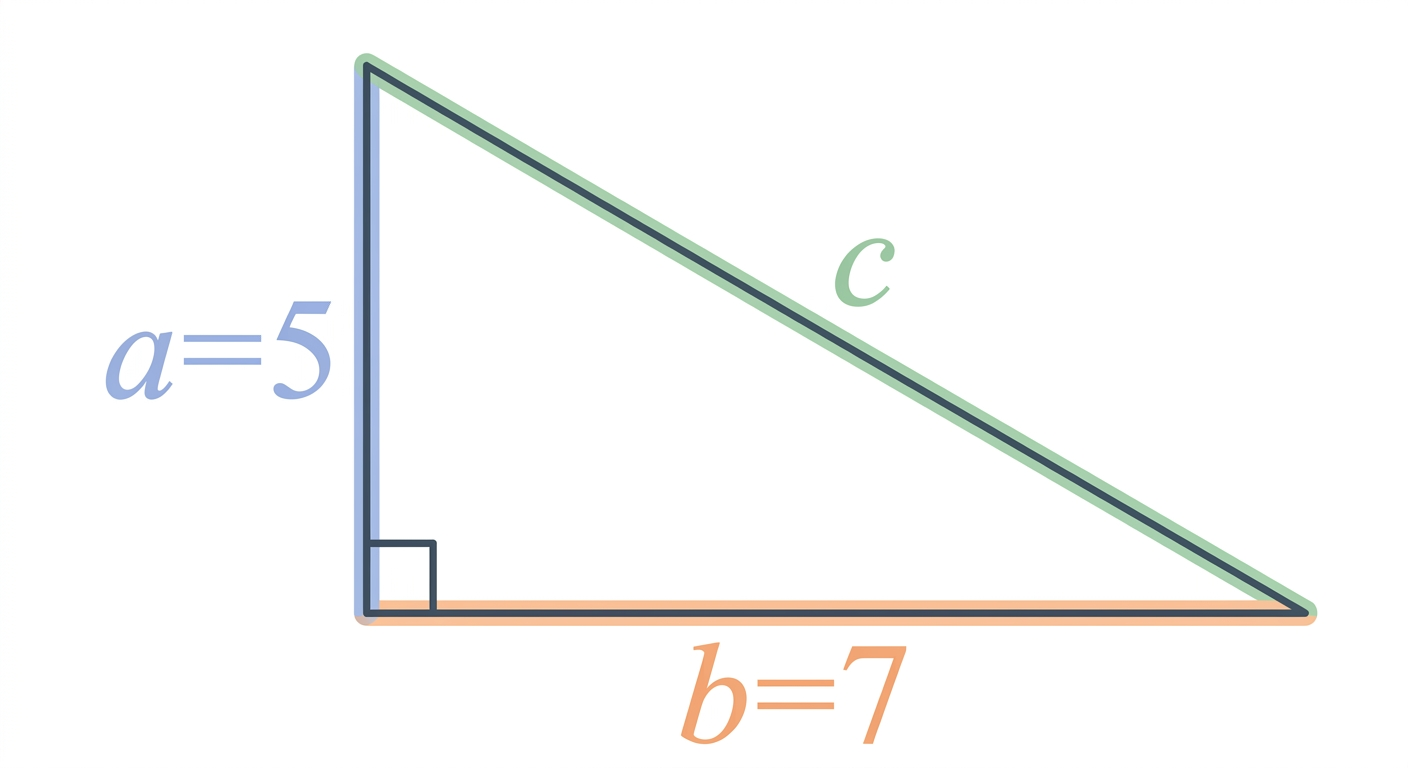
**Step 3 — Finding when }
In this case, we know one shorter side . We also know the hypotenuse . We need to find the other shorter side, . From the Pythagorean theorem, . We can rearrange this to find .
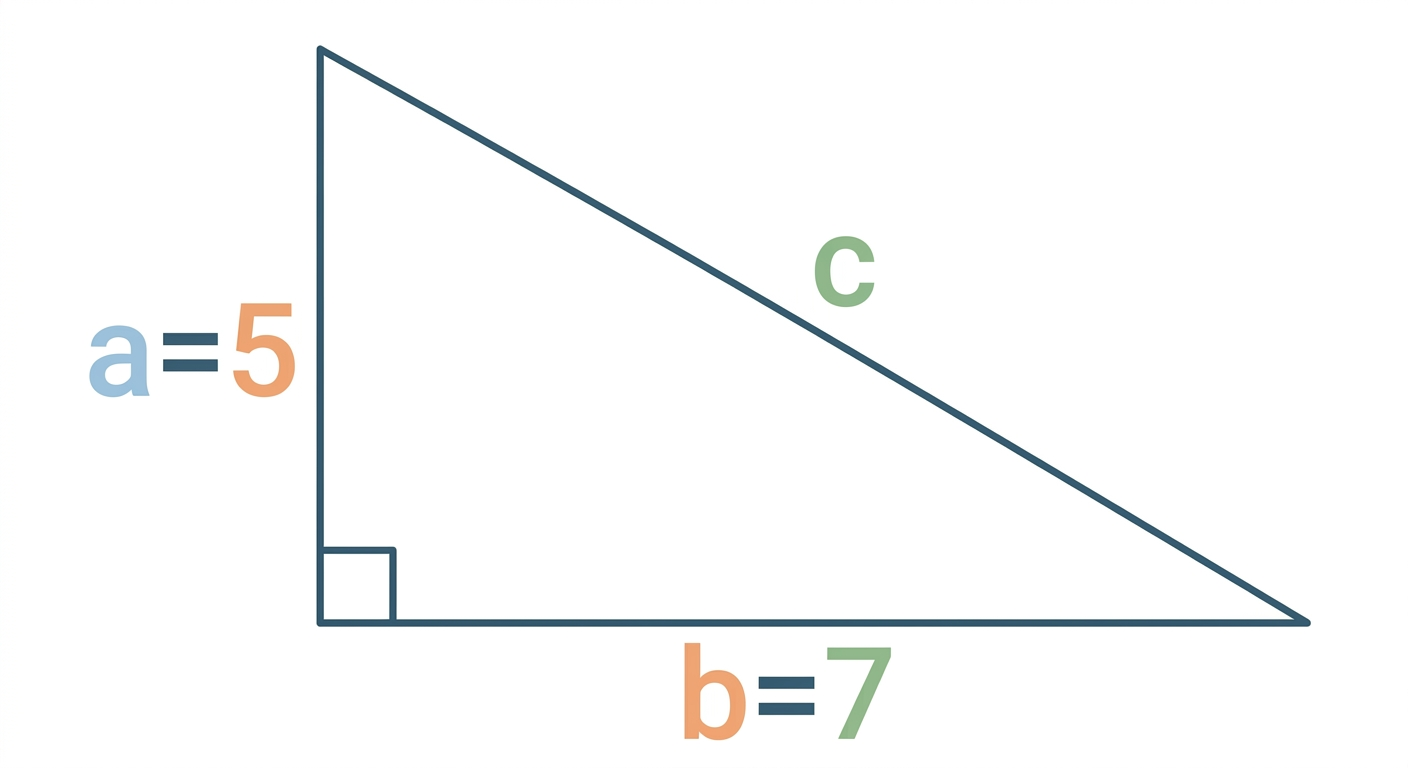
**Step 4 — Finding when }
We are given the shorter sides and . We need to find the hypotenuse, . Let us use the Pythagorean theorem.
The number 193 is a prime number. So, its square root cannot be simplified further.
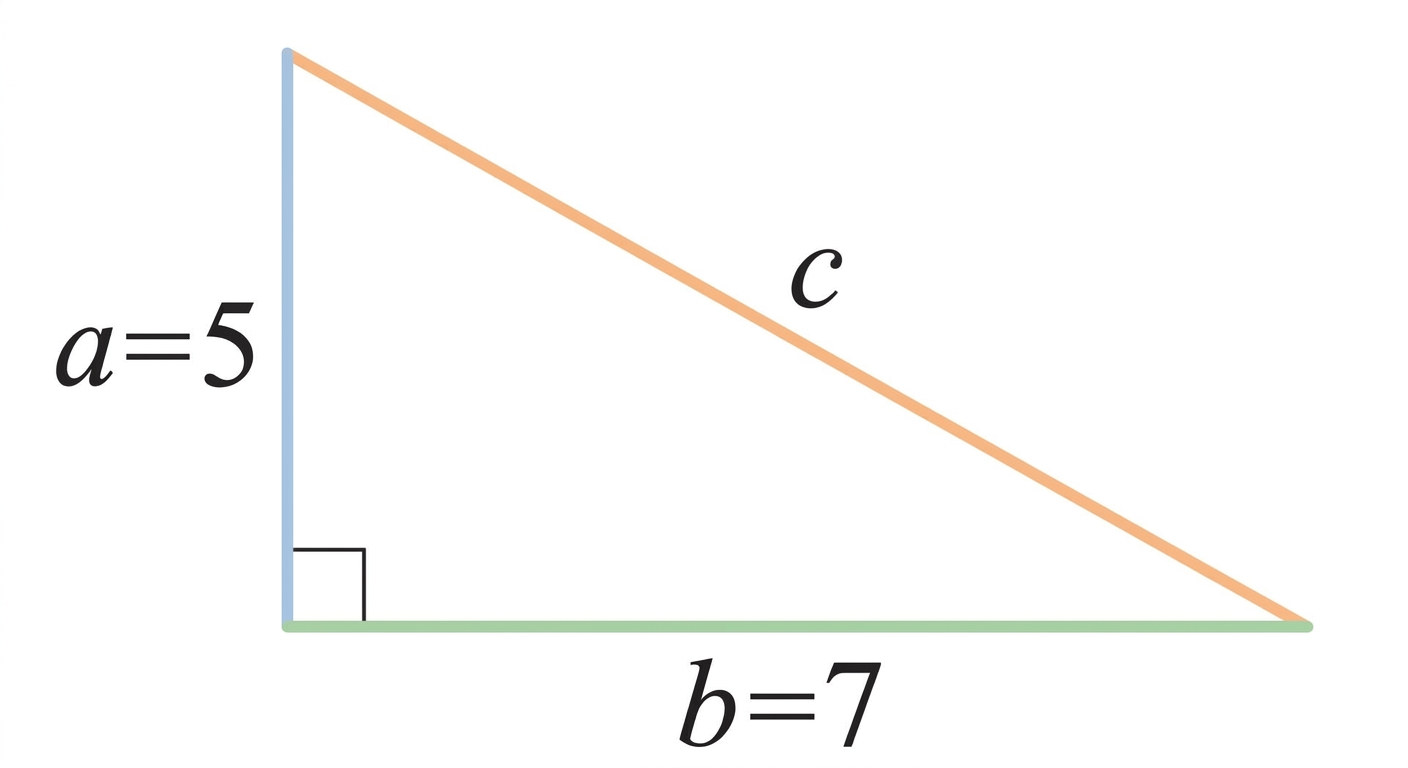
**Step 5 — Finding when }
Here, we have decimal side lengths. Let and . We need to find the hypotenuse, . Let us apply the Pythagorean theorem.
Answer
(i) (ii) (iii) (iv) (v)
More questions in FIO
Earlier, we saw a method to create a square with double the area of a given square paper. There is another method to do this in which two identical square papers are cut in the following way.
Can you arrange these pieces to create a square with double the area of either square?
The length of the two equal sides of an isosceles right triangle is given. Find the length of the hypotenuse. Find bounds on the length of the hypotenuse such that they have at least one digit after the decimal point.
(i) 3
(ii) 4
(iii) 6
(iv) 8
(v) 9
The hypotenuse of an isosceles right triangle is 10. What are its other two sidelengths? [Hint: Find the area of the square composed of two such right triangles.]
If a right-angled triangle has shorter sides of lengths 5 cm and 12 cm, then what is the length of its hypotenuse? First draw the right-angled triangle with these sidelengths and measure the hypotenuse, then check your answer using Baudhāyana's Theorem.
If a right-angled triangle has a short side of length 8 cm and hypotenuse of length 17 cm, what is the length of the third side? Again, try drawing the triangle and measuring, and then check your answer using Baudhāyana's Theorem.
Using the constructions you have now seen, how would you construct a square whose area is triple the area of a given square? Five times the area of a given square? (Baudhāyana's Śulba-Sūtra, Verse 1.10)
Let , and denote the length of the sides of a right triangle, with being the length of the hypotenuse. Find the missing sidelength in each of the following cases:
(i)
(ii)
(iii)
(iv)
(v)
Find 5 more Baudhāyana triples using this idea.
Does this method yield non-primitive Baudhāyana triples?
[Hint: Observe that among the triples generated, one of the smaller sidelengths is one less than the hypotenuse.]
Are there primitive triples that cannot be obtained through this method? If yes, give examples.
Find the diagonal of a square with sidelength 5 cm.
Find the missing sidelengths in the following right triangles:
Find the sidelength of a rhombus whose diagonals are of length 24 units and 70 units.
Is the hypotenuse the longest side of a right triangle? Justify your answer.
True or False—Every Baudhāyana triple is either a primitive triple or a scaled version of a primitive triple.
Give 5 examples of rectangles whose sidelengths and diagonals are all integers.
Construct a square whose area is equal to the difference of the areas of squares of sidelengths 5 units and 7 units.
(i) Using the dots of a grid as the vertices, can you create a square that has an area of (a) 2 sq. units, (b) 3 sq. units, (c) 4 sq.units, and (d) 5 sq. unit?
(ii) Suppose the grid extends indefinitely. What are the possible integer-valued areas of squares you can create in this manner?
Find the area of an equilateral triangle with sidelength 6 units. [Hint: Show that an altitude bisects the opposite side. Use this to find the height.]