Question 4
In each of the figures given below, find the fraction of the big square that the shaded region occupies.
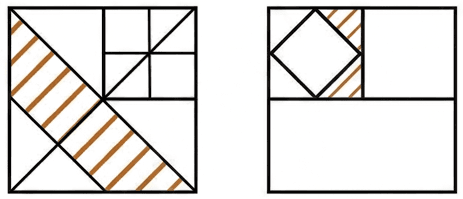
We will find the fraction of the big square that the shaded region occupies for each figure.
Step 1 — Analyze the first figure
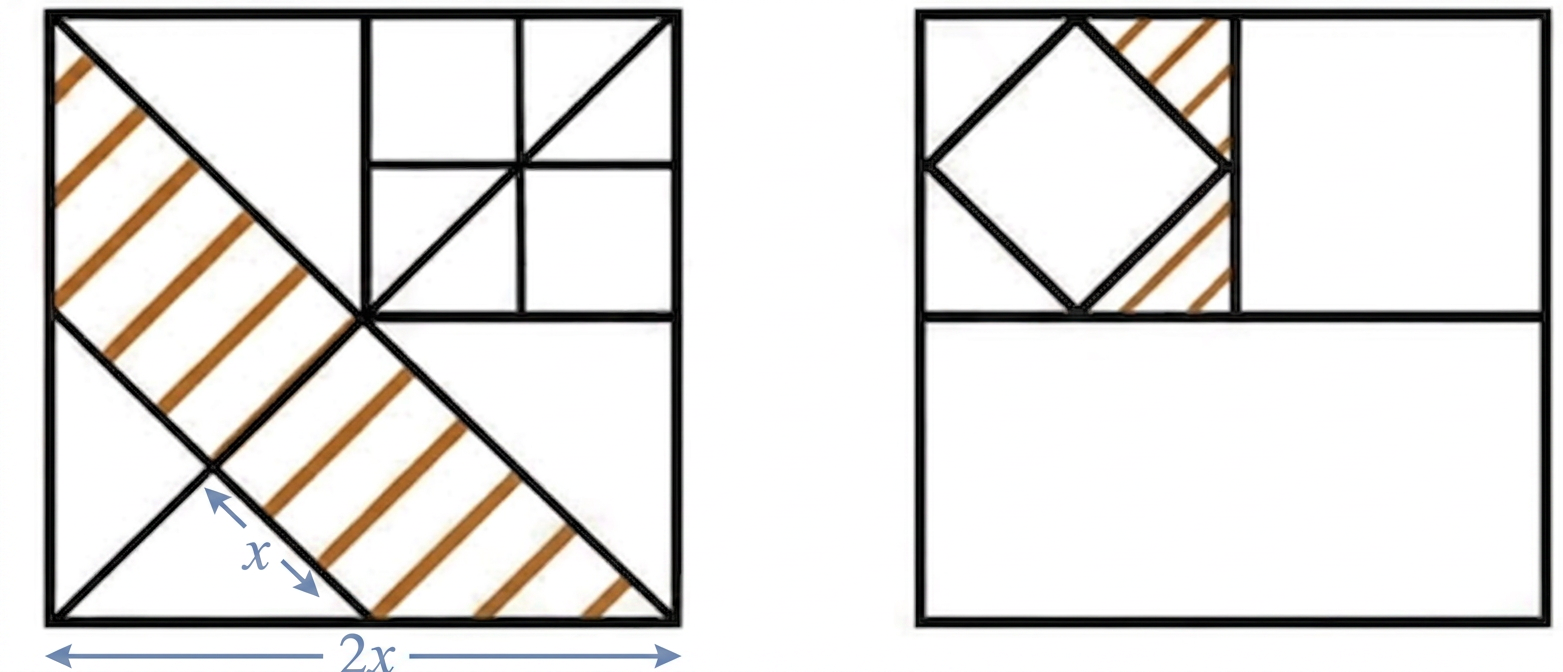
Let us consider the big square. We can see it is divided into four equal smaller squares. Let the side length of each small square be . The side length of the big square is . The area of the big square is . The area of each small square is . So, each small square is of the big square.
Step 2 — Calculate shaded area in the first figure
The shaded region in the first figure has three parts. Part 1 is a triangle in the bottom-left small square. Its base is and its height is . The area of this triangle is . Part 2 is a triangle in the top-right small square. Its base is and its height is . The area of this triangle is also . Part 3 is a parallelogram in the middle. This parallelogram is formed by the center of the big square and points on the sides of the top-left and bottom-right small squares. We can divide this parallelogram into two equal triangles. Each of these triangles has a base of and a height of . The area of one such triangle is . The area of the parallelogram is the sum of these two triangles. The total shaded area is the sum of these three parts. The fraction of the big square that is shaded is the total shaded area divided by the big square's area.
Step 3 — Analyze the second figure
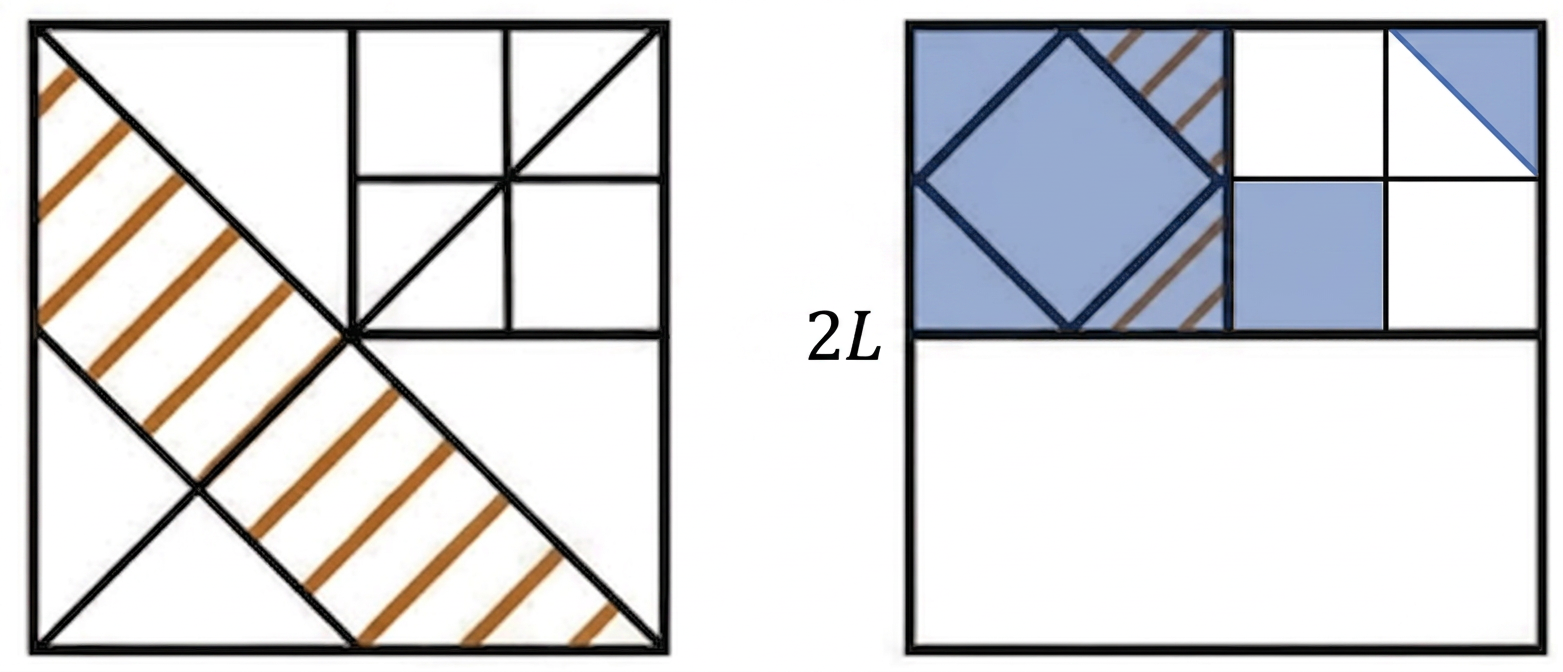
Let us consider the big square. It is divided into a top half and a bottom half. The top half is further divided into two equal squares. Let the side length of each of these top squares be . The area of one such square is . The big square has side length . The area of the big square is . So, each of the top squares (top-left and top-right) occupies of the big square.
Step 4 — Calculate shaded area in the second figure
We focus on the top-left square. This top-left square has side length . We can divide this square into 8 identical triangles. To do this, we draw both diagonals of the square. Then we draw lines from the center of the square to the midpoints of its four sides. Each of these 8 triangles has an area of of the top-left square. The shaded region in the top-left square consists of 2 of these identical triangles. So, the shaded area in the top-left square is of its area. The top-left square occupies of the area of the whole big square. So, the shaded region occupies of of the big square.
Answer
(i) For the first figure: (ii) For the second figure:
More questions in IT
Context: In Fig. 8.3, the length and breadth of the shaded rectangle are unit and unit, and its area is square units.
Q. Do you see any relation between the area and the product of length and breadth?
In each of the division problems above, observe how we found the answer. Can we frame a rule that tells us how to divide two fractions?
When do you think the quotient is less than the dividend and when is it greater than the dividend?
Is there a similar relationship between the divisor and the quotient?
In each of the figures given below, find the fraction of the big square that the shaded region occupies.
Context: If we assume 1 gold dinar = 12 silver drammas, 1 silver dramma = 4 copper panas, 1 copper pana = 6 mashakas, and 1 pana = 30 cowrie shells,
Given: 1 copper pana = gold dinar
Fill in the blanks:
(i) 1 cowrie shell = ______ copper panas
(ii) 1 cowrie shell = ______ gold dinar.