Question 1
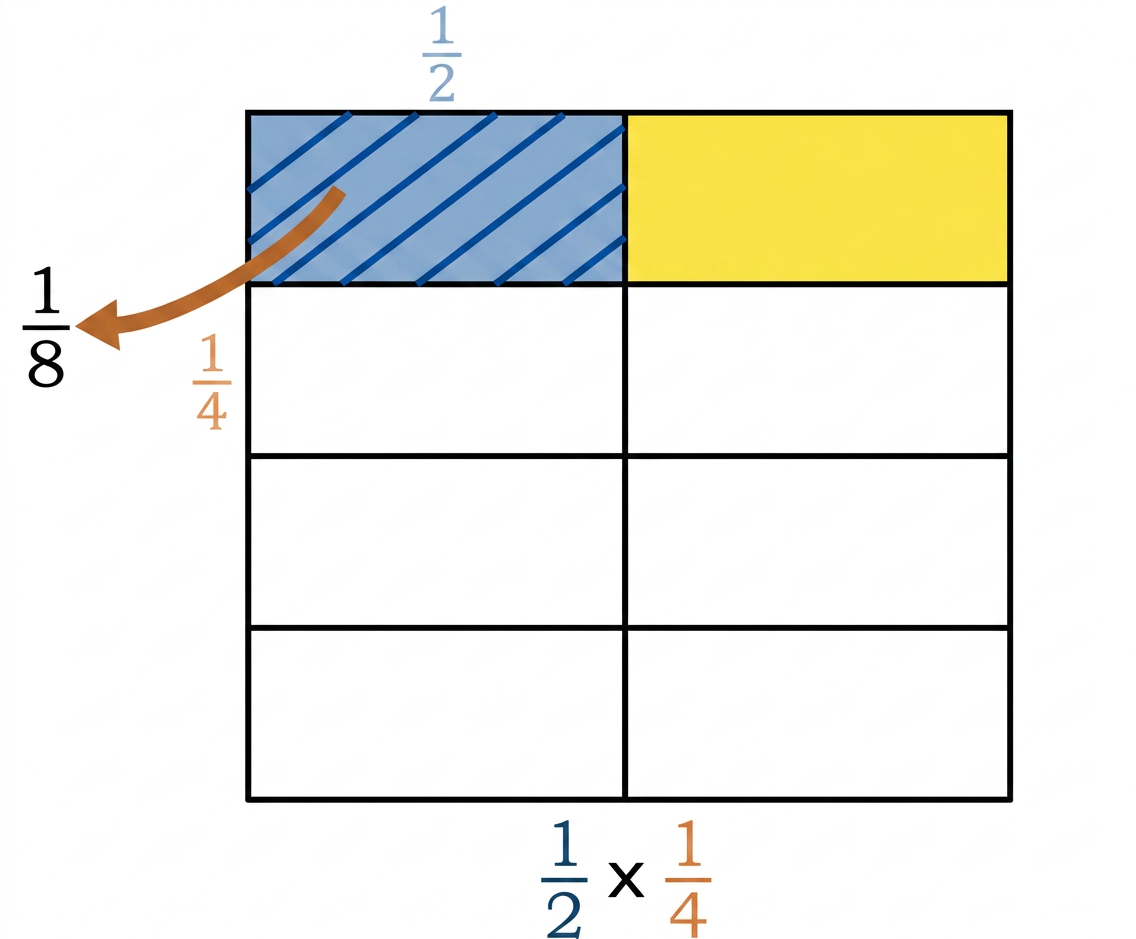
Context: In Fig. 8.3, the length and breadth of the shaded rectangle are unit and unit, and its area is square units.
Q. Do you see any relation between the area and the product of length and breadth?
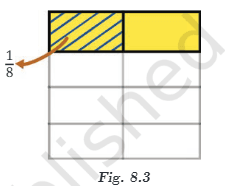
We will check if the area is the product of length and breadth.
Step 1 — Note the dimensions
The problem gives us the length. Let the length be L.
The problem also gives us the breadth. Let the breadth be B.
The problem states the area. Let the area be A.
Step 2 — Calculate the product
Let us multiply the length and breadth. This is .
We multiply the numerators. We multiply the denominators.
Step 3 — Compare the values
We found the product of length and breadth. The product is square units. The problem states the area is square units. Both values are the same.
Answer
Yes, the area is equal to the product of length and breadth.
More questions in IT
Context: In Fig. 8.3, the length and breadth of the shaded rectangle are unit and unit, and its area is square units.
Q. Do you see any relation between the area and the product of length and breadth?
In each of the division problems above, observe how we found the answer. Can we frame a rule that tells us how to divide two fractions?
When do you think the quotient is less than the dividend and when is it greater than the dividend?
Is there a similar relationship between the divisor and the quotient?
In each of the figures given below, find the fraction of the big square that the shaded region occupies.
Context: If we assume 1 gold dinar = 12 silver drammas, 1 silver dramma = 4 copper panas, 1 copper pana = 6 mashakas, and 1 pana = 30 cowrie shells,
Given: 1 copper pana = gold dinar
Fill in the blanks:
(i) 1 cowrie shell = ______ copper panas
(ii) 1 cowrie shell = ______ gold dinar.