Question 5
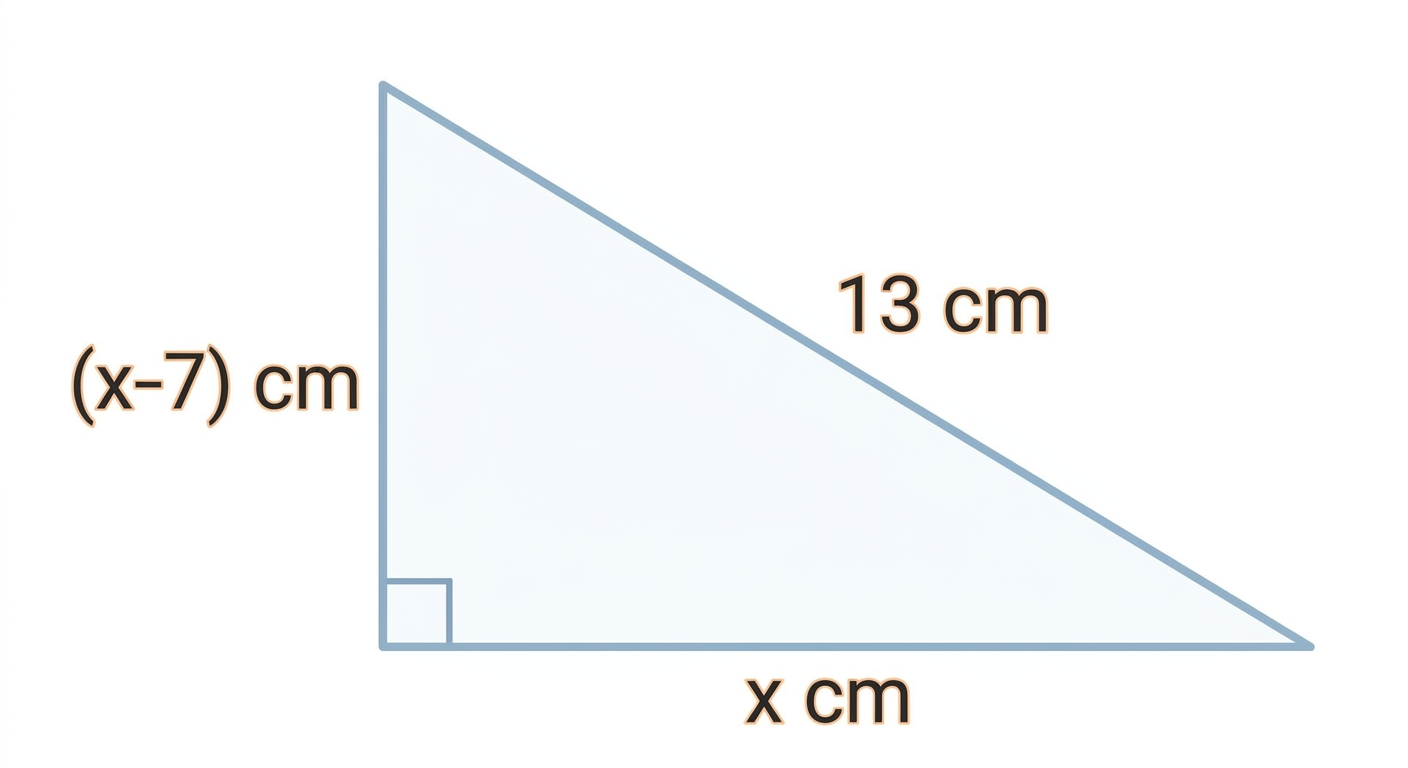
The altitude of a right triangle is 7 cm less than its base. If the hypotenuse is 13 cm, find the other two sides.
We will use the Pythagorean theorem to form a quadratic equation.
Step 1 — Form the equation
Let's define the sides of the triangle. Let the base of the right triangle be cm. The altitude is cm less than the base. So, the altitude is cm. The hypotenuse is given as cm. We use the Pythagorean theorem. The square of the hypotenuse equals the sum of the squares of the other two sides.
Let's divide the entire equation by .
Step 2 — Solve the equation
We have the quadratic equation . Let's factorize this equation. We need two numbers that multiply to and add up to . These numbers are and .
This gives us two possible values for . Either or . So, or . A side length cannot be negative. Therefore, we reject . The base of the triangle is cm. The altitude is . Altitude cm.
Answer
The other two sides of the triangle are 5 cm and 12 cm.
More questions in Exercise 4.2
Find the roots of the following quadratic equations by factorisation:
(i)
(ii)
(iii)
(iv)
(v)
Solve the problems given in Example 1.
Find two numbers whose sum is 27 and product is 182.
Find two consecutive positive integers, sum of whose squares is 365.
The altitude of a right triangle is 7 cm less than its base. If the hypotenuse is 13 cm, find the other two sides.
A cottage industry produces a certain number of pottery articles in a day. It was observed on a particular day that the cost of production of each article (in rupees) was 3 more than twice the number of articles produced on that day. If the total cost of production on that day was ₹ 90, find the number of articles produced and the cost of each article.