Question 2
Solve the problems given in Example 1.
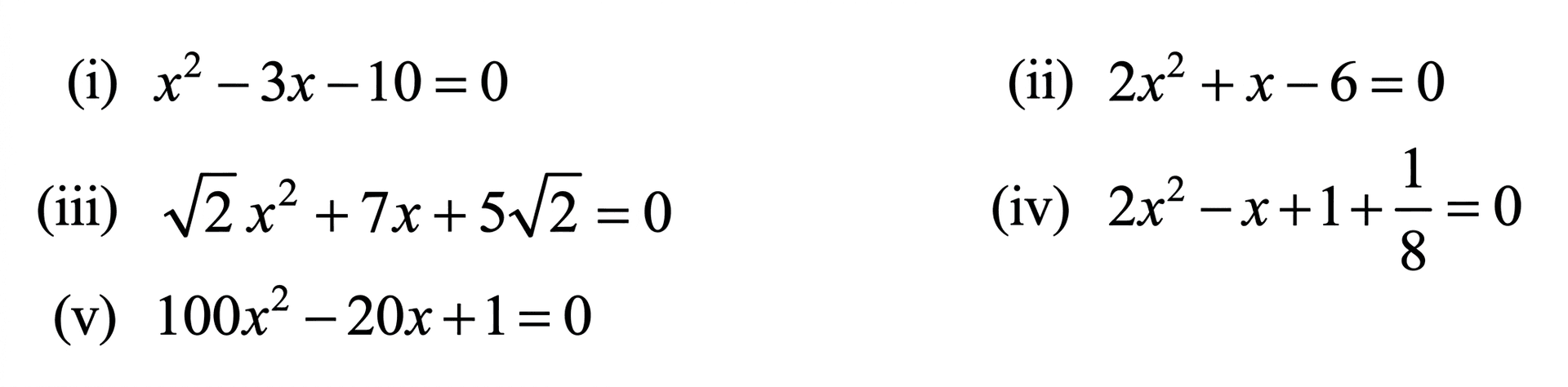
Let's solve each quadratic equation by finding its roots.
Step 1 — Solve
We will factor the quadratic expression. We need two numbers that multiply to -10 and add to -3. These numbers are -5 and 2.
This means either or .
Step 2 — Solve
We will factor this quadratic equation. We look for two numbers whose product is and whose sum is 1. These numbers are 4 and -3.
This means either or .
Step 3 — Solve
We will use the quadratic formula to find the roots. The coefficients are , , and .
First, let's calculate the discriminant .
Now, we apply the quadratic formula .
We find the two possible roots.
Step 4 — Solve
First, let's simplify the constant terms.
Let's multiply the entire equation by 8 to remove the fraction.
Now, we use the quadratic formula. The coefficients are , , and .
Let's calculate the discriminant .
Since the discriminant is negative, there are no real roots for this equation.
Step 5 — Solve
We can recognize this as a perfect square trinomial. It is in the form .
We can write as and as . The middle term is , which is .
This means must be equal to 0.
Answer
(i) or (ii) or (iii) or (iv) No real roots (v)
More questions in Exercise 4.2
Find the roots of the following quadratic equations by factorisation:
(i)
(ii)
(iii)
(iv)
(v)
Solve the problems given in Example 1.
Find two numbers whose sum is 27 and product is 182.
Find two consecutive positive integers, sum of whose squares is 365.
The altitude of a right triangle is 7 cm less than its base. If the hypotenuse is 13 cm, find the other two sides.
A cottage industry produces a certain number of pottery articles in a day. It was observed on a particular day that the cost of production of each article (in rupees) was 3 more than twice the number of articles produced on that day. If the total cost of production on that day was ₹ 90, find the number of articles produced and the cost of each article.