Introduction to Trigonometry | Exercise 8.1

Question 1

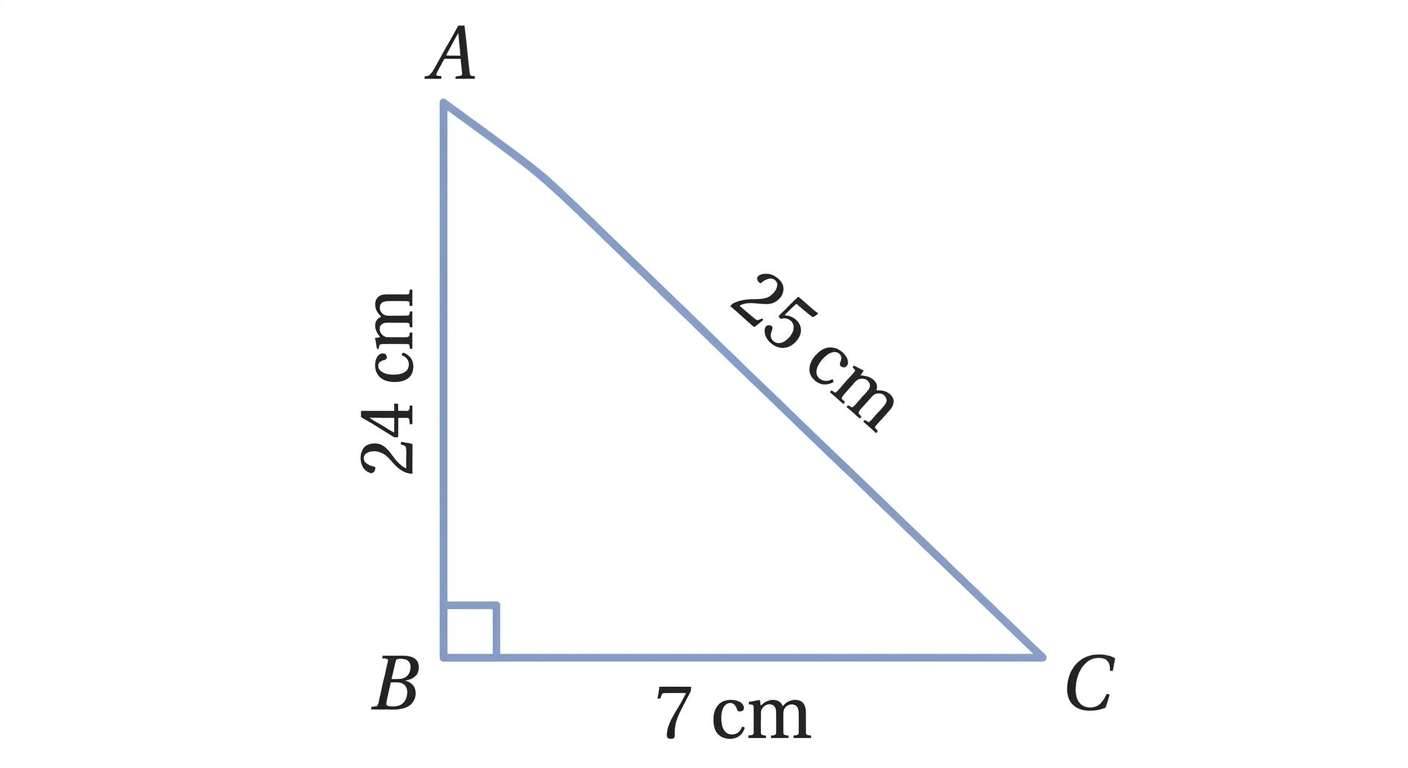
In ΔABC\Delta \text{ABC}, right-angled at B, AB=24 cm\text{AB} = 24\text{ cm}, BC=7 cm\text{BC} = 7\text{ cm}. Determine :

(i) sinA\sin A, cosA\cos A (ii) sinC\sin C, cosC\cos C

Check your answer with HomiSolve it yourself, then let Homi check your steps and spot mistakes.
Solution

Right-Angled Triangle: A triangle with one angle equal to 90°. The side opposite the right angle is the longest side, called the hypotenuse. The other two sides are called the legs (opposite and adjacent, depending on the angle in question).

Pythagoras Theorem: In a right-angled triangle, the square of the hypotenuse equals the sum of squares of the other two sides:

AC2=AB2+BC2AC^2 = AB^2 + BC^2

Here, the right angle is at B, so AC is the hypotenuse. We first find AC, then use it to calculate the trigonometric ratios.

We will use the Pythagoras theorem and trigonometric ratios.

Step 1 — Find Hypotenuse AC

Let's find the length of the hypotenuse AC. We use the Pythagoras theorem.
AC2=AB2+BC2AC^2 = AB^2 + BC^2

AC2=(24 cm)2+(7 cm)2AC^2 = (24\text{ cm})^2 + (7\text{ cm})^2

AC2=576 cm2+49 cm2AC^2 = 576\text{ cm}^2 + 49\text{ cm}^2

AC2=625 cm2AC^2 = 625\text{ cm}^2

AC=625 cm2AC = \sqrt{625\text{ cm}^2}

AC=25 cm\boxed{AC = 25\text{ cm}}

Diagram 1

Step 2 — Determine sin A and cos A

For angle A, BC is the opposite side. AB is the adjacent side. AC is the hypotenuse.

sinA=OppositeHypotenuse=BCAC\sin A = \frac{\text{Opposite}}{\text{Hypotenuse}} = \frac{BC}{AC}

sinA=725\sin A = \frac{7}{25}

cosA=AdjacentHypotenuse=ABAC\cos A = \frac{\text{Adjacent}}{\text{Hypotenuse}} = \frac{AB}{AC}

cosA=2425\cos A = \frac{24}{25}

Step 3 — Determine sin C and cos C

For angle C, AB is the opposite side. BC is the adjacent side. AC is the hypotenuse.

sinC=OppositeHypotenuse=ABAC\sin C = \frac{\text{Opposite}}{\text{Hypotenuse}} = \frac{AB}{AC}

sinC=2425\sin C = \frac{24}{25}

cosC=AdjacentHypotenuse=BCAC\cos C = \frac{\text{Adjacent}}{\text{Hypotenuse}} = \frac{BC}{AC}

cosC=725\cos C = \frac{7}{25}

Answer

(i) sinA=725\sin A = \frac{7}{25}, cosA=2425\cos A = \frac{24}{25} (ii) sinC=2425\sin C = \frac{24}{25}, cosC=725\cos C = \frac{7}{25}

More questions in Exercise 8.1

Q1

In ΔABC\Delta \text{ABC}, right-angled at B, AB=24 cm\text{AB} = 24\text{ cm}, BC=7 cm\text{BC} = 7\text{ cm}. Determine :

(i) sinA\sin A, cosA\cos A (ii) sinC\sin C, cosC\cos C

Q2

In Fig. 8.13, find tanPcotR\tan P - \cot R.

Q3

If sinA=34\sin A = \frac{3}{4}, calculate cosA\cos A and tanA\tan A.

Q4

Given 15cotA=815 \cot A = 8, find sinA\sin A and secA\sec A.

Q5

Given secθ=1312\sec \theta = \frac{13}{12}, calculate all other trigonometric ratios.

Q6

If A\angle A and B\angle B are acute angles such that cosA=cosB\cos A = \cos B, then show that A=B\angle A = \angle B.

Q7

If cotθ=78\cot \theta = \frac{7}{8}, evaluate :

(i) (1+sinθ)(1sinθ)(1+cosθ)(1cosθ)\frac{(1 + \sin \theta)(1 - \sin \theta)}{(1 + \cos \theta)(1 - \cos \theta)} (ii) cot2θ\cot^2 \theta

Q8

If 3cotA=43 \cot A = 4, check whether 1tan2A1+tan2A=cos2Asin2A\frac{1 - \tan^2 A}{1 + \tan^2 A} = \cos^2 A - \sin^2 A or not.

Q9

In triangle ABC, right-angled at B, if tanA=13\tan A = \frac{1}{\sqrt{3}}, find the value of:

(i) sinAcosC+cosAsinC\sin A \cos C + \cos A \sin C

(ii) cosAcosCsinAsinC\cos A \cos C - \sin A \sin C

Q10

In ΔPQR\Delta \text{PQR}, right-angled at Q, PR+QR=25 cm\text{PR} + \text{QR} = 25\text{ cm} and PQ=5 cm\text{PQ} = 5\text{ cm}. Determine the values of sinP\sin P, cosP\cos P and tanP\tan P.

Q11

State whether the following are true or false. Justify your answer.

(i) The value of tanA\tan A is always less than 1.

(ii) secA=125\sec A = \frac{12}{5} for some value of angle A.

(iii) cosA\cos A is the abbreviation used for the cosecant of angle A.

(iv) cotA\cot A is the product of cot\cot and AA.

(v) sinθ=43\sin \theta = \frac{4}{3} for some angle θ\theta.

← Back to Introduction to Trigonometry