Useful identity:(1+sinθ)(1−sinθ)=1−sin2θ and (1+cosθ)(1−cosθ)=1−cos2θ. These come from the difference of squares formula (a+b)(a−b)=a2−b2.
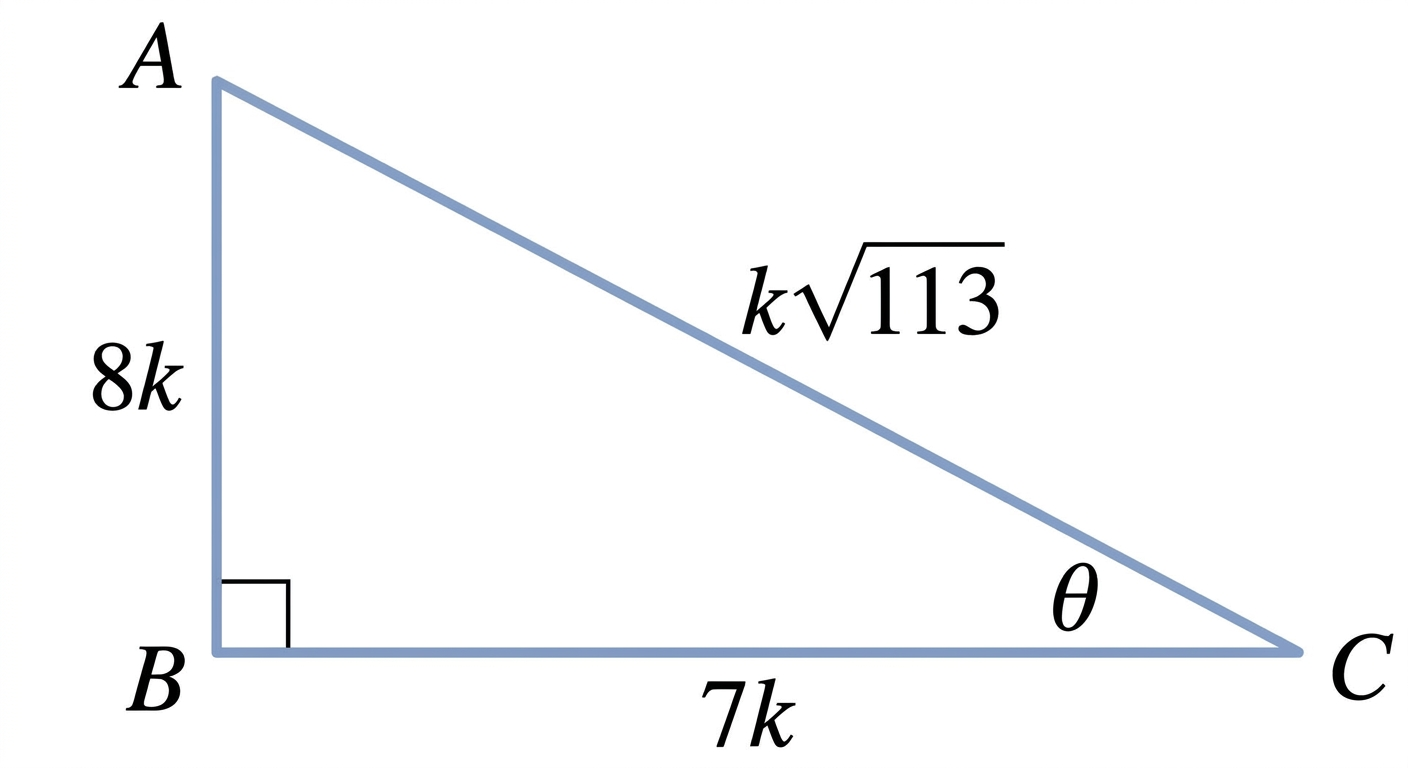
Since cotθ=87, we take adjacent =7k, opposite =8k, find hypotenuse via Pythagoras, then compute all required values.
We will use a right-angled triangle to find the values of sinθ and cosθ.
Step 1 — Find sides of the triangle
Let's draw a right-angled triangle ABC.
Let angle B be 90∘.
Let angle C be θ.
We are given cotθ=87.
We know cotθ=Opposite sideAdjacent side.
So, BC is the adjacent side.
AB is the opposite side.
Let BC=7k and AB=8k for some positive number k.
Now, we find the hypotenuse AC.
We use the Pythagoras theorem.
AC2=AB2+BC2
=(8k)2+(7k)2
=64k2+49k2
=113k2
AC=113k2
AC=k113
Now, we find sinθ and cosθ.
We know sinθ=HypotenuseOpposite side.
sinθ=ACAB
=k1138k
sinθ=1138
We know cosθ=HypotenuseAdjacent side.
cosθ=ACBC
=k1137k
cosθ=1137
Step 2 — Evaluate the first expression
Let's evaluate the first expression.
The expression is (1+cosθ)(1−cosθ)(1+sinθ)(1−sinθ).
We use the identity (a+b)(a−b)=a2−b2.
So, the numerator becomes 12−sin2θ.
The denominator becomes 12−cos2θ.
(1+cosθ)(1−cosθ)(1+sinθ)(1−sinθ)=1−cos2θ1−sin2θ
Now, we substitute the values of sinθ and cosθ.
=1−(1137)21−(1138)2
=1−113491−11364
=113113−49113113−64
=1136411349
=11349×64113
6449
Step 3 — Evaluate the second expression
Let's evaluate the second expression.
The expression is cot2θ.
We are given that cotθ=87.