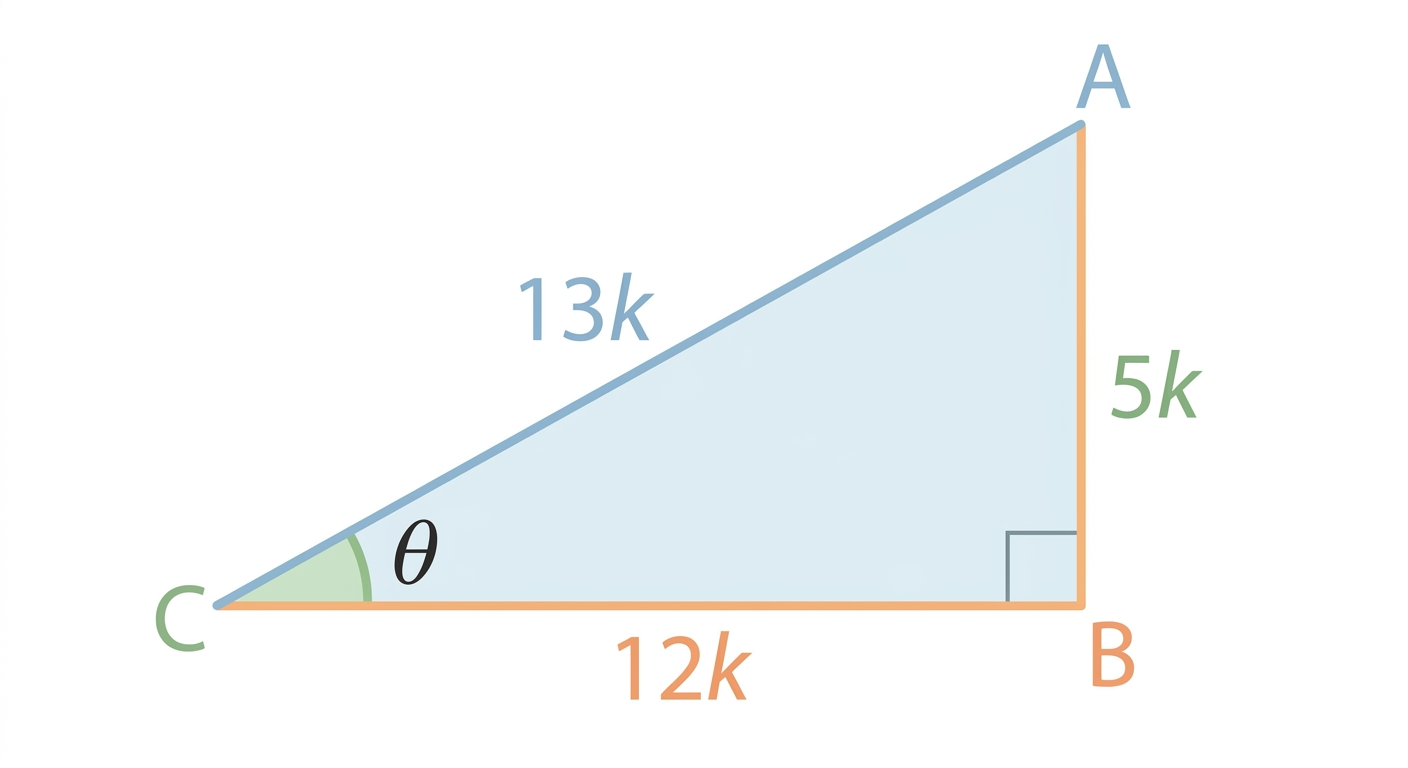
Right-Angled Triangle: For any acute angle θ \theta θ
Opposite — side facing θ \theta θ Adjacent — side next to θ \theta θ Hypotenuse — longest side, opposite the 90° angle
All six trigonometric ratios:
sin θ = Opp Hyp , cos θ = Adj Hyp , tan θ = Opp Adj \sin\theta = \frac{\text{Opp}}{\text{Hyp}}, \quad \cos\theta = \frac{\text{Adj}}{\text{Hyp}}, \quad \tan\theta = \frac{\text{Opp}}{\text{Adj}} sin θ = Hyp Opp , cos θ = Hyp Adj , tan θ = Adj Opp
csc θ = Hyp Opp , sec θ = Hyp Adj , cot θ = Adj Opp \csc\theta = \frac{\text{Hyp}}{\text{Opp}}, \quad \sec\theta = \frac{\text{Hyp}}{\text{Adj}}, \quad \cot\theta = \frac{\text{Adj}}{\text{Opp}} csc θ = Opp Hyp , sec θ = Adj Hyp , cot θ = Opp Adj
Pythagoras Theorem: Hypotenuse 2 = Opposite 2 + Adjacent 2 \text{Hypotenuse}^2 = \text{Opposite}^2 + \text{Adjacent}^2 Hypotenuse 2 = Opposite 2 + Adjacent 2
Since sec θ = 13 12 \sec\theta = \frac{13}{12} sec θ = 12 13 = 13 k = 13k = 13 k = 12 k = 12k = 12 k
We can use a right-angled triangle to find the lengths of its sides.
Step 1 — Find the unknown side
Let's draw a right-angled triangle.
Let θ \theta θ sec θ = 13 12 \sec \theta = \frac{13}{12} sec θ = 12 13 sec θ = Hypotenuse Adjacent side \sec \theta = \frac{\text{Hypotenuse}}{\text{Adjacent side}} sec θ = Adjacent side Hypotenuse A C AC A C 13 k \mathbf{13k} 13k A B AB A B 12 k \mathbf{12k} 12k A C 2 = A B 2 + B C 2 AC^2 = AB^2 + BC^2 A C 2 = A B 2 + B C 2
( 13 k ) 2 = ( 12 k ) 2 + B C 2 (13k)^2 = (12k)^2 + BC^2 ( 13 k ) 2 = ( 12 k ) 2 + B C 2
169 k 2 = 144 k 2 + B C 2 169k^2 = 144k^2 + BC^2 169 k 2 = 144 k 2 + B C 2
B C 2 = 169 k 2 − 144 k 2 BC^2 = 169k^2 - 144k^2 B C 2 = 169 k 2 − 144 k 2
B C 2 = 25 k 2 BC^2 = 25k^2 B C 2 = 25 k 2
B C = 25 k 2 BC = \sqrt{25k^2} B C = 25 k 2
B C = 5 k \boxed{BC = 5k} B C = 5 k
Step 2 — Calculate other ratios
Now we have all three sides.
We can find the other trigonometric ratios.
Let's find sin θ \sin \theta sin θ sin θ = Opposite Hypotenuse = B C A C \sin \theta = \frac{\text{Opposite}}{\text{Hypotenuse}} = \frac{BC}{AC} sin θ = Hypotenuse Opposite = A C B C
= 5 k 13 k = \frac{5k}{13k} = 13 k 5 k
= 5 13 = \frac{5}{13} = 13 5
Let's find cos θ \cos \theta cos θ cos θ = Adjacent Hypotenuse = A B A C \cos \theta = \frac{\text{Adjacent}}{\text{Hypotenuse}} = \frac{AB}{AC} cos θ = Hypotenuse Adjacent = A C A B
= 12 k 13 k = \frac{12k}{13k} = 13 k 12 k
= 12 13 = \frac{12}{13} = 13 12
Let's find tan θ \tan \theta tan θ tan θ = Opposite Adjacent = B C A B \tan \theta = \frac{\text{Opposite}}{\text{Adjacent}} = \frac{BC}{AB} tan θ = Adjacent Opposite = A B B C
= 5 k 12 k = \frac{5k}{12k} = 12 k 5 k
= 5 12 = \frac{5}{12} = 12 5
Let's find csc θ \csc \theta csc θ csc θ = Hypotenuse Opposite = A C B C \csc \theta = \frac{\text{Hypotenuse}}{\text{Opposite}} = \frac{AC}{BC} csc θ = Opposite Hypotenuse = B C A C
= 13 k 5 k = \frac{13k}{5k} = 5 k 13 k
= 13 5 = \frac{13}{5} = 5 13
Let's find cot θ \cot \theta cot θ cot θ = Adjacent Opposite = A B B C \cot \theta = \frac{\text{Adjacent}}{\text{Opposite}} = \frac{AB}{BC} cot θ = Opposite Adjacent = B C A B
= 12 k 5 k = \frac{12k}{5k} = 5 k 12 k
= 12 5 = \frac{12}{5} = 5 12
Answer
(i) sin θ = 5 13 \sin \theta = \frac{5}{13} sin θ = 13 5 (ii) cos θ = 12 13 \cos \theta = \frac{12}{13} cos θ = 13 12 (iii) tan θ = 5 12 \tan \theta = \frac{5}{12} tan θ = 12 5 (iv) csc θ = 13 5 \csc \theta = \frac{13}{5} csc θ = 5 13 (v) cot θ = 12 5 \cot \theta = \frac{12}{5} cot θ = 5 12