Question 1
There are two fruit baskets A and B. Basket A has one apple and two oranges. Basket B has one banana and one mango. You randomly pick one fruit from each basket.
(i) Draw a tree diagram showing all possible pairs of fruits.
(ii) List the sample space.
(iii) What is the probability of picking one apple and one banana?
We will find all possible combinations of fruits picked from two baskets and then calculate a specific probability.
Step 1 — Draw the tree diagram
Let's list the fruits in each basket. Basket A has one Apple (A) and two Oranges (O). Basket B has one Banana (B) and one Mango (M). We pick one fruit from Basket A first. Then we pick one fruit from Basket B. The tree diagram shows these choices.
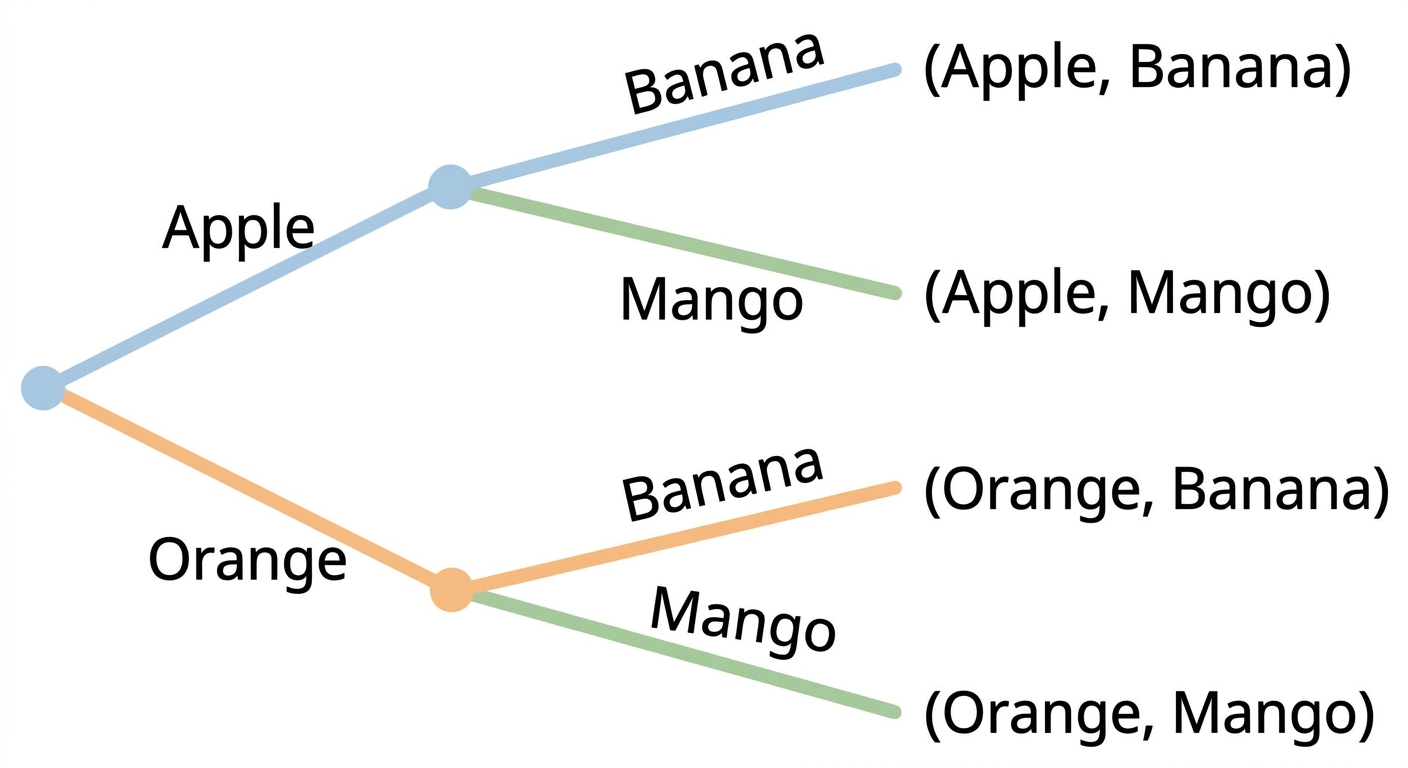
The possible pairs are: (Apple, Banana) (Apple, Mango) (Orange, Banana) (Orange, Mango)
Step 2 — List the sample space
The sample space is a list of all possible outcomes. We found these outcomes from our tree diagram. Let's write them as a set.
The total number of outcomes is 4.
Step 3 — Calculate the probability
We want the probability of picking one apple and one banana. Let's identify the favourable outcome. The favourable outcome is (Apple, Banana). There is only 1 favourable outcome. The total number of outcomes is 4. We use the probability formula.
Answer
(i) Tree Diagram: Basket A /
Apple Orange / \ /
Banana Mango Banana Mango Possible pairs: (Apple, Banana), (Apple, Mango), (Orange, Banana), (Orange, Mango) (ii) Sample Space: S = {(Apple, Banana), (Apple, Mango), (Orange, Banana), (Orange, Mango)} (iii) Probability of picking one apple and one banana =
More questions in Exercise 7.4
There are two fruit baskets A and B. Basket A has one apple and two oranges. Basket B has one banana and one mango. You randomly pick one fruit from each basket.
(i) Draw a tree diagram showing all possible pairs of fruits.
(ii) List the sample space.
(iii) What is the probability of picking one apple and one banana?
Let us say that you have a box containing 3 red pens, 4 black pens and 2 green pens. You pick a pen (without looking) from the box and put it back. Then your friend does the same.
(i) What are the possible outcomes of the pen colours? Can you draw a tree diagram representing the possible outcomes?
(ii) Can you use the tree diagram to guess the probability that both you and your friend pick pens of the same colour?