Question 2
If the bathroom door has a hinge at and opens into the bedroom, will it hit the wardrobe? Are there any changes you would suggest if the door is made wider?
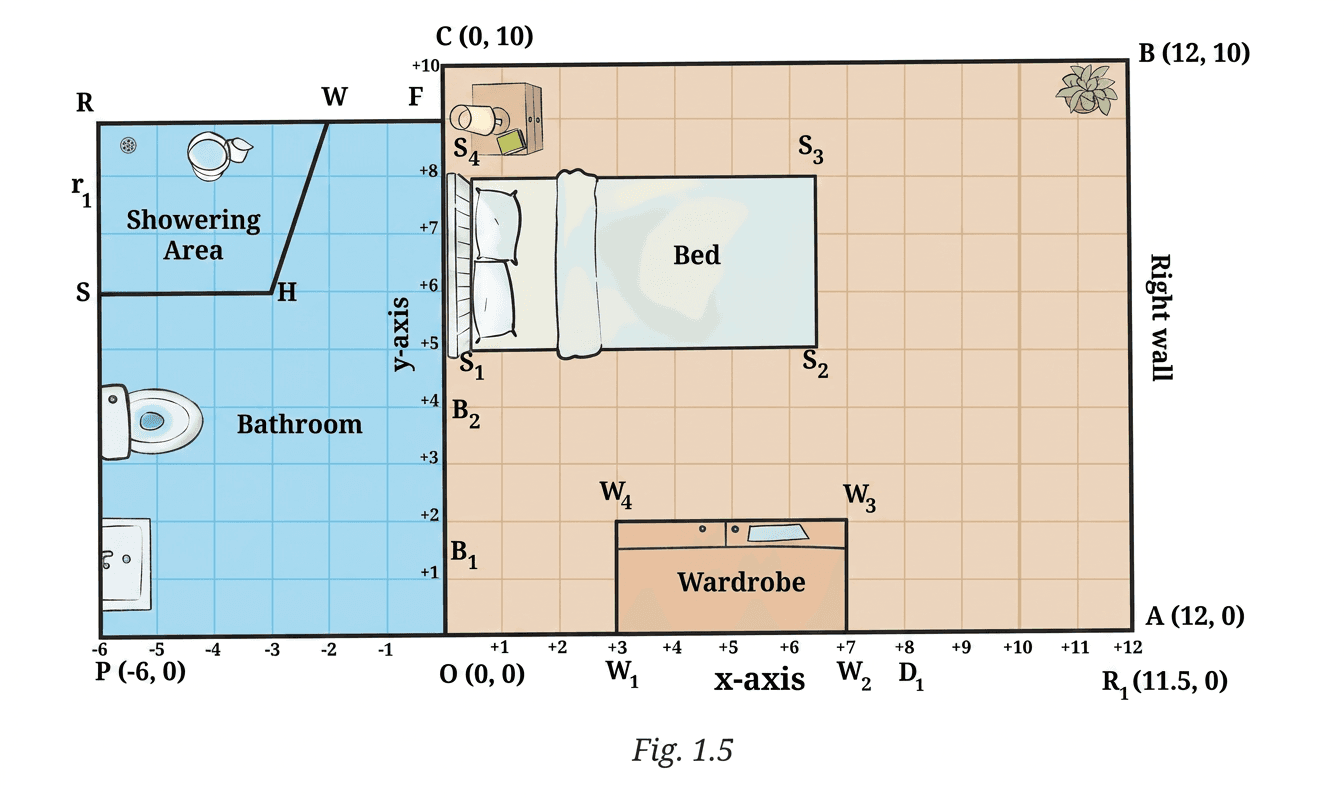
Let's find the door's width and its swing to check for collision.
Step 1 — Calculate door width
First, we find the coordinates of points B1 and B2. From the diagram, B1 is at and . So, . From the diagram, B2 is at and . So, . The bathroom door is between and . Its width is the distance between these two points.
Bathroom door width:
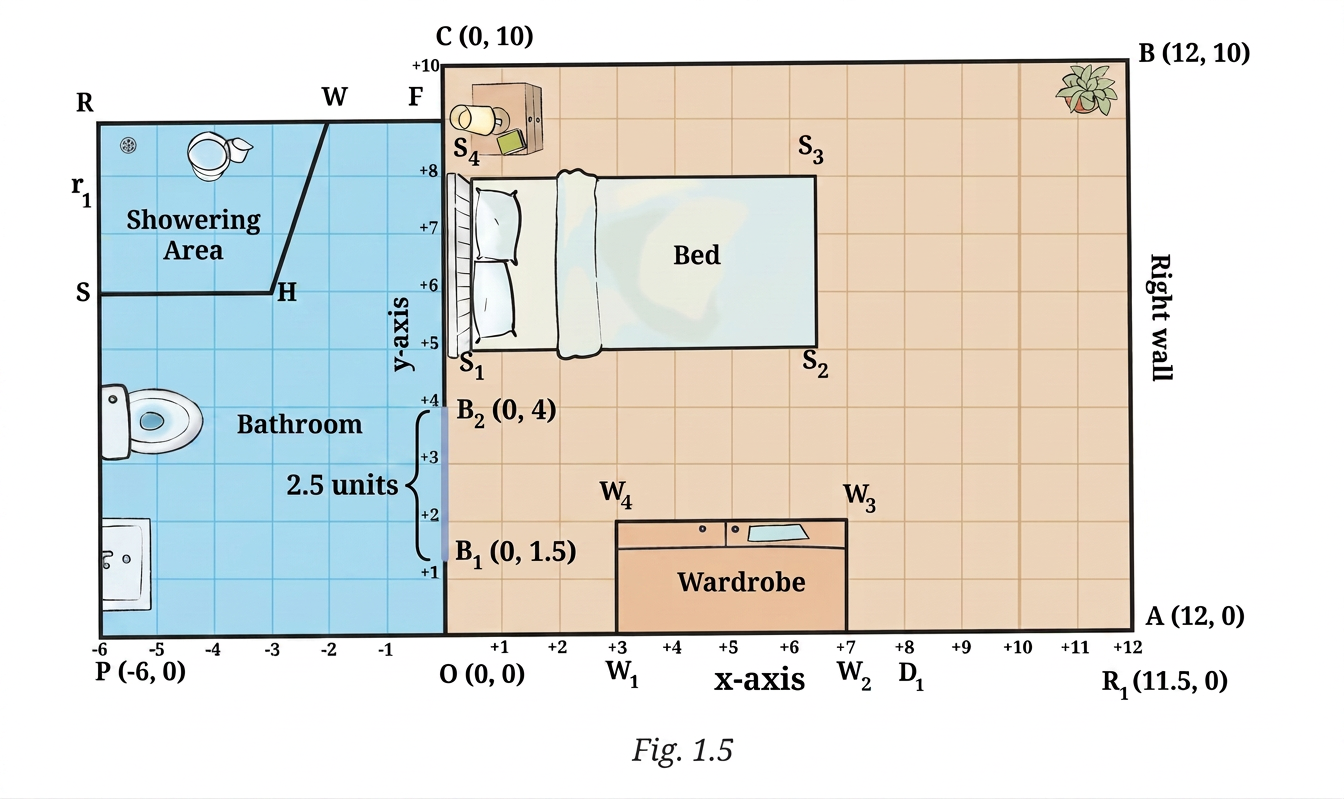
Step 2 — Check for collision
The door is hinged at . It opens into the bedroom. The door will sweep an arc with a radius of 2.5 units. This arc starts from and moves into the positive x-direction. The farthest point the door can reach is from the hinge. Now, let's look at the wardrobe. The wardrobe starts at and . The nearest x-coordinate of the wardrobe is 3 units. We compare the door's maximum reach with the wardrobe's position.
Door's maximum reach:
Wardrobe's nearest x-position:
Since , the door will not hit the wardrobe.
Step 3 — Suggest changes for a wider door
If the door is made wider, its swing radius will increase. If the width exceeds 3 units, it will hit the wardrobe. Let's consider some changes.
Answer
(i) No, the bathroom door will not hit the wardrobe. (ii) If the door is made much wider, it may hit the wardrobe. (iii) We could make the door open inwards into the bathroom. Alternatively, the wardrobe could be shifted to the right. Or, the door width could be kept limited for comfortable movement.
More questions in Exercise 1.2
Place Reiaan’s rectangular study table with three of its feet at the points (8, 9), (11, 9) and (11, 7).
(i) Where will the fourth foot of the table be? (ii) Is this a good spot for the table? (iii) What is the width of the table? The length? Can you make out the height of the table?
If the bathroom door has a hinge at and opens into the bedroom, will it hit the wardrobe? Are there any changes you would suggest if the door is made wider?
Look at Reiaan’s bathroom.
(i) What are the coordinates of the four corners O, F, R, and P of the bathroom?
(ii) What is the shape of the showering area SHWR in Reiaan’s bathroom? Write the coordinates of the four corners.
(iii) Mark off a 3 ft × 2 ft space for the washbasin and a 2 ft × 3 ft space for the toilet. Write the coordinates of the corners of these spaces.
Other rooms in the house:
(i) Reiaan’s room door leads from the dining room which has the length 18 ft and width 15 ft. The length of the dining room extends from point P to point A. Sketch the dining room and mark the coordinates of its corners.
(ii) Place a rectangular 5 ft × 3 ft dining table precisely in the centre of the dining room. Write down the coordinates of the feet of the table.