Question 4
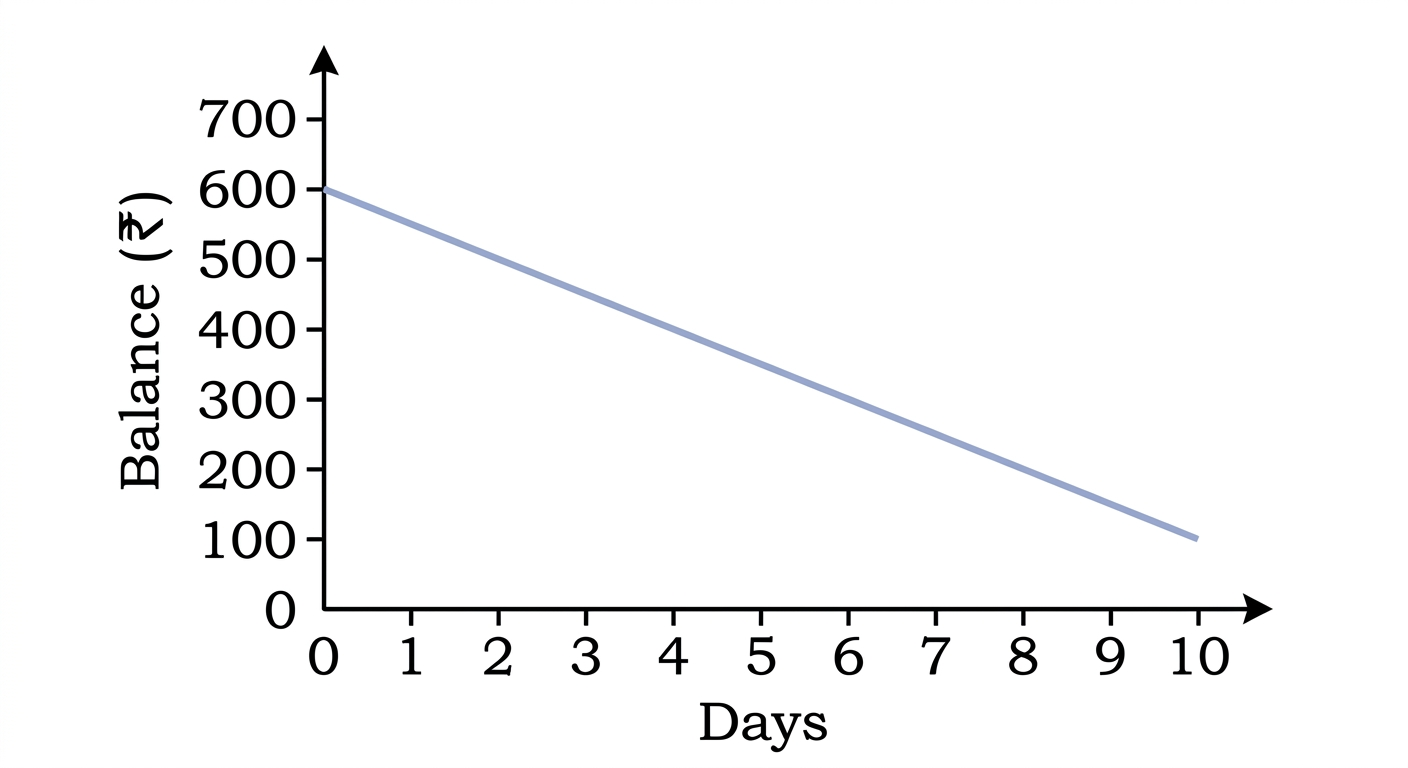
A telecom company charges ₹600 for a certain recharge scheme. This prepaid balance is reduced by ₹15 each day after the recharge.
(i) Write an equation that models the remaining balance after using the scheme for days. Explain why it represents linear decay.
(ii) After how many days will the balance run out?
(iii) Make a table of values for varying from 1 to 10 days and show how the balance reduces with time.
This problem involves understanding how a balance decreases at a constant rate over time.
Step 1 — Model the balance
Let's define the variables. Let be the remaining balance. Let be the number of days. The initial recharge amount is ₹600. The balance reduces by ₹15 each day. So, the total reduction after days is . The remaining balance is the initial amount minus the total reduction.
This equation represents linear decay. The balance decreases by a constant amount. It decreases by ₹15 every single day. This constant rate of change shows linear decay.
Step 2 — Calculate days to run out
The balance runs out when it becomes zero. We set the remaining balance to 0.
Let's solve this equation for . We add to both sides of the equation.
Now, we divide both sides by 15.
The balance will run out after 40 days.
Step 3 — Create the table of values
We will calculate the balance for from 1 to 10 days. We use the equation .
For :
For :
We continue this calculation for other values of .
| x (days) | b(x) (₹) | | :------- | :------- | | 1 | 585 | | 2 | 570 | | 3 | 555 | | 4 | 540 | | 5 | 525 | | 6 | 510 | | 7 | 495 | | 8 | 480 | | 9 | 465 | | 10 | 450 |
The table shows how the balance reduces with time.
Answer
(i) The equation that models the remaining balance after days is . This represents linear decay because the balance decreases by a constant amount (₹15) every day. (ii) The balance will run out after 40 days. (iii) | x (days) | b(x) (₹) | | :------- | :------- | | 1 | 585 | | 2 | 570 | | 3 | 555 | | 4 | 540 | | 5 | 525 | | 6 | 510 | | 7 | 495 | | 8 | 480 | | 9 | 465 | | 10 | 450 |
More questions in Exercise 2.4
Suppose a plant has height 1.75 feet and it grows by 0.5 feet each month.
(i) Find the height after 7 months.
(ii) Make a table of values for varying from 0 to 10 months and show how the height, , increases every month.
(iii) Find an expression that relates and , and explain why it represents linear growth.
A mobile phone is bought for ₹10,000. Its value decreases by ₹800 every year.
(i) Find the value of the phone after 3 years.
(ii) Make a table of values for varying from 0 to 8 years and show how the value of the phone, , depreciates with time.
(iii) Find an expression that relates and , and explain why it represents linear decay.
The initial population of a village is 750. Every year, 50 people move from a nearby city to the village.
(i) Find the population of the village after 6 years.
(ii) Make a table of values for varying from 0 to 10 years and show how the population, , increases every year.
(iii) Find an expression that relates and , and explain why it represents linear growth.
A telecom company charges ₹600 for a certain recharge scheme. This prepaid balance is reduced by ₹15 each day after the recharge.
(i) Write an equation that models the remaining balance after using the scheme for days. Explain why it represents linear decay.
(ii) After how many days will the balance run out?
(iii) Make a table of values for varying from 1 to 10 days and show how the balance reduces with time.