Question 1
Use the Baudhāyana–Pythagoras theorem to show why Theorem 6 must be true.
Let's use the Baudhāyana–Pythagoras theorem to prove that equal chords are equidistant from the circle's center.
Step 1 — Set up the diagram and knowns
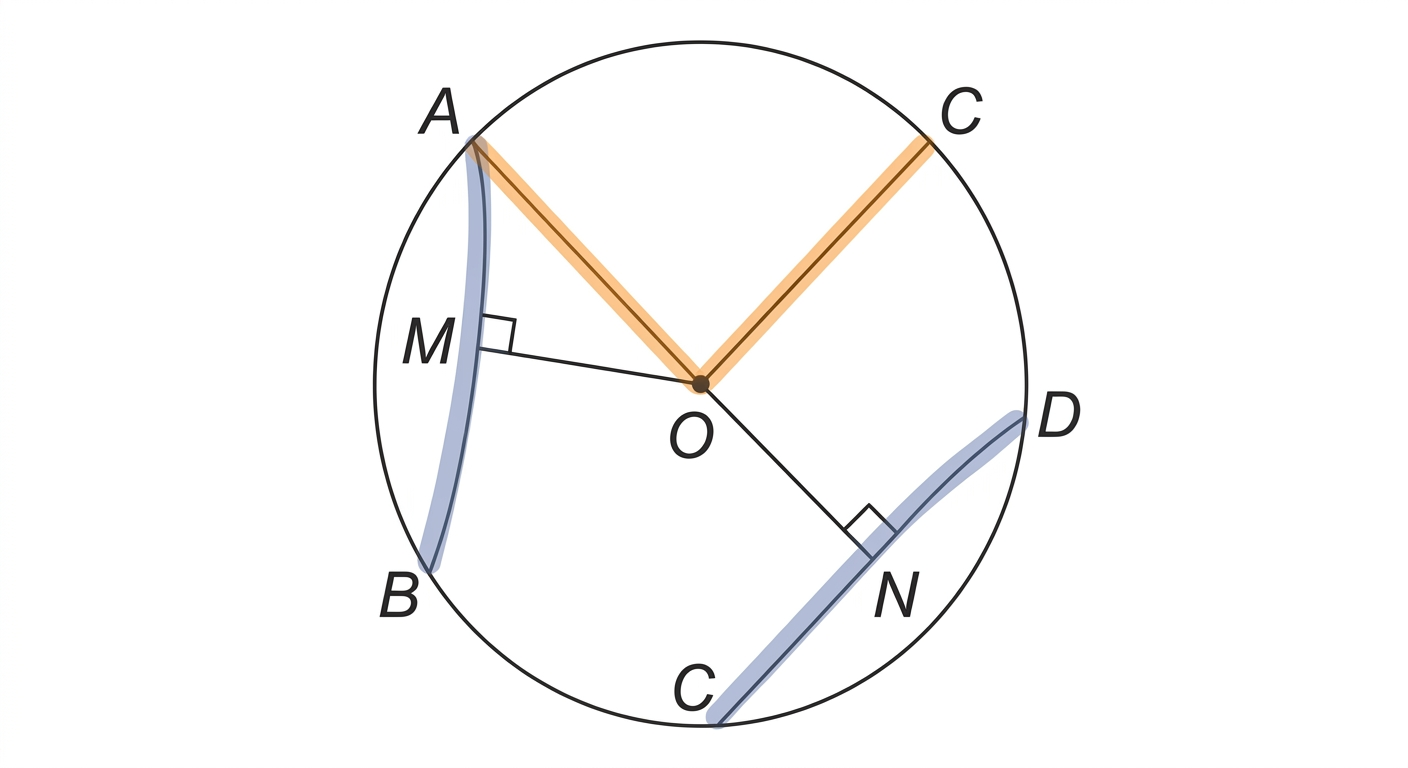
Let's consider a circle with center O. We draw two chords, AB and CD. We are given that AB and CD have the same length. Let's draw a perpendicular from O to AB, meeting at M. Let's draw a perpendicular from O to CD, meeting at N. We know that a perpendicular from the center bisects the chord. So, M is the midpoint of AB, and N is the midpoint of CD.
We know that AB = CD. Therefore, their halves must also be equal.
Also, OA and OC are radii of the same circle.
Step 2 — Apply the Baudhāyana–Pythagoras theorem
Now, let's look at the right-angled triangle OMA. The Baudhāyana–Pythagoras theorem states that . Here, OA is the hypotenuse.
Next, let's look at the right-angled triangle ONC. Here, OC is the hypotenuse.
From Step 1, we know that OA = OC. So, their squares must also be equal.
Now, we can substitute the expressions from the Baudhāyana–Pythagoras theorem.
From Step 1, we also know that AM = CN. So, we can replace with .
Let's subtract from both sides of the equation.
Taking the square root of both sides, we get:
Answer
Since OM and ON represent the distances of the chords AB and CD from the center O, and we have shown that OM = ON, it proves that chords of a circle having the same length are at the same distance from the center.