Question 2
Consider Fig. 5.15. If CE is perpendicular to AB, CH is perpendicular to GH, and CE = CH, show that AB = GF.
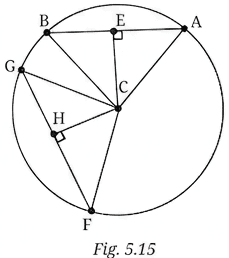
We will show that chords equidistant from the center are equal in length.
Step 1 — Bisected chords
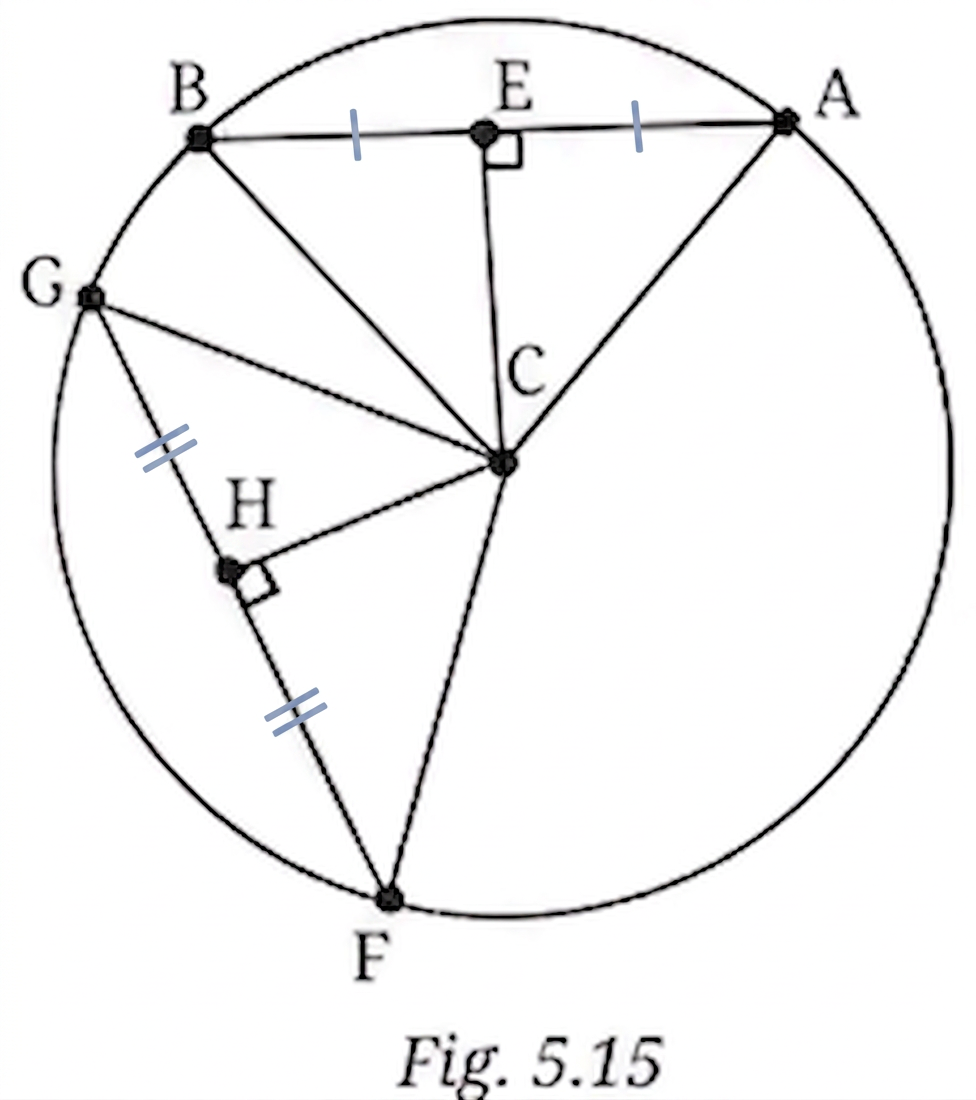
The line from the center is perpendicular to the chord. It bisects the chord into two equal parts. CE is perpendicular to AB. So, E is the midpoint of AB. This means .
CH is perpendicular to GF. So, H is the midpoint of GF. This means .
Step 2 — Congruent triangles
Let's consider two triangles. These are and . CA and CG are radii of the same circle. So, . We are given that . is a right angle. is a right angle. So, . By RHS congruence rule, . Corresponding parts of congruent triangles are equal. Therefore, .
Step 3 — Equal chords
From Step 1, we know . From Step 1, we know . From Step 2, we found . Let's substitute for .
We also know . Therefore,
Answer
(i) AB = GF is shown.