Question 2
Let and be two points on a circle with centre .
(i) Are there points on the circle, on the same side of , such that is different from ?
(ii) Is it true that if , then and lie on the same side of the circle?
(iii) If , and and do not lie on the circle, does the circle through , and also pass through ?
We will use properties of angles subtended by a chord in a circle.
Step 1 — Analyze Part (i)
Let's consider points and on the circle. They are on the same side of chord .
Angles subtended by the same chord in the same segment are equal. Chord subtends and . Since and are on the same side of , they are on the same arc. Therefore, must be equal to . There are no points on the same side of where these angles differ.
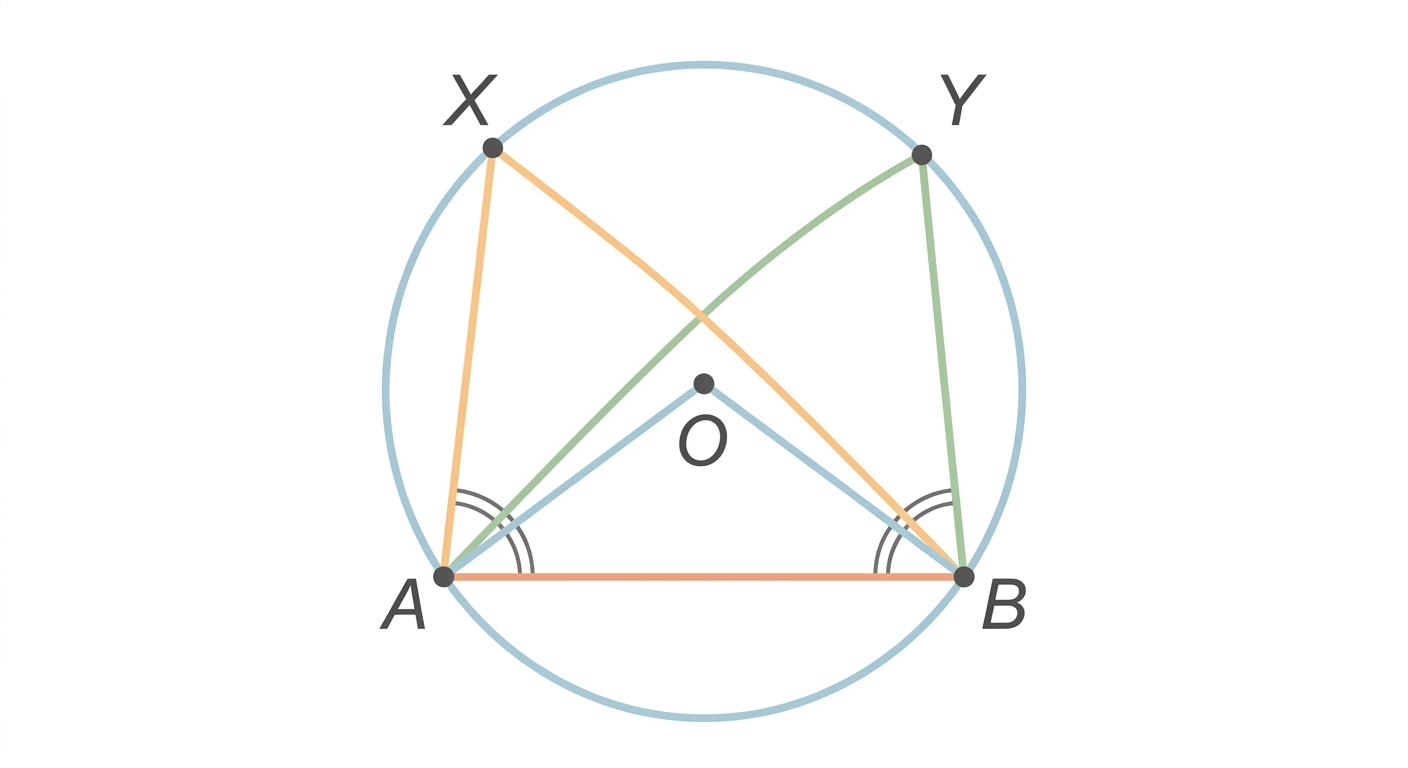
Step 2 — Analyze Part (ii)
Let's assume . We need to check if and must be on the same side of chord . Consider on the major arc . Consider on the minor arc . If and are on opposite sides of , then forms a cyclic quadrilateral. In a cyclic quadrilateral, opposite angles are supplementary. So, . If , then . This means . In this specific case, if is a diameter, then and . Here, , but and are on opposite sides of . So, and do not always lie on the same side of .
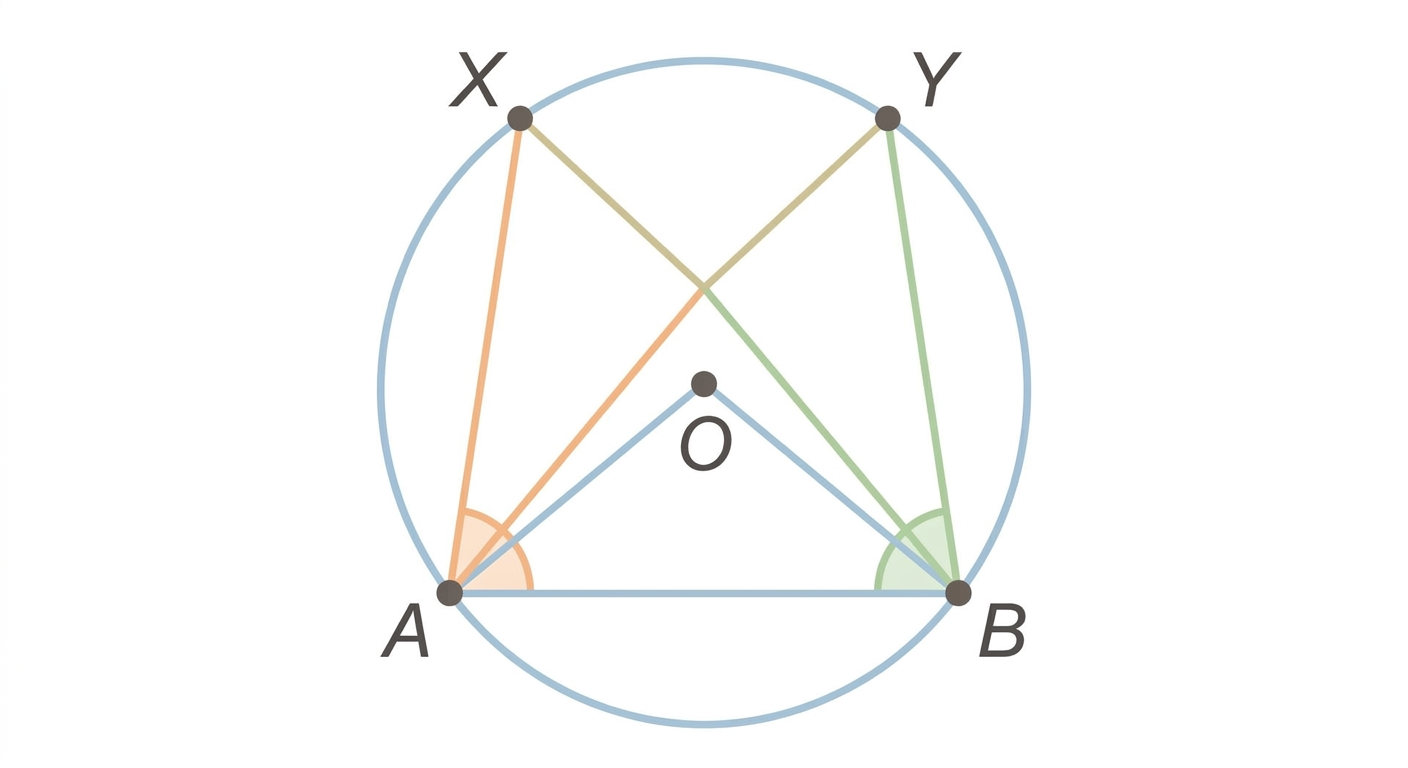
Step 3 — Analyze Part (iii)
We are given that . Also, and do not lie on the original circle. We need to check if the circle through also passes through . This means we need to check if points are concyclic. The converse theorem of angles in the same segment states: If a line segment () subtends equal angles () at two points ( and ) on the same side of the line segment, then the four points () are concyclic. Assuming and are on the same side of , this theorem applies. Therefore, points lie on the same circle. So, the circle passing through will also pass through .
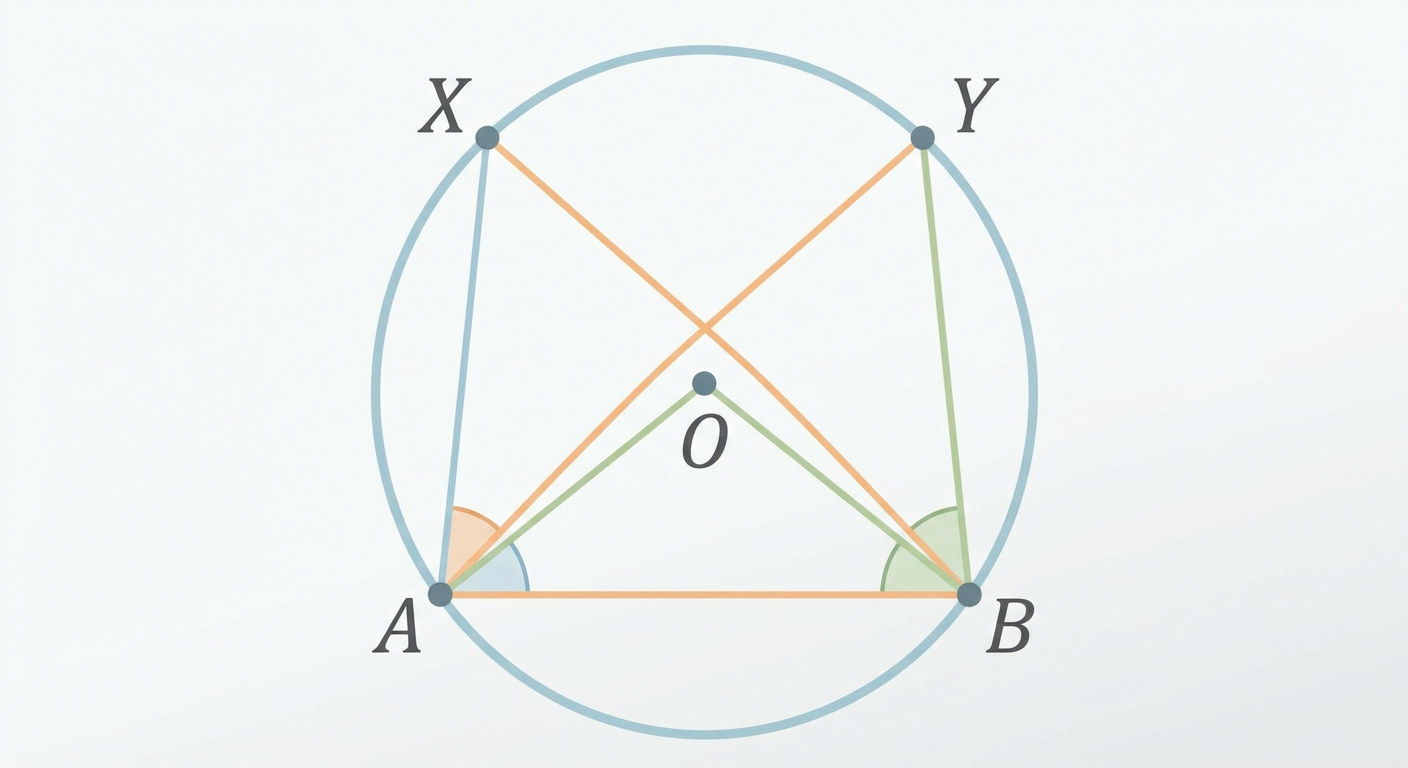
Answer
(i) No. (ii) No, this is not always true. (iii) Yes.
More questions in Exercise 5.6
In a circle with centre O, the central angle AOB is 60°. If the radius of the circle is 12 cm, what is the length of the chord AB?
Let and be two points on a circle with centre .
(i) Are there points on the circle, on the same side of , such that is different from ?
(ii) Is it true that if , then and lie on the same side of the circle?
(iii) If , and and do not lie on the circle, does the circle through , and also pass through ?
Find in Fig. 5.26.