Question 3
Find in Fig. 5.26.
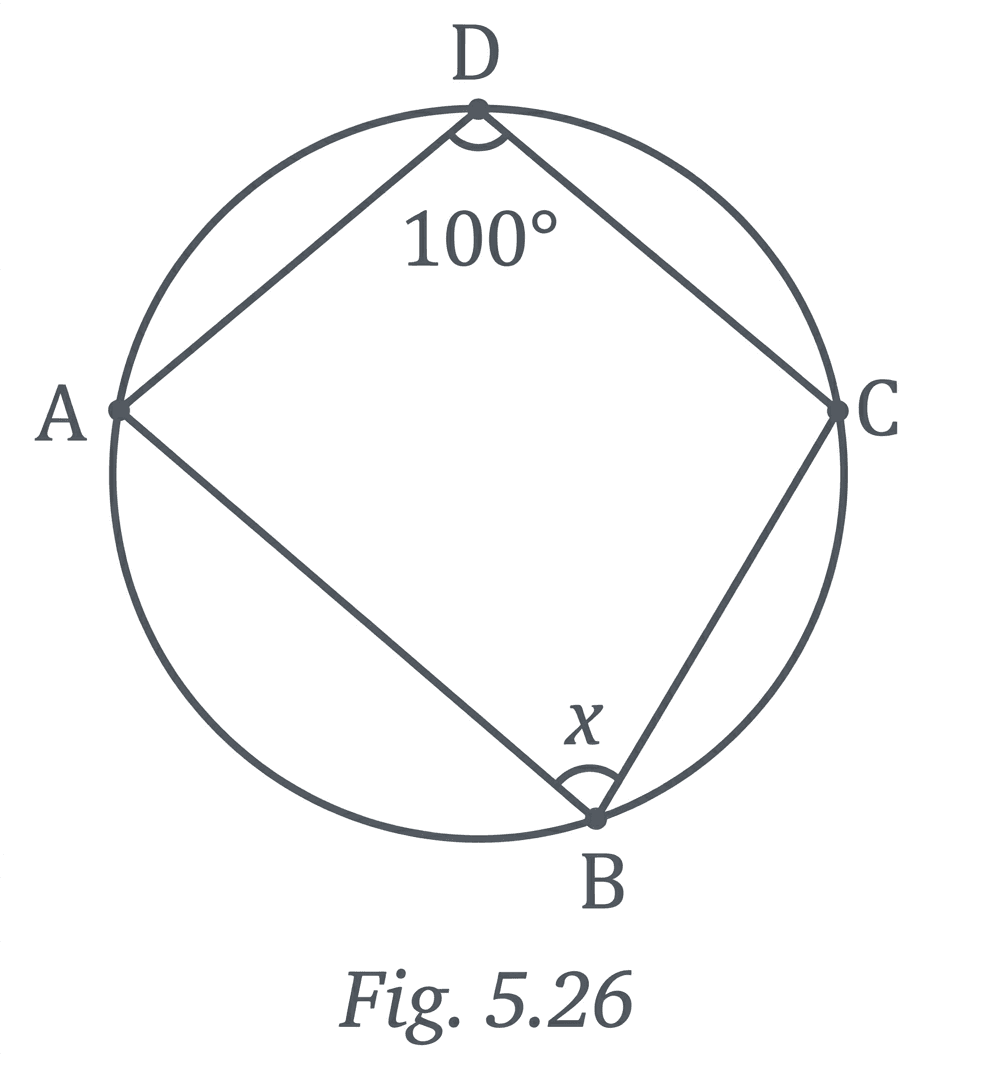
We will use the property that opposite angles of a cyclic quadrilateral are supplementary.
Step 1 — Identify the shape
The points A, D, C, and B lie on the circle.
This means that ADCB is a cyclic quadrilateral.
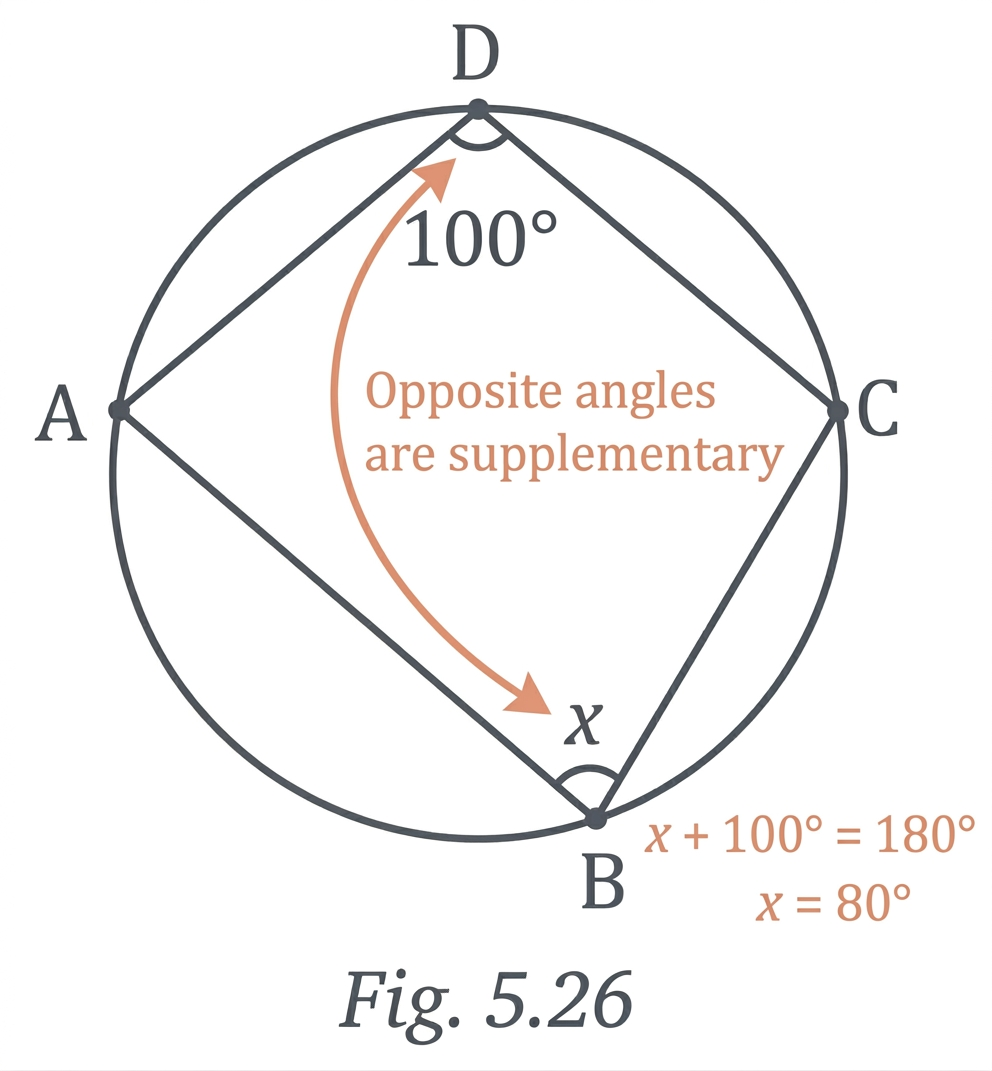
Step 2 — Apply the property
Opposite angles in a cyclic quadrilateral add up to .
So, .
We are given .
We need to find , which is .
Answer
(i)
More questions in Exercise 5.6
In a circle with centre O, the central angle AOB is 60°. If the radius of the circle is 12 cm, what is the length of the chord AB?
Let and be two points on a circle with centre .
(i) Are there points on the circle, on the same side of , such that is different from ?
(ii) Is it true that if , then and lie on the same side of the circle?
(iii) If , and and do not lie on the circle, does the circle through , and also pass through ?
Find in Fig. 5.26.