Question 1
Can you explain why the converse to Theorem 4 is true, i.e., why does the perpendicular from the centre of a circle to a chord of the circle bisect the chord?
(Hint: Use Fig. 5.12. You are told that . You need to show that .)
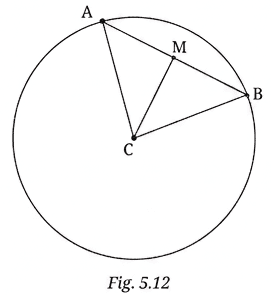
We will use triangle congruence to prove that the perpendicular from the center bisects the chord.
Step 1 — Identify given information
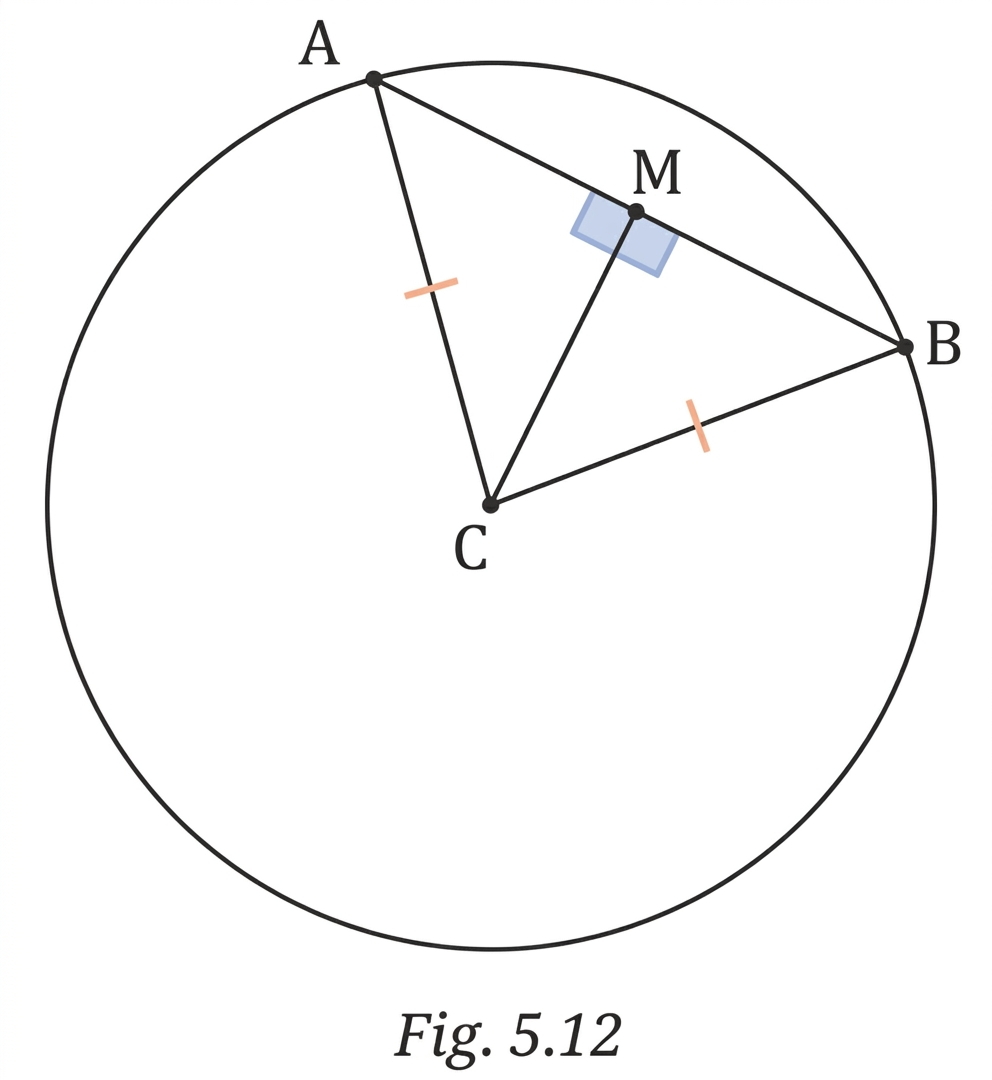
Let's consider a circle. It has a center, C. Let AB be a chord of this circle. Let CM be a line segment. CM is drawn from the center C. CM is perpendicular to the chord AB. This means . It also means . We need to show that AM equals BM.
Step 2 — Prove triangle congruence
Let's look at two triangles. These are and . Side CA is a radius of the circle. Side CB is also a radius of the circle. So, . Side CM is common to both triangles. So, . We know . We also know . So, . We can use the RHS congruence rule. RHS stands for Right angle, Hypotenuse, Side. The triangles and are congruent. By CPCT, corresponding parts of congruent triangles. The side AM corresponds to side BM. So, . This means point M is the midpoint of chord AB. Therefore, the perpendicular from the center bisects the chord.
Answer
The perpendicular from the center of a circle to a chord bisects the chord because the two triangles formed by the radii, the perpendicular, and the chord segments are congruent by the RHS rule, making the chord segments equal.
More questions in Exercise 5.3
Can you explain why the converse to Theorem 4 is true, i.e., why does the perpendicular from the centre of a circle to a chord of the circle bisect the chord?
(Hint: Use Fig. 5.12. You are told that . You need to show that .)
An isosceles triangle ABC is inscribed in a circle, with . Show that the altitude from A to BC passes through the centre of the circle.
Two parallel chords of lengths and are on opposite sides of the centre of a circle. If the radius of the circle is , find the distance between the midpoints of the chords.