Question 2
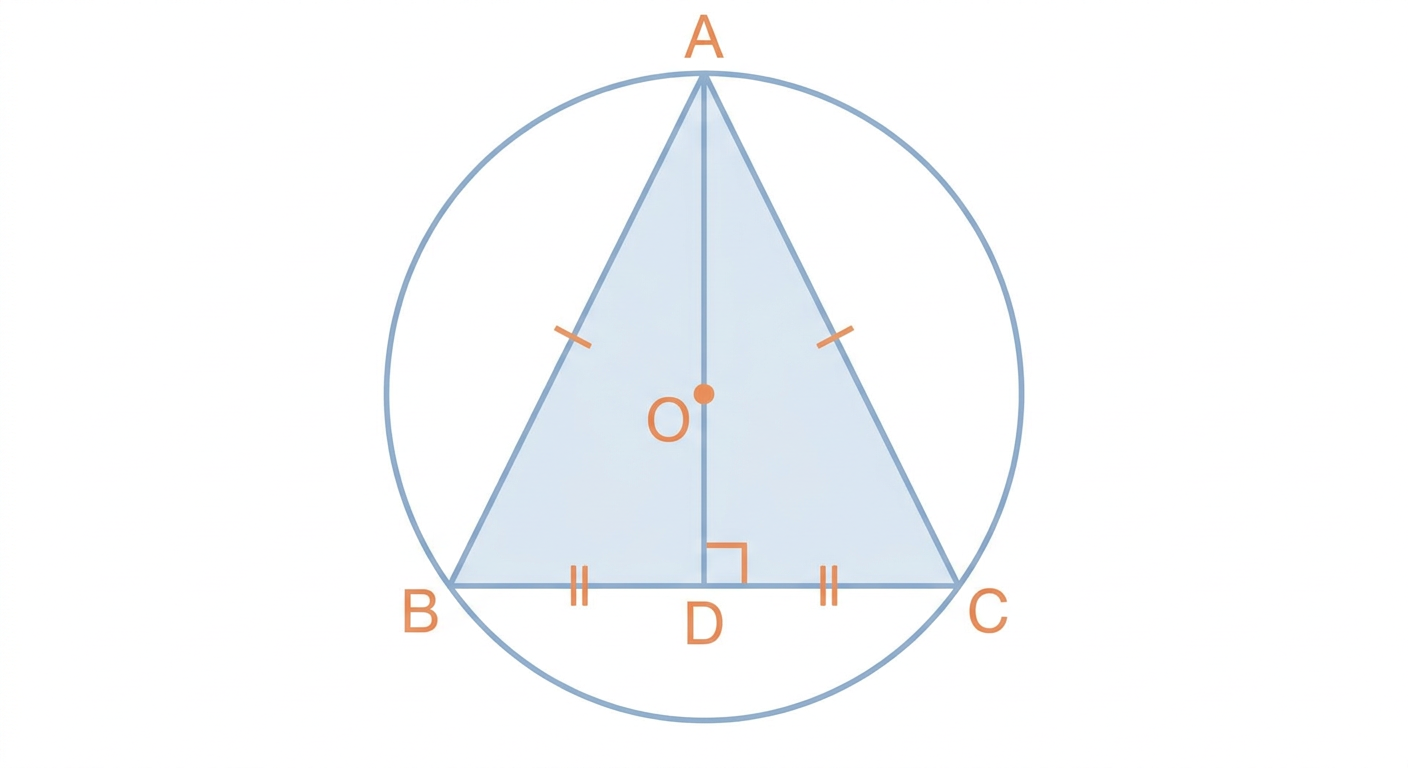
An isosceles triangle ABC is inscribed in a circle, with . Show that the altitude from A to BC passes through the centre of the circle.
The perpendicular bisector of any chord in a circle always passes through the center of the circle.
Step 1 — Altitude AD bisects BC
We have an isosceles triangle ABC. It is inscribed in a circle. Side AB equals side AC. Let's draw an altitude from A to BC. Let's call this altitude AD. This means AD is perpendicular to BC. So, angle ADB is 90 degrees. Angle ADC is also 90 degrees. Let's look at two triangles: △ABD and △ACD. We know AB = AC. This was given to us. Side AD is common to both triangles. Angle ADB equals angle ADC. Both are 90 degrees. So, △ABD is congruent to △ACD. We use the RHS congruence rule. This means BD equals DC. Therefore, AD bisects the side BC.
Step 2 — AD passes through the center
We found that AD is perpendicular to BC. We also found that AD bisects BC. So, AD is the perpendicular bisector of BC. BC is a chord of the circle. We know a property of circles. The perpendicular bisector of any chord always passes through the center of the circle. Since AD is the perpendicular bisector of chord BC, AD must pass through the center of the circle. This proves our statement.
Answer
The altitude from A to BC passes through the centre of the circle.
More questions in Exercise 5.3
Can you explain why the converse to Theorem 4 is true, i.e., why does the perpendicular from the centre of a circle to a chord of the circle bisect the chord?
(Hint: Use Fig. 5.12. You are told that . You need to show that .)
An isosceles triangle ABC is inscribed in a circle, with . Show that the altitude from A to BC passes through the centre of the circle.
Two parallel chords of lengths and are on opposite sides of the centre of a circle. If the radius of the circle is , find the distance between the midpoints of the chords.