Question 9
How many tiny squares are there in the following picture? Write the prime factorisation of the number of tiny squares.
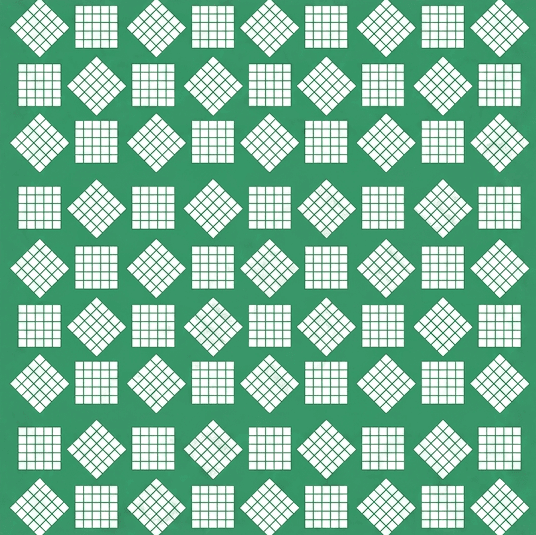
We need to count the total number of tiny squares and then find its prime factorization.
Step 1 — Counting the big squares
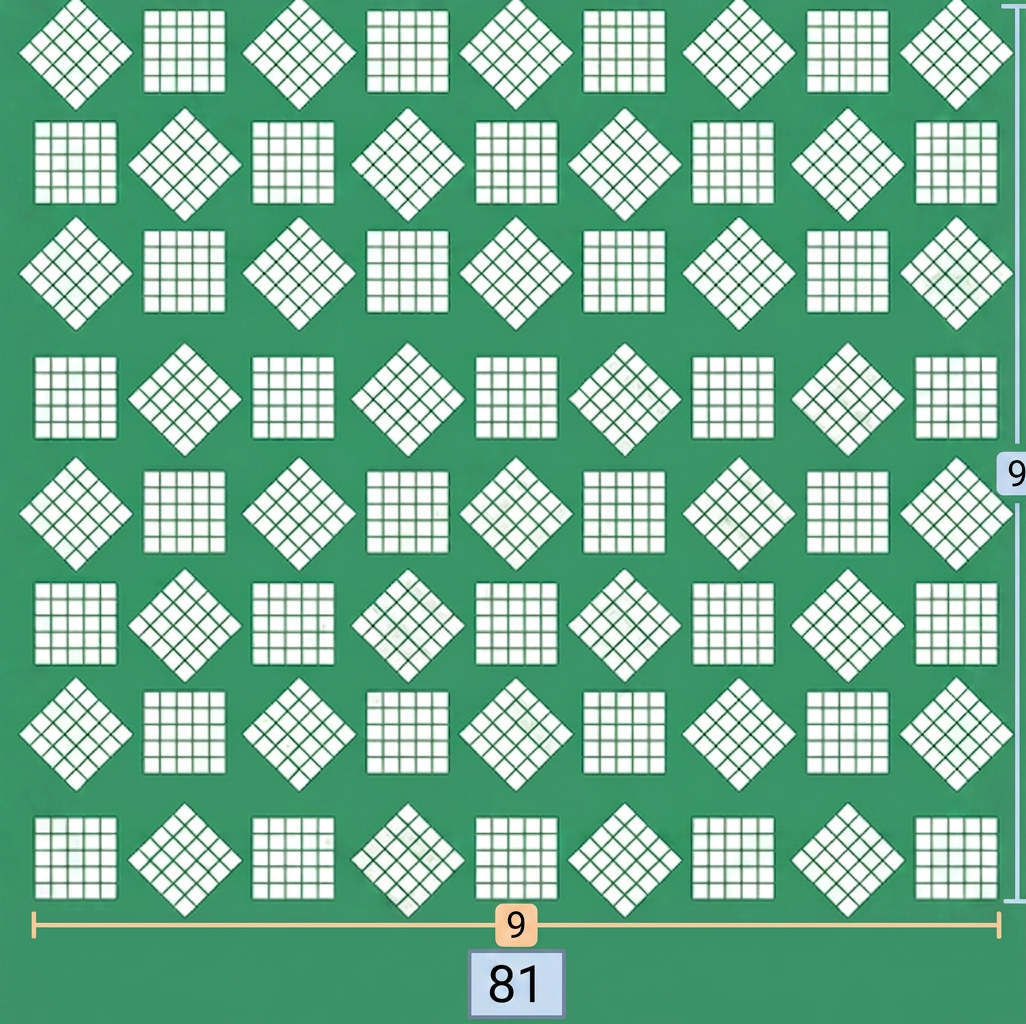
First, let us count how many big squares are arranged in the picture. We can count the number of big squares in each row and each column.
Number of big squares in a row = 9
Number of big squares in a column = 9
To find the total number of big squares, we multiply the number of rows by the number of columns.
Total number of big squares = Number of rows Number of columns
Step 2 — Counting tiny squares in one big square
Next, let us look closely at one of the big squares. Each big square is made up of many tiny squares. We count the tiny squares along one side of a big square.
Number of tiny squares along one side of a big square = 5
Since each big square is a grid, the total tiny squares in one big square is .
Number of tiny squares in each big square =
Step 3 — Calculating total tiny squares
Now, we can find the total number of tiny squares in the entire picture. We multiply the total number of big squares by the number of tiny squares in each big square.
Total tiny squares = Total number of big squares Number of tiny squares in each big square
Step 4 — Prime factorization of the total tiny squares
Prime factorization is breaking down a number into its prime factors (numbers only divisible by 1 and themselves). We will find the prime factors of 2025.
We start by dividing 2025 by the smallest prime numbers. Since 2025 ends in 5, it is divisible by 5.
Now we need to factorize 81. We know that . Since 9 is , we can write 81 as .
So, the prime factors of 2025 are 5, 5, 3, 3, 3, 3. We can write this using exponents.
Prime factorization of 2025 =
Answer
(i) The total number of tiny squares in the picture is 2025. (ii) The prime factorization of the number of tiny squares is .
More questions in FIO
Which of the following numbers are not perfect squares?
(i) 2032 (ii) 2048 (iii) 1027 (iv) 1089
Which one among , , , has last digit 4?
Given , what is the value of ?
(i) 15625 + 126
(ii)
(iii) 15625 + 253
(iv) 15625 + 251
(v)
Find the length of the side of a square whose area is .
Find the smallest square number that is divisible by each of the following numbers: 4, 9, and 10.
Find the smallest number by which 9408 must be multiplied so that the product is a perfect square. Find the square root of the product.
How many numbers lie between the squares of the following numbers?
(i) 16 and 17 (ii) 99 and 100
In the following pattern, fill in the missing numbers:
(a)
(b)
How many tiny squares are there in the following picture? Write the prime factorisation of the number of tiny squares.
Find the cube roots of 27000 and 10648.
What number will you multiply by 1323 to make it a cube number?
State true or false. Explain your reasoning.
(i) The cube of any odd number is even.
(ii) There is no perfect cube that ends with 8.
(iii) The cube of a 2-digit number may be a 3-digit number.
(iv) The cube of a 2-digit number may have seven or more digits.
(v) Cube numbers have an odd number of factors.
You are told that 1331 is a perfect cube. Can you guess without factorisation what its cube root is? Similarly, guess the cube roots of 4913, 12167, and 32768.
Which of the following is the greatest? Explain your reasoning.
(i)
(ii)
(iii)
(iv)