Question 2
Have you noticed that in many maps there is a ratio given, usually in the lower right corner of the map? It usually contains 1 and a very large number, such as 1 : 60,00,000. What does RF 1 : 60,00,000 mean? What does it indicate? Can you guess?
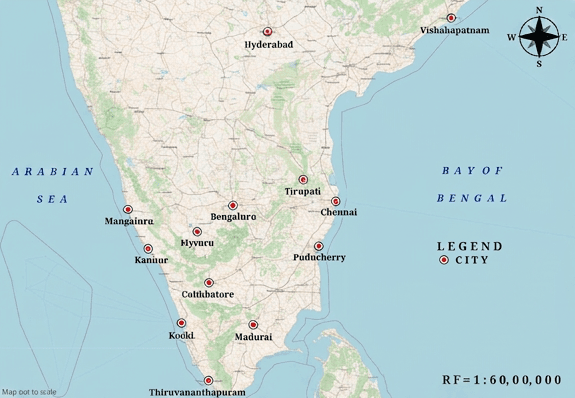
A map scale tells us how much the real world has been shrunk to fit on the map.
Step 1 — Understanding Representative Fraction (RF)
The ratio given on the map is called the Representative Fraction (RF). It shows the relationship between a distance on the map and the actual distance on the ground. The first number, 1, represents a unit of distance on the map. The second number, 60,00,000, represents the same unit of distance on the ground. So, 1 unit on the map equals 60,00,000 units in reality.
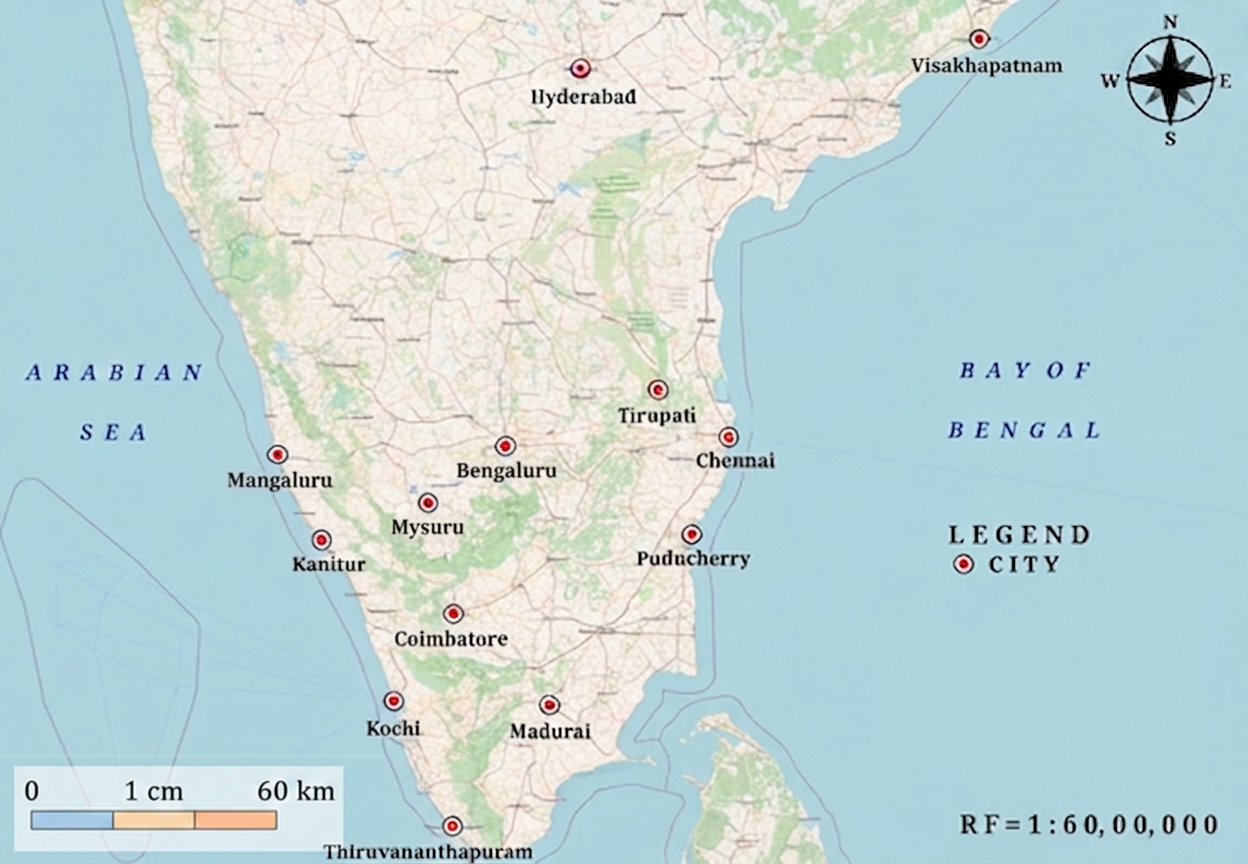
Step 2 — Interpreting RF 1:60,00,000
Let us assume the unit is centimeters (cm). So, 1 cm on the map represents 60,00,000 cm on the ground. We know that 1 meter equals 100 centimeters. We also know that 1 kilometer equals 1000 meters. Therefore, 1 kilometer equals 100,000 centimeters. Now, let us convert 60,00,000 cm into kilometers.
This means that 1 cm measured on the map represents an actual distance of 60 km on the ground. This ratio helps us calculate real distances from map measurements.
Answer
(i) RF 1 : 60,00,000 means that 1 unit of distance on the map represents 60,00,000 units of the same distance on the actual ground. (ii) It indicates the scale of the map. (iii) For example, if we measure 1 centimeter on this map, it corresponds to an actual distance of 60 kilometers on the ground.
More questions in IT
Viswanath made idlis by mixing 6 cups of rice with 3 cups of urad dal, while Puneet made idlis by mixing 4 cups of rice with 2 cups of urad dal. If cooked in the same way, would their idlis taste the same?
Have you noticed that in many maps there is a ratio given, usually in the lower right corner of the map? It usually contains 1 and a very large number, such as 1 : 60,00,000. What does RF 1 : 60,00,000 mean? What does it indicate? Can you guess?
Convert 60,00,000 cm to kilometres.
It is 60 km. Verify this.
Using the map above, can you find the geographical distance between Bengaluru and Chennai? Also, find the geographical distance between Mangaluru and Chennai.
[Hint: Use a ruler to find the distance between the cities on the map. Then, use the ratio given on the map to find the actual geographical distance.]
Try to find the distances between the same two pairs of cities with different maps that have different scales (ratios). Do they all give the same geographical distance, approximately?
Context: Puneeth's father went from Lucknow to Kanpur in 3 hours by riding his motorcycle at a speed of 30 km/h. If he takes a car instead and drives at 60 km/h, how long will it take him to reach Kanpur?
Q. Can we represent this problem with the following statement of proportionality — 30 : 60 :: 3 : x? Will the travel time increase or decrease as the speed of the motorcycle increases?