Question 6
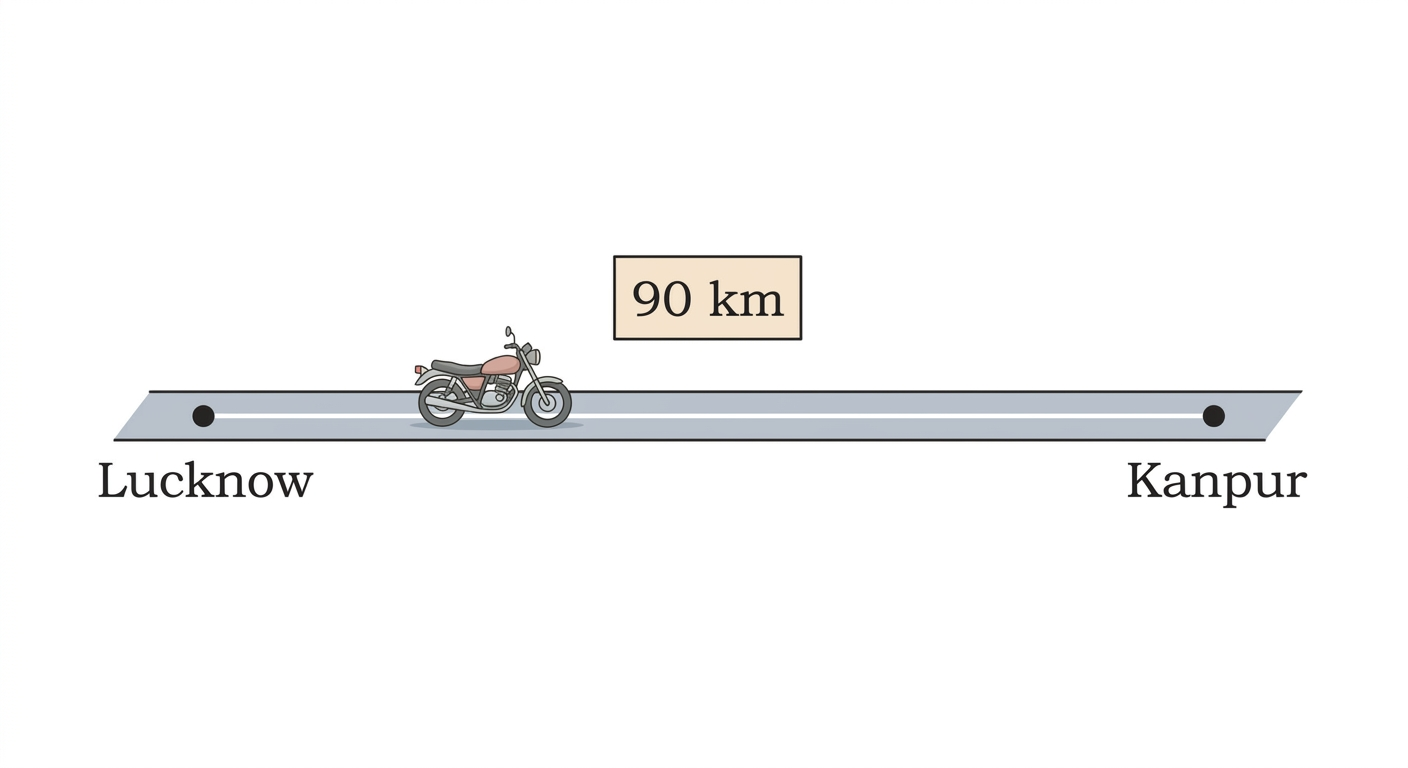
Context: Puneeth's father went from Lucknow to Kanpur in 3 hours by riding his motorcycle at a speed of 30 km/h. If he takes a car instead and drives at 60 km/h, how long will it take him to reach Kanpur?
Q. Can we represent this problem with the following statement of proportionality — 30 : 60 :: 3 : x? Will the travel time increase or decrease as the speed of the motorcycle increases?
When distance is fixed, speed and time are inversely proportional.
Step 1 — Find the total distance
Let us first find the distance between Lucknow and Kanpur. Distance is calculated by multiplying speed and time.
Step 2 — Calculate the new travel time
Puneeth's father now uses a car. Its speed is 60 km/h. The distance remains the same, which is 90 km. Let be the time taken to travel by car.
Step 3 — Evaluate the proportionality statement
The statement shows a direct proportion. It means the speed ratio equals the time ratio. Let us calculate using this statement.
This result (6 hours) differs from the actual time. Speed and time are inversely proportional for a fixed distance. This means as speed increases, time decreases. For inverse proportion, the statement should be . So, the given statement does not represent this problem.
Step 4 — Analyze the effect of increased speed on time
Speed increased from 30 km/h to 60 km/h. The time taken decreased from 3 hours to 1.5 hours. So, travel time decreases as speed increases.
Answer
(i) No, the problem cannot be represented by . (ii) The travel time will decrease as the speed of the motorcycle increases.
More questions in IT
Viswanath made idlis by mixing 6 cups of rice with 3 cups of urad dal, while Puneet made idlis by mixing 4 cups of rice with 2 cups of urad dal. If cooked in the same way, would their idlis taste the same?
Have you noticed that in many maps there is a ratio given, usually in the lower right corner of the map? It usually contains 1 and a very large number, such as 1 : 60,00,000. What does RF 1 : 60,00,000 mean? What does it indicate? Can you guess?
Convert 60,00,000 cm to kilometres.
It is 60 km. Verify this.
Using the map above, can you find the geographical distance between Bengaluru and Chennai? Also, find the geographical distance between Mangaluru and Chennai.
[Hint: Use a ruler to find the distance between the cities on the map. Then, use the ratio given on the map to find the actual geographical distance.]
Try to find the distances between the same two pairs of cities with different maps that have different scales (ratios). Do they all give the same geographical distance, approximately?
Context: Puneeth's father went from Lucknow to Kanpur in 3 hours by riding his motorcycle at a speed of 30 km/h. If he takes a car instead and drives at 60 km/h, how long will it take him to reach Kanpur?
Q. Can we represent this problem with the following statement of proportionality — 30 : 60 :: 3 : x? Will the travel time increase or decrease as the speed of the motorcycle increases?