Question 13
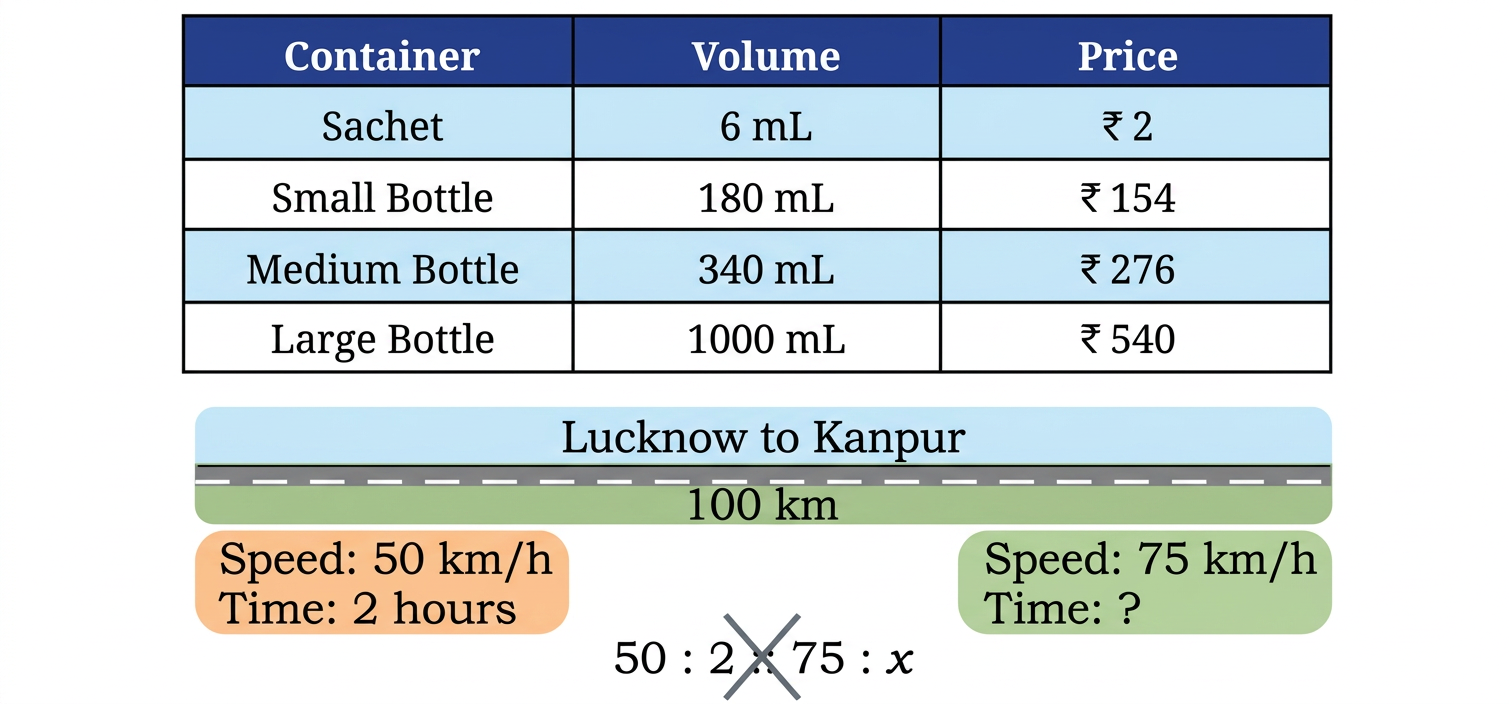
Puneeth’s father went from Lucknow to Kanpur in 2 hours by riding his motorcycle at a speed of 50 km/h. If he drives at 75 km/h, how long will it take him to reach Kanpur? Can we form this problem as a proportion—
Would it take Puneeth’s father more time or less time to reach Kanpur? Think about it.
When the distance traveled is fixed, speed and time are inversely proportional, meaning if one increases, the other decreases.
Step 1 — Understand the relationship
Let us consider how speed and time are connected when the distance between two places remains the same. If Puneeth's father drives his motorcycle at a higher speed, he will take less time to cover the same distance. Conversely, if he drives at a lower speed, it will take him more time. This shows that speed and time have an inverse relationship.
This means their product is constant, which is the distance. So, Speed Time = Distance. We cannot use a direct proportion like because that would imply that as speed increases, time also increases, which is incorrect for a fixed distance.
Step 2 — Calculate the total distance
First, we need to find the distance between Lucknow and Kanpur. We are given the initial speed and the time taken.
Let be the initial speed, which is . Let be the initial time taken, which is . Let be the distance between Lucknow and Kanpur.
Step 3 — Calculate the new time
Now, Puneeth's father drives at a new speed, and we need to find how long it will take him. The distance remains the same.
Let be the new speed, which is . Let be the new time taken.
Since the distance is constant, we can write: . We know that is the distance, which is .
To find , we divide the distance by the new speed.
To express this in hours and minutes, we convert the fraction of an hour to minutes. There are in .
Since the speed increased from to , it will take less time to reach Kanpur. The initial time was , and the new time is , which is indeed less.
Answer
(i) It will take Puneeth’s father less time to reach Kanpur. (ii) The time taken to reach Kanpur at is 1 hour 20 minutes. (iii) We cannot form this problem as a direct proportion like because speed and time are inversely proportional when the distance is constant.
More questions in IT
Q. Which images look similar and which ones look different?
Can you check by what factors the width and height of image D change as compared to image A? Are the factors the same?
By what factor should we multiply the ratio 60 : 40 (image A) to get 90 : 60 (image D)?
In my school, there are 5 teachers and 170 students. The ratio of teachers to students in my school is 5 : 170. Count the number of teachers and students in your school. What is the ratio of teachers to students in your school? Write it below.
Is the teacher-to-student ratio in your school proportional to the one in my school?
Measure the width and height (to the nearest cm) of the blackboard in your classroom. What is the ratio of width to height of the blackboard?
Can you draw a rectangle in your notebook whose width and height are proportional to the ratio of the blackboard?
Compare the rectangle you have drawn to those drawn by your classmates. Do they all look the same?
Context: Manjunath usually mixes 15 mL of coffee decoction with 35 mL of milk to make filter coffee (ratio 15 : 35). For 'stronger' coffee, he mixes 20 mL of decoction with 30 mL of milk (ratio 20 : 30).
Q. Why is this coffee stronger?
Context: Manjunath usually mixes 15 mL of coffee decoction with 35 mL of milk to make filter coffee (ratio 15 : 35). For 'lighter' coffee, he mixes 10 mL of coffee and 40 mL of milk, making the ratio 10 : 40.
Q. Why is this coffee lighter?
The following table shows the different ratios in which Manjunath mixes coffee decoction with milk. Write in the last column if the coffee is stronger or lighter than the regular coffee.
Does the drawing look more realistic if the ratios are proportional? Why? Why not?
Puneeth’s father went from Lucknow to Kanpur in 2 hours by riding his motorcycle at a speed of 50 km/h. If he drives at 75 km/h, how long will it take him to reach Kanpur? Can we form this problem as a proportion—
Would it take Puneeth’s father more time or less time to reach Kanpur? Think about it.
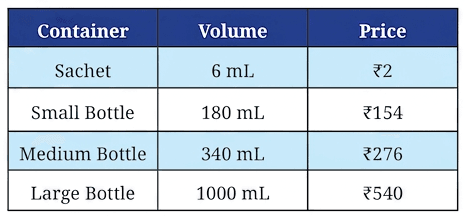
Context: The volume of a sachet is 6 mL and its price is ₹2. The volume of a small bottle is 180 mL and its price is ₹154. The ratio of the volume of a sachet to a small bottle is 6 : 180. The ratio of their prices is 2 : 154.
Q. Why do you think that the ratio of the prices is not proportional to the ratio of the volumes?
Context: You have 12 countable objects or counters to share between the two of you.
Q. If you divide them equally, what is the ratio of the number of counters with each of you?
Context: You have 12 countable objects or counters to share between the two of you.
Q. If your partner gets 5 counters, how many objects will you get? What is the ratio of the counters?