Question 6
Place an object in front of a plane, such as a wall of your room. Shine a torch light on the object in a direction perpendicular to the wall.
What do you see?
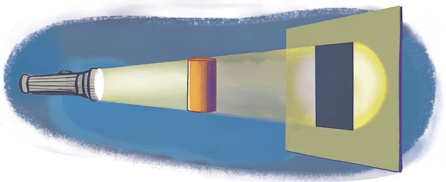
An opaque object blocks light, creating a shadow on the surface behind it.
Step 1 — Light Path and Obstruction
Let us consider the setup. We have a torch and an object. The object is placed in front of a wall. The torch emits light rays. These light rays travel in straight lines. The object is opaque (meaning light cannot pass through it). So, the object blocks some of the light rays.
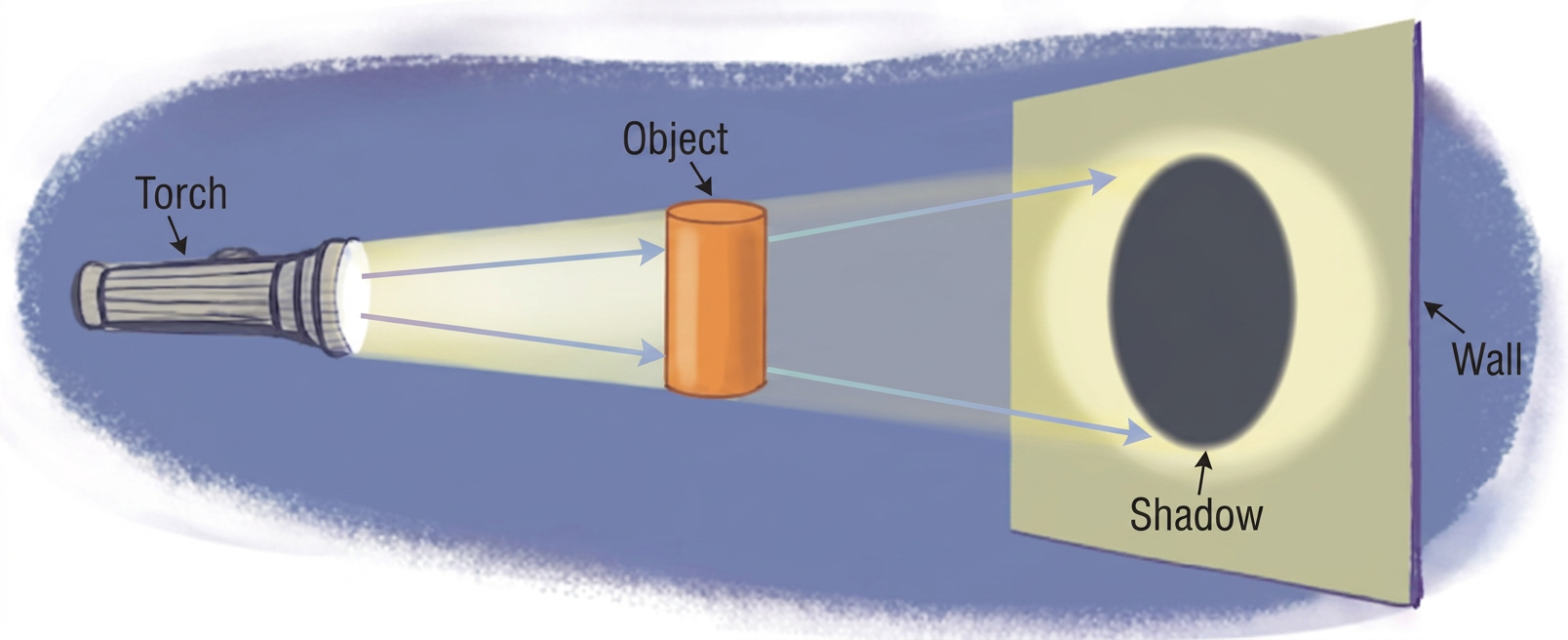
Step 2 — Shadow Formation
The light rays blocked by the object cannot reach the wall. This creates an area on the wall where no light falls. This area appears dark. We call this dark area a shadow. The shadow's shape will be the outline of the object. The shadow's size depends on the object's distance. It also depends on the distance from the torch to the wall.
Answer
We see a dark region on the wall. This dark region is the shadow of the object. The shadow will be rectangular, matching the profile of the cylindrical object.
More questions in A
Build it in Your Imagination
We will start this section by practising visualisation. For each prompt, feel free to talk to your partner, gesture, draw it in the air — but do not actually draw on paper!
- Picture your name, then read off the letters backwards. Make sure to do this by sight, not by sound — really see your name! Now try with your friend's name.
Cut off the four corners of an imaginary square, with each cut going between midpoints of adjacent edges. What shape is left over? How can you reassemble the four corners to make another square?
Mark the sides of an equilateral triangle into thirds. Cut off each corner of the triangle, as far as the marks. What shape do you get?
Mark the sides of a square into thirds and cut off each of its corners as far as the marks. What shape is left?
Net of a sphere? Experiment and see if you can make a paper cutout that can perfectly wrap around a ball without leaving any wrinkles, gaps or overlaps.
Place an object in front of a plane, such as a wall of your room. Shine a torch light on the object in a direction perpendicular to the wall.
What do you see?
Observe what happens to the size of the shadow as you vary the distance between your torch and your object.
Context: Observe what happens to the size of the shadow as you vary the distance between your torch and your object.
Q. Why does this happen?
Construct a model of a cube and use your hands to keep it balanced on one corner vertex. Can you try to understand why all the projected edges have equal length?