Question 7
Do you see a way of extending this method to represent bigger numbers as well? How?
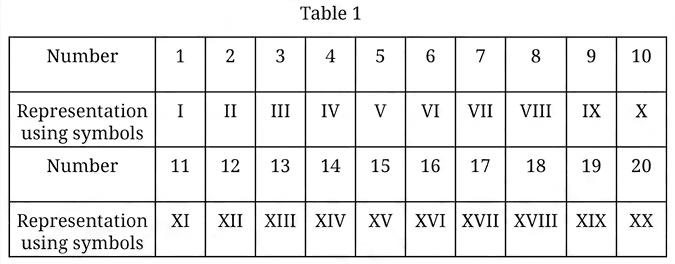
Yes, we can extend this method by understanding the basic Roman numeral symbols and the rules for combining them.
Step 1 — Basic Roman Numeral Symbols
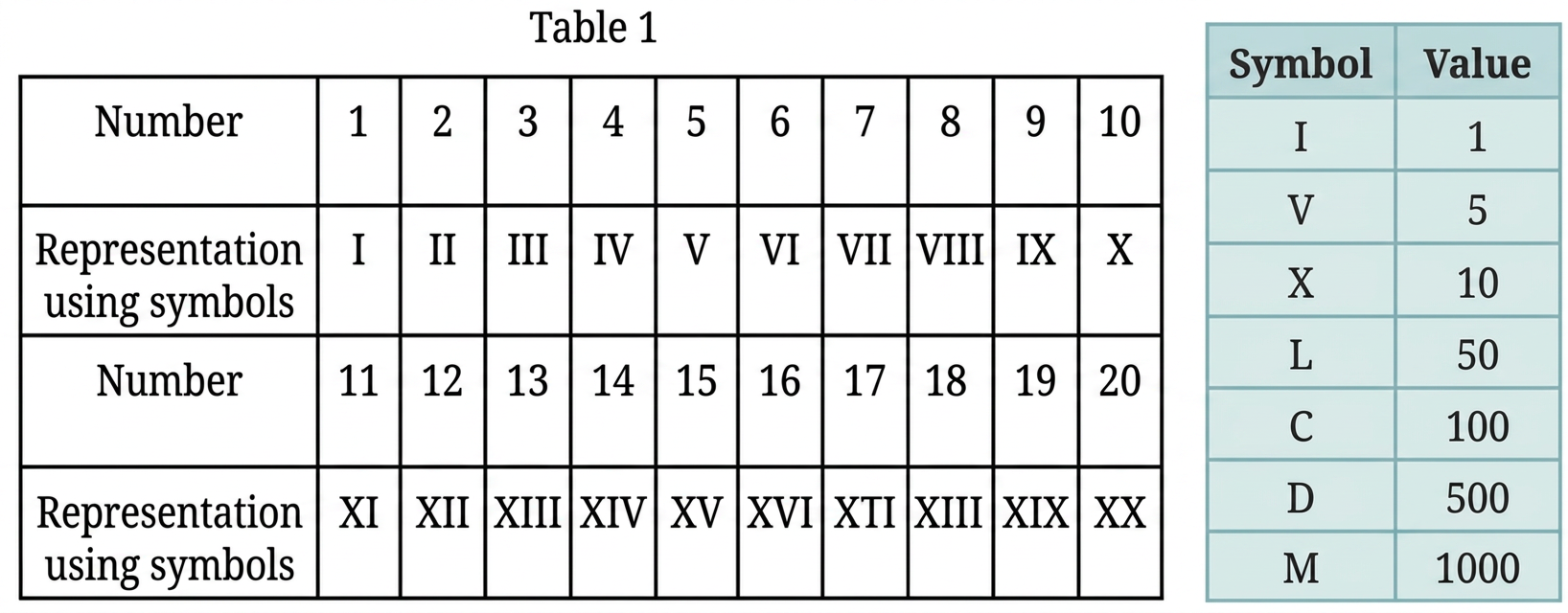
Let us first list the fundamental Roman numeral symbols and their corresponding values. These are the building blocks for all Roman numerals.
I = 1 V = 5 X = 10 L = 50 C = 100 D = 500 M = 1000
Step 2 — Rules for Combining Symbols
We combine these symbols using specific rules to form larger numbers.
Rule 1: Repetition A symbol can be repeated up to three times to add its value. For example, III means . XX means . CCC means . Symbols V, L, and D are never repeated.
Rule 2: Addition (Right Placement) If a symbol of smaller value is placed to the right of a symbol of larger value, their values are added. For example, VI means . LX means . MC means .
Rule 3: Subtraction (Left Placement) If a symbol of smaller value is placed to the left of a symbol of larger value, the smaller value is subtracted from the larger value. Only I, X, and C can be used for subtraction. I can be subtracted from V and X. IV means . IX means . X can be subtracted from L and C. XL means . XC means . C can be subtracted from D and M. CD means . CM means . Symbols V, L, and D are never used for subtraction.
Step 3 — Representing Larger Numbers
We apply these rules to represent any number. Let us represent some numbers larger than 20.
For example, to represent 21, we combine XX (20) and I (1).
To represent 49, we use XL (40) and IX (9).
To represent 1994, we break it down into thousands, hundreds, tens, and ones. So, .
For very large numbers, a bar placed over a numeral multiplies its value by 1,000. For example, means . means . means .
Answer
Yes, we can extend this method to represent bigger numbers. We use basic symbols (I, V, X, L, C, D, M) and rules for combining them. (i) Repetition: A symbol (I, X, C, M) can be repeated up to three times to add its value (e.g., III = 3). (ii) Addition: A smaller value symbol to the right of a larger value symbol means addition (e.g., VI = 6). (iii) Subtraction: A smaller value symbol (I, X, C) to the left of a larger value symbol means subtraction (e.g., IV = 4, XL = 40, CD = 400). (iv) Bar Notation: A bar over a numeral multiplies its value by 1,000 (e.g., = 5,000).
More questions in IT
Q. Reema's curiosity was sparked, and questions started swirling in her head:
(i) Since when have humans been counting?
(ii) What was their need for counting? What were they counting?
(iii) Since when have people been writing numbers in the modern form?
(iv) How would the Mesopotamians have written 20? 50? 100?
Context: Imagine that we are living in the Stone Age, say, around ten thousand years ago. Suppose we have a herd of cows.
Q. How do we ensure that all cows have returned safely after grazing?
Context: Imagine that we are living in the Stone Age, say, around ten thousand years ago. Suppose we have a herd of cows.
Q. Do we have fewer cows than our neighbour?
Context: Imagine that we are living in the Stone Age, say, around ten thousand years ago. Suppose we have a herd of cows.
Q. If there are fewer, how many more cows would we need so that we have the same number of cows as our neighbour?
Context: Suppose we have a herd of cows. We want to answer the following questions: Q2. Do we have fewer cows than our neighbour? Q3. If there are fewer, how many more cows would we need so that we have the same number of cows as our neighbour?
Q. How will you use such sticks to answer the other two questions (Q2 and Q3)?
How many numbers can you represent in this way using the sounds of the letters of your language?
Do you see a way of extending this method to represent bigger numbers as well? How?
Context: A group of indigenous people in Australia called the Gumulgal had the following words for their numbers:
- urapon
- ukasar
- ukasar-urapon
- ukasar-ukasar
- ukasar-ukasar-urapon
- ukasar-ukasar-ukasar
Q. Can you see how their number names are formed?
Context: A group of indigenous people in Australia called the Gumulgal had the following words for their numbers:
- urapon
- ukasar
- ukasar-urapon
- ukasar-ukasar
- ukasar-ukasar-urapon
- ukasar-ukasar-ukasar
Q. Can you see how the names of the other numbers are formed?
What could be the difficulties with using a number system that counts only in groups of a single particular size? How would you represent a number like 1345 in a system that counts only by 5s?
Do it yourself now:
(b) LXXXVII + LXXVIII
How will you multiply two numbers given in Roman numerals, without converting them to Hindu numerals? Try to find the product of the following pairs of landmark numbers: V × L, L × D, V × D, VII × IX.
Instead of grouping together 10 collections of size equal to the previous landmark number (as in the case of the Egyptian system), can we get a number system by grouping together 5 collections of size equal to the previous landmark number? Can this 5 be replaced by any positive integer?
What is any landmark number multiplied by (that is 10)? Find the following products—
Each landmark number is a power of 10 and so multiplying it with 10 increases the power by 1, which is the next landmark number.
What is any landmark number multiplied by ()? Find the following products—
Find the following products—
Thus, the product of any two landmark numbers is another landmark number!
Context: Thus, the product of any two landmark numbers is another landmark number!
Q. Does this property hold true in the base-5 system that we created? Does this hold for any number system with a base?
Now find the following products—
What would be a simple rule to multiply a number with ∩?
Context: To get an idea of how the abacus was used for calculations, let us consider a simple addition problem: 2907 + 43. The two numbers were taken on either side of the vertical partition.
Q. How would you use this to find the sum?
Context: To get an idea of how the abacus was used for calculations, let us consider a simple addition problem: 2907 + 43. The two numbers were taken on either side of the vertical partition. The counters along each line were brought together.
Q. What is to be done if the total in a line exceeded 10?
Look at the representation of 60. What will be the representation for 3,600?
How is this to be read?
Represent the following numbers using the Mayan system:
(i) 77 (ii) 100 (iii) 361 (iv) 721
Where does the Hindu/Indian number system figure in the evolution of ideas of number representation? What are its landmark numbers? And does it use a place value system?