Question 7
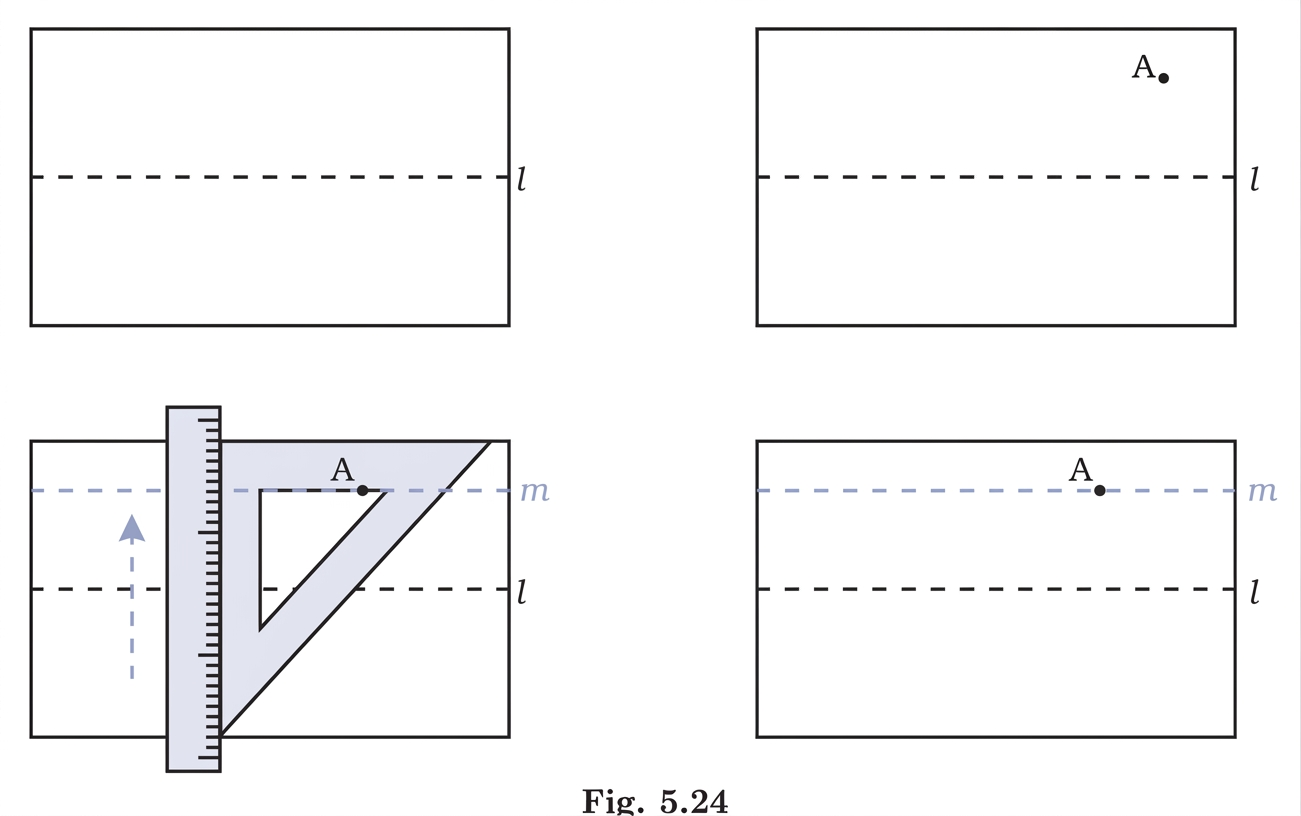
Can you draw a line parallel to , that goes through point A? How will you do it with the tools from your geometry box? Describe your method.
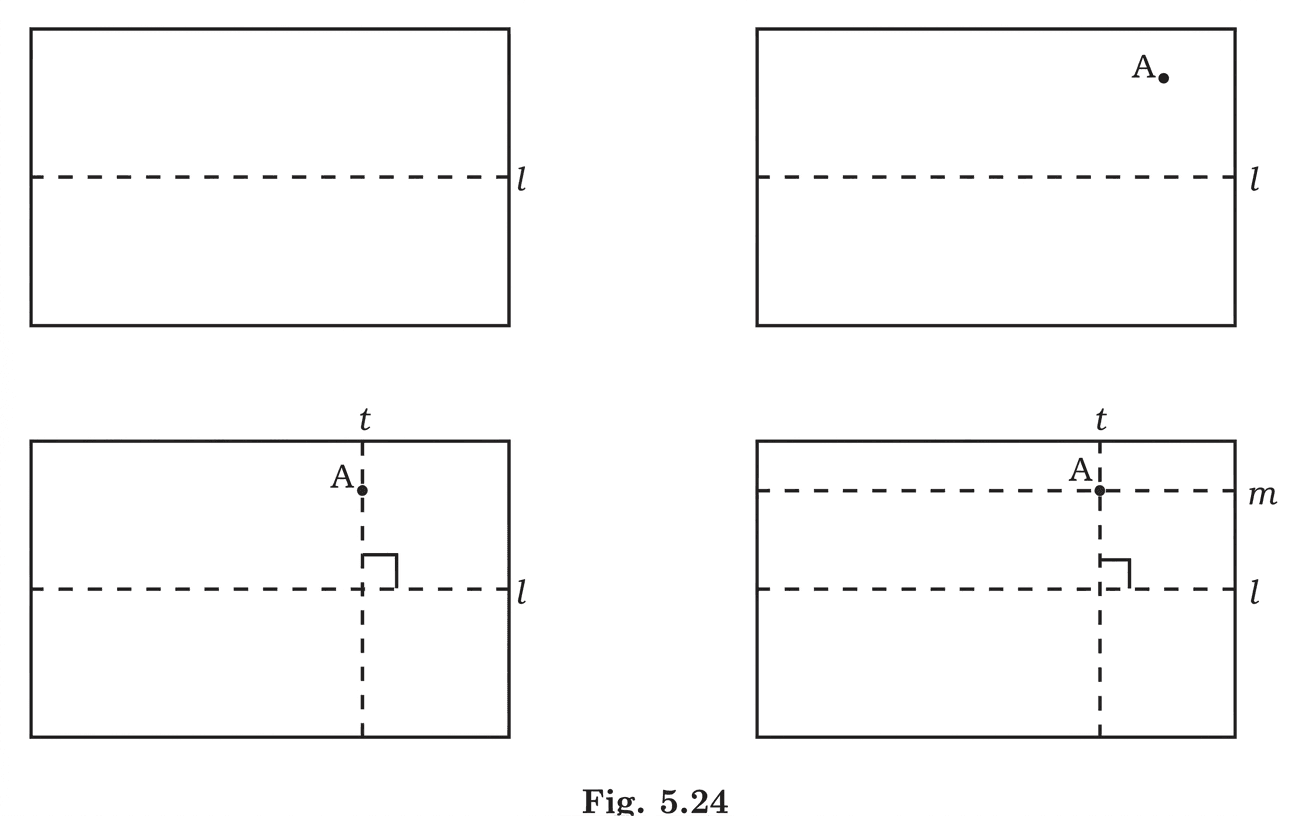
We can draw a parallel line using a set square and a ruler.
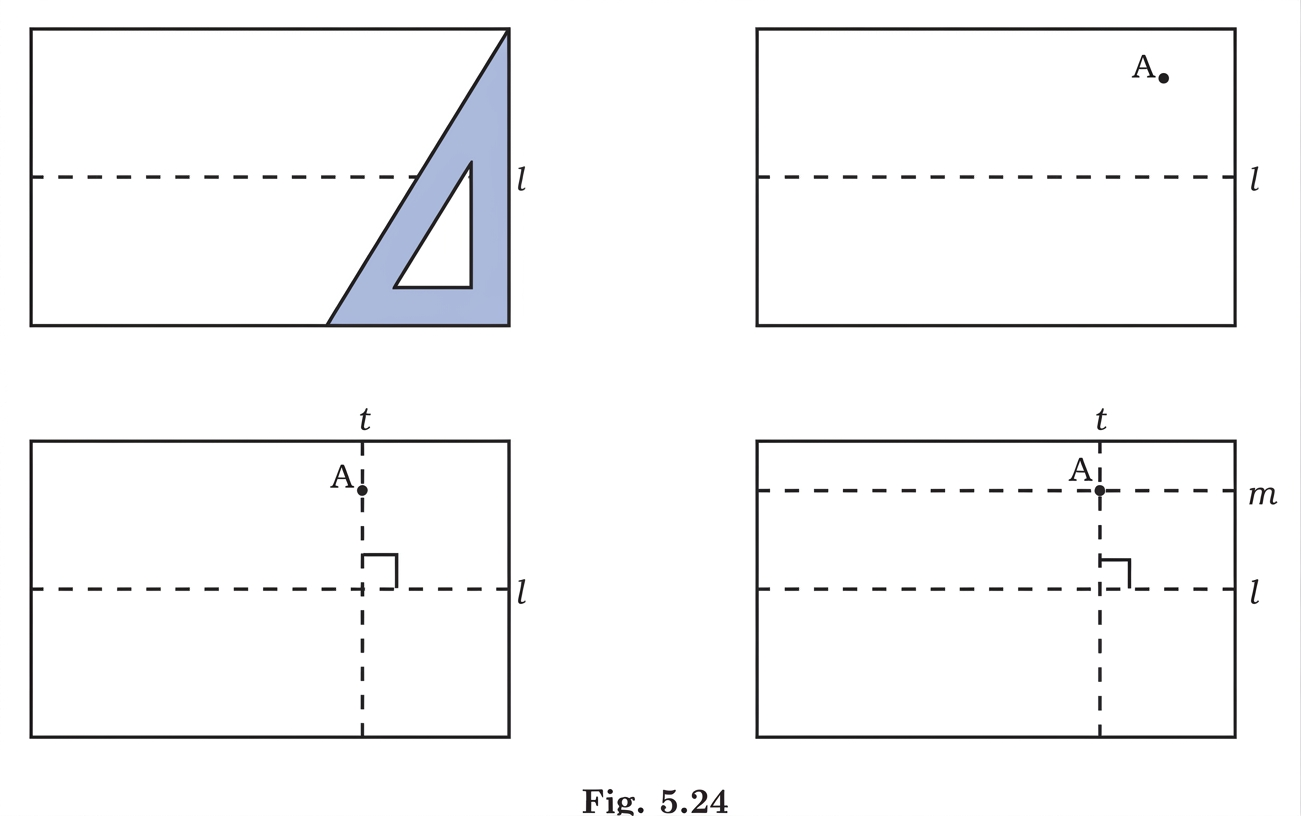
Step 1 — Align the set square Place one straight edge of the set square exactly on line . Make sure the edge is perfectly aligned.
Step 2 — Position the ruler Hold a ruler against the other straight edge of the set square. This edge is usually the longer one. The ruler must not move during the next step.
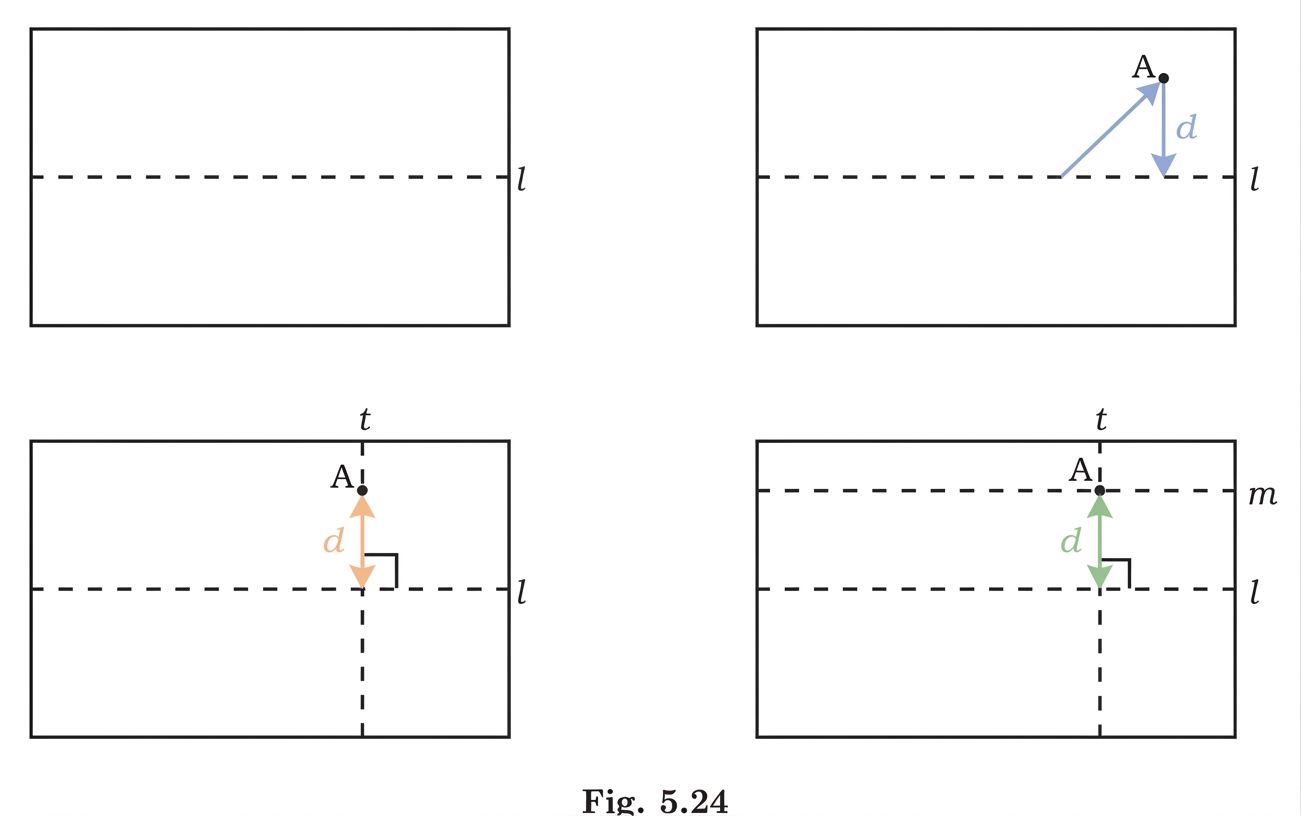
Step 3 — Slide the set square Keep the ruler completely still. Carefully slide the set square along the ruler. Move it until the first edge reaches point A. Point A should be on the set square's edge.
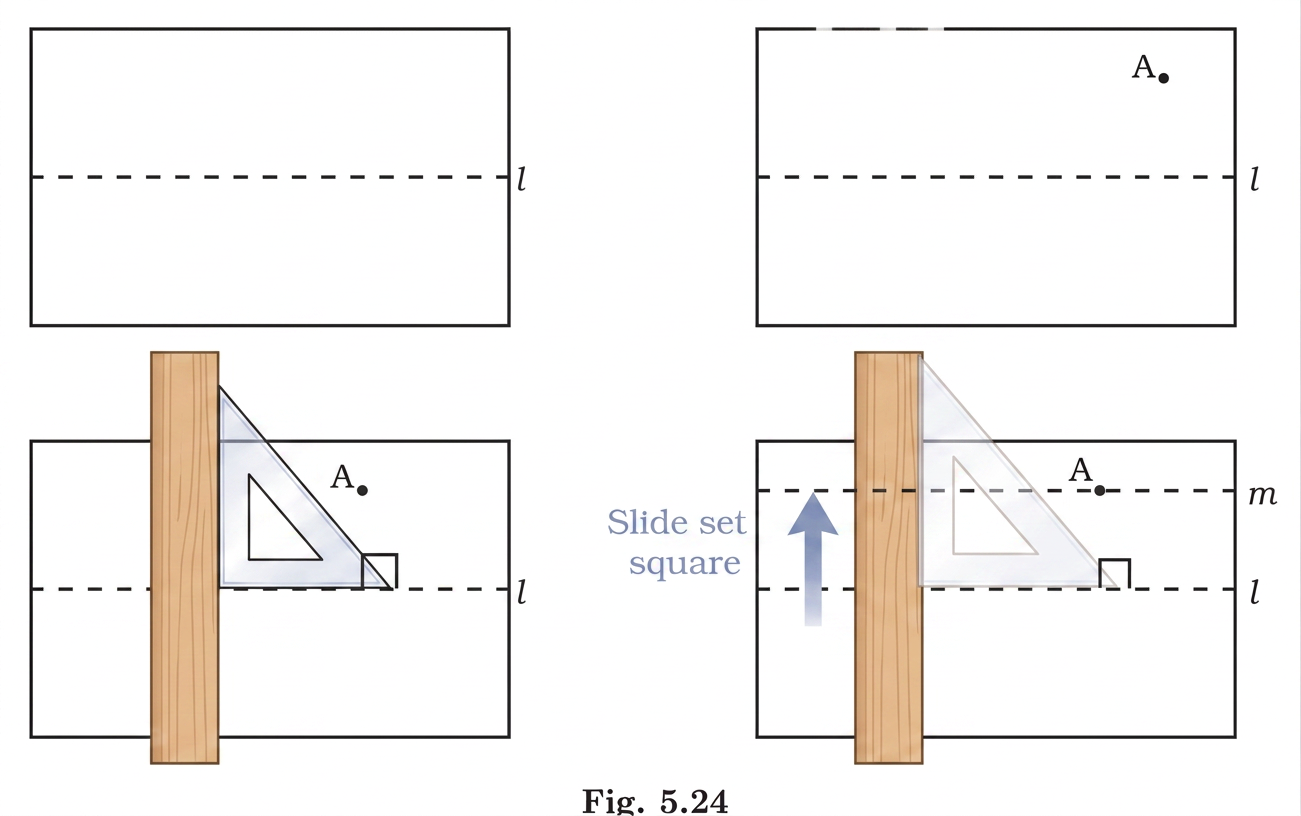
Step 4 — Draw the parallel line Hold the set square firmly in its new position. Use a pencil to draw a line along this edge. This line passes through point A. This new line is parallel to line .
Answer
(i) Tools needed: Ruler, Set-square, Pencil (ii) Method:
- Place one side of the set square along line .
- Hold the ruler against the other side of the set square.
- Slide the set square along the ruler until one side reaches point A.
- Draw a line along this edge of the set square through point A.
- This new line is parallel to and passes through A.
More questions in FIO
List all the linear pairs and vertically opposite angles you observe in Fig. 5.3:
Draw some lines perpendicular to the lines given on the dot paper in Fig. 5.10.
In Fig. 5.11, mark the parallel lines using the notation given above (single arrow, double arrow etc.). Mark the angle between perpendicular lines with a square symbol.
(a) How did you spot the perpendicular lines?
(b) How did you spot the parallel lines?
In the dot paper following, draw different sets of parallel lines. The line segments can be of different lengths but should have dots as endpoints.
Using your sense of how parallel lines look, try to draw lines parallel to the line segments on this dot paper.
(a) Did you find it challenging to draw some of them? (b) Which ones? (c) How did you do it?
In Fig. 5.13, which line is parallel to line a — line b or line c? How do you decide this?
Can you draw a line parallel to , that goes through point A? How will you do it with the tools from your geometry box? Describe your method.
Find the angles marked below.
Find the angle represented by .
In the figures below, what angles do and stand for?
In Fig. 5.33, and . Find angles , ,
In Fig. 5.34, is parallel to CD and CD is parallel to EF. Also, EA is perpendicular to AB. If , find the values of and .
What is the measure of angle in Fig. 5.35?
[Hint: Draw lines parallel to LM and PQ through points N and O.]