Question 3
Using your understanding of the pictorial representation of odd and even numbers, find out the parity of the following sums:
(a) Sum of 2 even numbers and 2 odd numbers (e.g., even + even + odd + odd)
(b) Sum of 2 odd numbers and 3 even numbers
(c) Sum of 5 even numbers
(d) Sum of 8 odd numbers
We can understand odd and even numbers by thinking about pairs.
Step 1 — Understanding Even and Odd Numbers
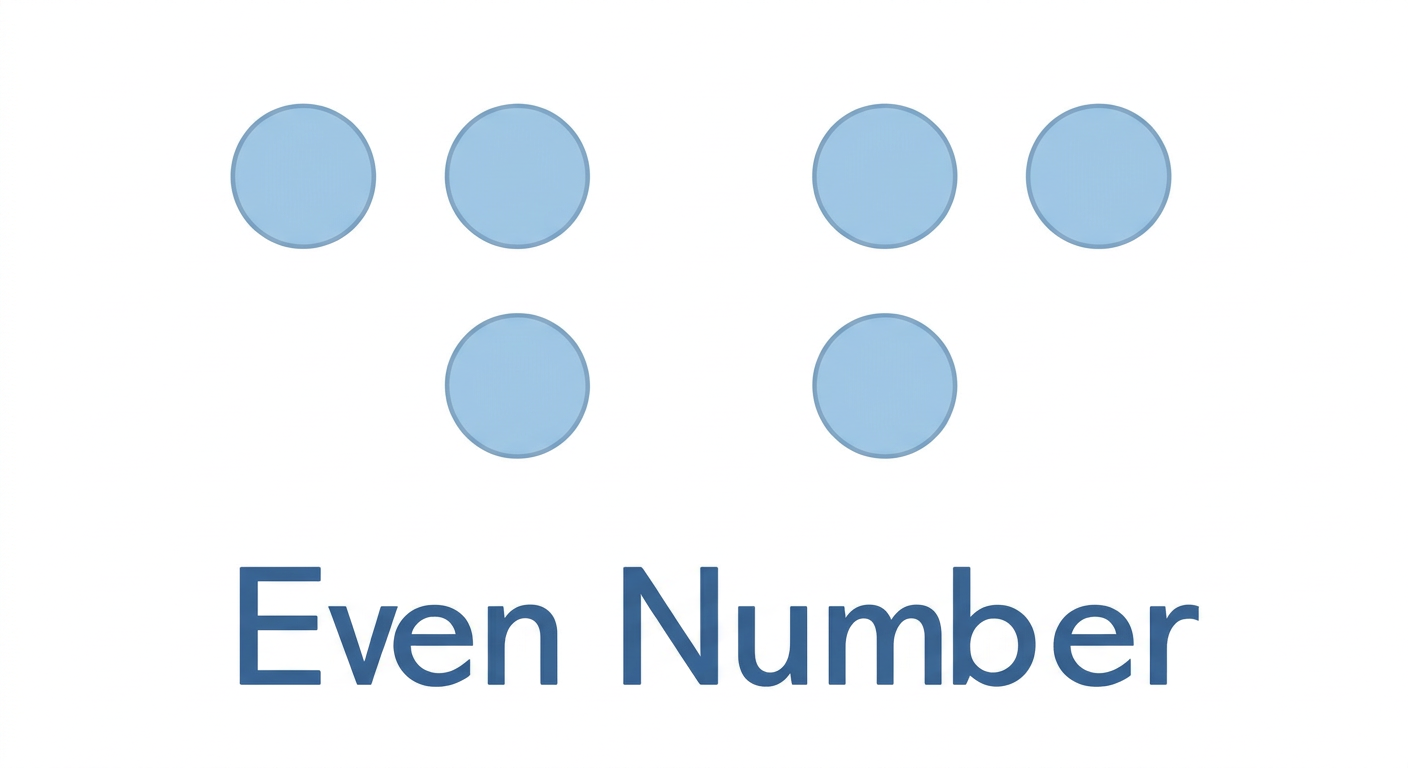
An even number can be split into perfect pairs. There are no items left over. For example, the number 4 can be seen as two pairs.
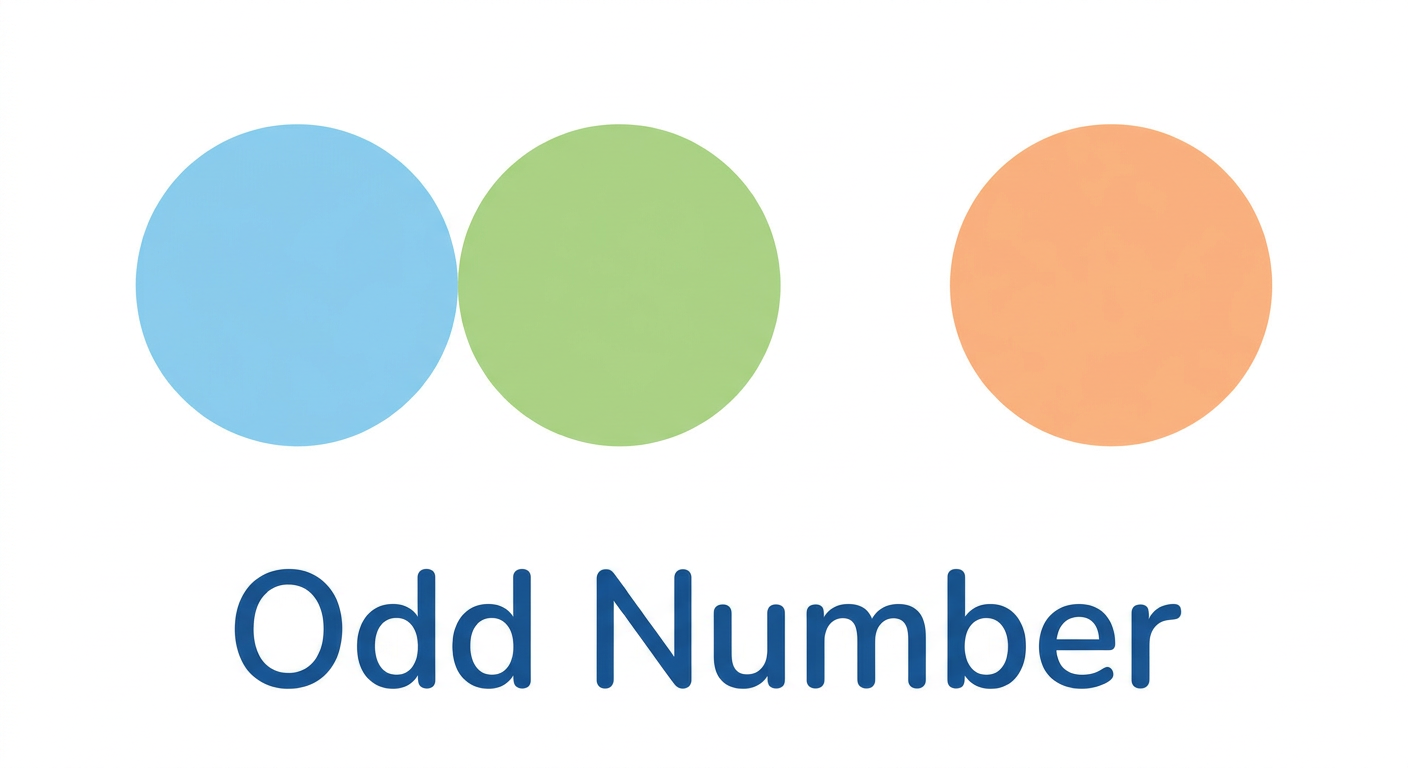
An odd number can be split into pairs. But one item is always left over. For example, the number 3 has one pair. One item is left over.
Step 2 — Adding Even and Odd Numbers
Let us see what happens when we add them.
Case 1: Even + Even We combine two groups with no leftovers. The total will have no leftovers. So, Even + Even = Even. Example: .
Case 2: Odd + Odd We combine two groups. Each group has one leftover. The two leftovers form a new pair. So, the total will have no leftovers. So, Odd + Odd = Even. Example: .
Case 3: Even + Odd We combine a group with no leftovers. We combine it with a group with one leftover. The total will have one leftover. So, Even + Odd = Odd. Example: .
Now we will use these rules to find the parity of the given sums.
Step 3 — Parity of Sum (a)
We need to find the parity of the sum of 2 even numbers and 2 odd numbers. Let us add the two even numbers first. Even + Even = Even.
Next, let us add the two odd numbers. Odd + Odd = Even.
Now we add these two results. Even (from the even numbers) + Even (from the odd numbers) = Even.
The parity of the result is even. Example: . This is an even number.
Step 4 — Parity of Sum (b)
We need to find the parity of the sum of 2 odd numbers and 3 even numbers. Let us add the two odd numbers first. Odd + Odd = Even.
Next, let us add the three even numbers. Even + Even = Even. Then, Even (from the first two evens) + Even (the third even) = Even. So, the sum of 3 even numbers is Even.
Now we add these two results. Even (from the odd numbers) + Even (from the even numbers) = Even.
The parity of the result is even. Example: . This is an even number.
Step 5 — Parity of Sum (c)
We need to find the parity of the sum of 5 even numbers. We know that Even + Even = Even. We can keep adding even numbers. Even + Even + Even + Even + Even. The sum of any number of even numbers will always be Even.
The parity of the result is even. Example: . This is an even number.
Step 6 — Parity of Sum (d)
We need to find the parity of the sum of 8 odd numbers. We know that Odd + Odd = Even. We have 8 odd numbers. We can group them into pairs. There will be 4 pairs of odd numbers. (Odd + Odd) + (Odd + Odd) + (Odd + Odd) + (Odd + Odd).
Each pair (Odd + Odd) gives an Even number. So, we have Even + Even + Even + Even.
The sum of these 4 even numbers will be Even.
The parity of the result is even. Example: . This is an even number.
Answer
(a) The parity of the result is even. (b) The parity of the result is even. (c) The parity of the result is even. (d) The parity of the result is even.
More questions in FIO
Arrange the stick figure cutouts given at the end of the book or draw a height arrangement such that the sequence reads:
(a) 0, 1, 1, 2, 4, 1, 5
(b) 0, 0, 0, 0, 0, 0, 0
(c) 0, 1, 2, 3, 4, 5, 6
(d) 0, 1, 0, 1, 0, 1, 0
(e) 0, 1, 1, 1, 1, 1, 1
(f) 0, 0, 0, 3, 3, 3, 3
For each of the statements given below, think and identify if it is Always True, Only Sometimes True, or Never True. Share your reasoning.
(a) If a person says '0', then they are the tallest in the group.
(b) If a person is the tallest, then their number is '0'.
(c) The first person's number is '0'.
(d) If a person is not first or last in line (i.e., if they are standing somewhere in between), then they cannot say '0'.
(e) The person who calls out the largest number is the shortest.
(f) What is the largest number possible in a group of 8 people?
Using your understanding of the pictorial representation of odd and even numbers, find out the parity of the following sums:
(a) Sum of 2 even numbers and 2 odd numbers (e.g., even + even + odd + odd)
(b) Sum of 2 odd numbers and 3 even numbers
(c) Sum of 5 even numbers
(d) Sum of 8 odd numbers
Lakpa has an odd number of ₹1 coins, an odd number of ₹5 coins and an even number of ₹10 coins in his piggy bank. He calculated the total and got ₹205. Did he make a mistake? If he did, explain why. If he didn't, how many coins of each type could he have?
We know that:
(a) even + even = even
(b) odd + odd = even
(c) even + odd = odd
Similarly, find out the parity for the scenarios below:
(d) even - even = _________
(e) odd - odd = _________
(f) even - odd = _________
(g) odd - even = _________
How many different magic squares can be made using the numbers 1 – 9?
Create a magic square using the numbers 2 – 10. What strategy would you use for this? Compare it with the magic squares made using 1 – 9.
Take a magic square, and
(a) increase each number by 1
(b) double each number
In each case, is the resulting grid also a magic square? How do the magic sums change in each case?
What other operations can be performed on a magic square to yield another magic square?
Discuss ways of creating a magic square using any set of 9 consecutive numbers (like 2 – 10, 3 – 11, 9 – 17, etc.).
Using this generalised form, find a magic square if the centre number is 25.
What is the expression obtained by adding the 3 terms of any row, column or diagonal?
Write the result obtained by— (a) adding 1 to every term in the generalised form. (b) doubling every term in the generalised form
Create a magic square whose magic sum is 60.
Is it possible to get a magic square by filling nine non-consecutive numbers?
A light bulb is ON. Dorjee toggles its switch 77 times. Will the bulb be on or off? Why?
Liswini has a large old encyclopaedia. When she opened it, several loose pages fell out of it. She counted 50 sheets in total, each printed on both sides. Can the sum of the page numbers of the loose sheets be 6000? Why or why not?
Here is a 2 × 3 grid. For each row and column, the parity of the sum is written in the circle; 'e' for even and 'o' for odd. Fill the 6 boxes with 3 odd numbers ('o') and 3 even numbers ('e') to satisfy the parity of the row and column sums.
Make a 3 × 3 magic square with 0 as the magic sum. All numbers can not be zero. Use negative numbers, as needed.
Fill in the following blanks with 'odd' or 'even':
(a) Sum of an odd number of even numbers is ______
(b) Sum of an even number of odd numbers is ______
(c) Sum of an even number of even numbers is ______
(d) Sum of an odd number of odd numbers is ______
What is the parity of the sum of the numbers from 1 to 100?
Two consecutive numbers in the Virahāṅka sequence are 987 and 1597. What are the next 2 numbers in the sequence? What are the previous 2 numbers in the sequence?
Angaan wants to climb an 8-step staircase. His playful rule is that he can take either 1 step or 2 steps at a time. For example, one of his paths is 1, 2, 2, 1, 2. In how many different ways can he reach the top?
What is the parity of the 20th term of the Virahāṅka sequence?
Identify the statements that are true.
(a) The expression always gives odd numbers. (b) All even numbers can be expressed as . (c) Both expressions and describe all odd numbers. (d) The expression gives both even and odd numbers.
Solve this cryptarithm: