Question 19
Context: Does a triangle exist with sidelengths , and ? This satisfies the triangle inequality:
Q. Why do we not need to check the other two sides?
We need to understand the triangle inequality rule.
Step 1 — Recall the Triangle Inequality
Let us call the three side lengths , , and . The triangle inequality has three rules. Each rule checks if two sides are longer than the third. Let us write these rules down.
We have side lengths of 4 cm, 5 cm, and 8 cm. Let us assign these to , , and . Let . Let . Let .
Now we check each rule.
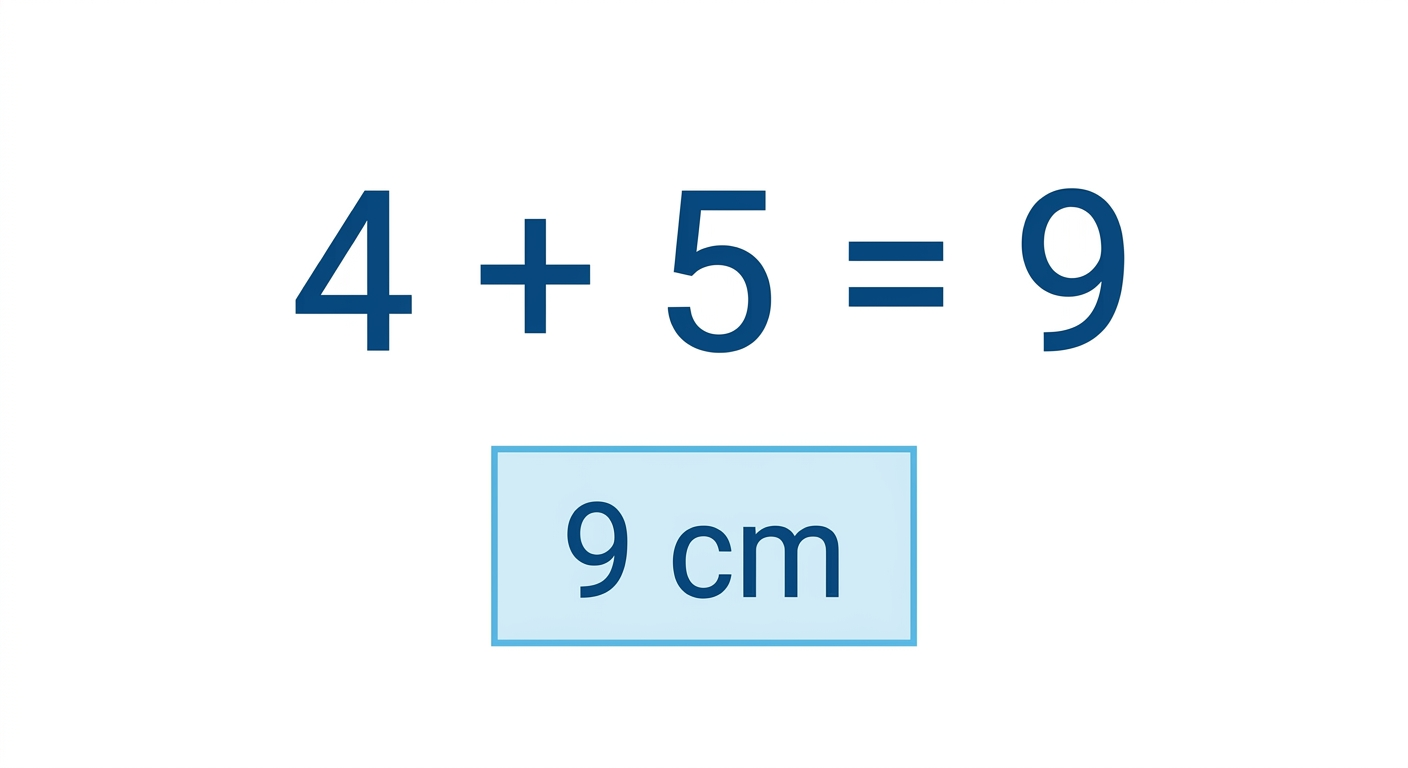
First, we check if is greater than . This means we check 4 cm plus 5 cm. Is this sum greater than 8 cm?
So, 9 cm is greater than 8 cm. The first rule is satisfied.
Next, we check if is greater than . This means we check 4 cm plus 8 cm. Is this sum greater than 5 cm?
So, 12 cm is greater than 5 cm. The second rule is satisfied.
Finally, we check if is greater than . This means we check 5 cm plus 8 cm. Is this sum greater than 4 cm?
So, 13 cm is greater than 4 cm. The third rule is satisfied. All three rules are satisfied. So, a triangle with these sides exists.
Step 2 — The Key Insight
Let us look at the side lengths again. They are 4 cm, 5 cm, and 8 cm. The longest side is 8 cm. The two shorter sides are 4 cm and 5 cm.
The triangle inequality has a key condition. The sum of the two shorter sides is important. This sum must be greater than the longest side.
Let us call the shortest side . Let us call the middle side . Let us call the longest side .
We need to check if . For our triangle, this is 4 cm + 5 cm > 8 cm. This gives 9 cm > 8 cm, which is true.
Now consider the other two conditions. One condition is . We know that is already greater than . Also, is a positive length. So, will always be greater than .
The last condition is . We know that is already greater than . Also, is a positive length. So, will always be greater than .
This means we only need to check one condition. We only check if . The other two conditions will always be true. This happens because is the biggest side. Adding any positive side to makes the sum larger. This sum will always be greater than or .
Answer
(i) We do not need to check the other two sides because if the sum of the two shorter sides is greater than the longest side, the other two conditions are automatically satisfied.
More questions in IT
What happens when the three vertices lie on a straight line?
Construct a triangle in which all the sides are of length 4 cm.
Context: Construct a triangle in which all the sides are of length 4 cm.
Q. How did you construct this triangle and what tools did you use? Can this construction be done only using a marked ruler (and a pencil)?
Q. How do we make this construction more efficient?
Context: Step 2: Construct another arc of radius from . Let be the point of intersection of the arcs.
Q. The construction ensures that both and are of length . Can you see why?
-
How do we construct triangles that are not equilateral?
-
Construct a triangle of sidelength 4 cm, 5 cm and 6 cm.
Context: Construct a triangle of sidelength 4 cm, 5 cm and 6 cm.
Q. How do we construct this triangle more efficiently?
Construct
Construct triangles having the following sidelengths (all the units are in cm):
(a) 4, 4, 6
(b) 3, 4, 5
(c) 1, 5, 5
(d) 4, 6, 8
(e) 3.5, 3.5, 3.5
Construct a triangle with sidelengths 3 cm, 4 cm, and 8 cm.
What is happening? Are you able to construct the triangle?
Here is another set of lengths: 2 cm, 3 cm, and 6 cm. Check if a triangle is possible for these sidelengths.
Try to find more sets of lengths for which a triangle construction is impossible. See if you can find any pattern in them.
Context: Clearly, the direct straight-line path from the tent to the tree is shorter than the roundabout path via the pole. In fact, the direct straight-line path is the shortest possible path to the tree from the tent. Will the direct path between any two points be shorter than the roundabout path via a third point? Clearly, the answer is yes.
Q. Can this understanding be used to tell something about the existence of a triangle having sidelengths , and ?
Can we say anything about the existence of a triangle having sidelengths 3 cm, 3 cm and 7 cm? Verify your answer by construction.
In the rough diagram in Fig. 7.4, is it possible to assign lengths in a different order such such that the direct paths are always coming out to be shorter than the roundabout paths? If this is possible, then a triangle might exist.
Context: "In the rough diagram in Fig. 7.4, is it possible to assign lengths in a different order such that the direct paths are always coming out to be shorter than the roundabout paths? If this is possible, then a triangle might exist."
Q. Is such rearrangement of lengths possible in the triangle?
Will this always happen? That is, for any set of lengths, will there be at least two comparisons where the direct length is less than the sum of the other two? Explore for different sets of lengths.
Further, for a given set of lengths, is it possible to identify which lengths will immediately be less than the sum of the other two, without calculations?
[Hint: Consider the direct lengths in the increasing order.]
Given three sidelengths, what do we need to compare to check for the existence of a triangle?
Context: Does a triangle exist with sidelengths , and ? This satisfies the triangle inequality:
Q. Why do we not need to check the other two sides?
Now, suppose that a circle of radius 5 cm is constructed, centred at B. Can you draw a rough diagram of the resulting figure?
Will triangles always exist when a set of lengths satisfies the triangle inequality? How can we be sure?
Q. Let us study each of these cases by finding the relation between the radii (the smaller two lengths) and AB (longest length).
Context: Case 2: Circles do not intersect internally
Q. For this case to happen, what should be the relation between the radii and AB?
Can we use this analysis to tell if a triangle exists when the lengths satisfy the triangle inequality?
How will the two circles turn out for a set of lengths that do not satisfy the triangle inequality? Find 3 examples of sets of lengths for which the circles:
(a) touch each other at a point,
(b) do not intersect.
Frame a complete procedure that can be used to check the existence of a triangle.
We have seen that triangles do not exist for all sets of sidelengths. Is there a combination of measurements in the case of two sides and the included angle where a triangle is not possible? Justify your answer using what you observe during construction.
Do triangles exist for every combination of two angles and their included side? Explore.
Find examples of measurements of two angles with the included side where a triangle is not possible.
It is clear that if the line from B is "inclined" sufficiently to the right, then it will not meet the line .
(a) Try to find a possible (marked in the figure) for this to happen. (b) What could be smallest value of for the lines to not meet?
Like the triangle inequality, can you form a rule that describes the two angles for which a triangle is possible?
Can the sum of the two angles be used for framing this rule?
Context: Let us take two angles, say and , whose sum is less than . Let the included side be 5 cm.
Q. What could the measure of the third angle be? Does this measure change if the base length is changed to some other value, say 7 cm? Construct and find out.
In general, once the two angles are fixed, does the third angle depend on the included sidelength? Try with different pairs of angles and lengths.
Try experimenting with different triangles to see if there is a relation between any two angles and the third one. To find this relation, what data will you keep track of and how will you organise the data you collect?
Context: Consider a triangle ABC with and . Suppose we construct a line XY parallel to BC through vertex A.
Q. We can see new angles being formed here: , and . What are their values?
Angle Sum Property
What can we say about the sum of the angles of any triangle?
There is a convenient way of verifying the angle sum property by folding a triangular cut-out of a paper. Do you see how this shows that the sum of the angles in this triangle is ?
Find the exterior angle for different measures of and . Do you see any relation between the exterior angle and these two angles?
[Hint: From angle sum property, we have .]
We also have , since they form a straight angle.
What does this show?
What would the altitude from A to BC be in this triangle?
Construct an arbitrary triangle. Label the vertices A, B, C taking BC to be the base.
Construct the altitude from A to BC,
Context: Construction of the Altitudes of a Triangle Construct an arbitrary triangle. Label the vertices , , taking to be the base. Construct the altitude from to .
Q. Constructing the altitude using just a ruler is not accurate. To get a more precise angle of , we use a set square along with a ruler.
Can you see how to do this?
Does there exist a triangle in which a side is also an altitude?
Visualise such a triangle and draw a rough diagram.
Context: In our study of triangles, we have encountered the following types of triangles; equilateral, isosceles, scalene and right-angled triangles.
Q. Did you spot any other type of triangle?
What are the other types of triangles based on angle measures?
What could an acute-angled triangle be? Can we define it as a triangle with one acute angle? Why not?