Question 15
Draw the following. In each case, the figure should contain at least one curved boundary.
a. A figure with exactly one line of symmetry. b. A figure with exactly two lines of symmetry. c. A figure with exactly four lines of symmetry.
We need to draw figures. Each figure must have a curved edge. It also needs a certain number of symmetry lines. A line of symmetry cuts a figure in half. Both halves must match perfectly. It is like folding paper. The two sides must lie on top of each other.
Step 1 — Drawing a figure with one line of symmetry
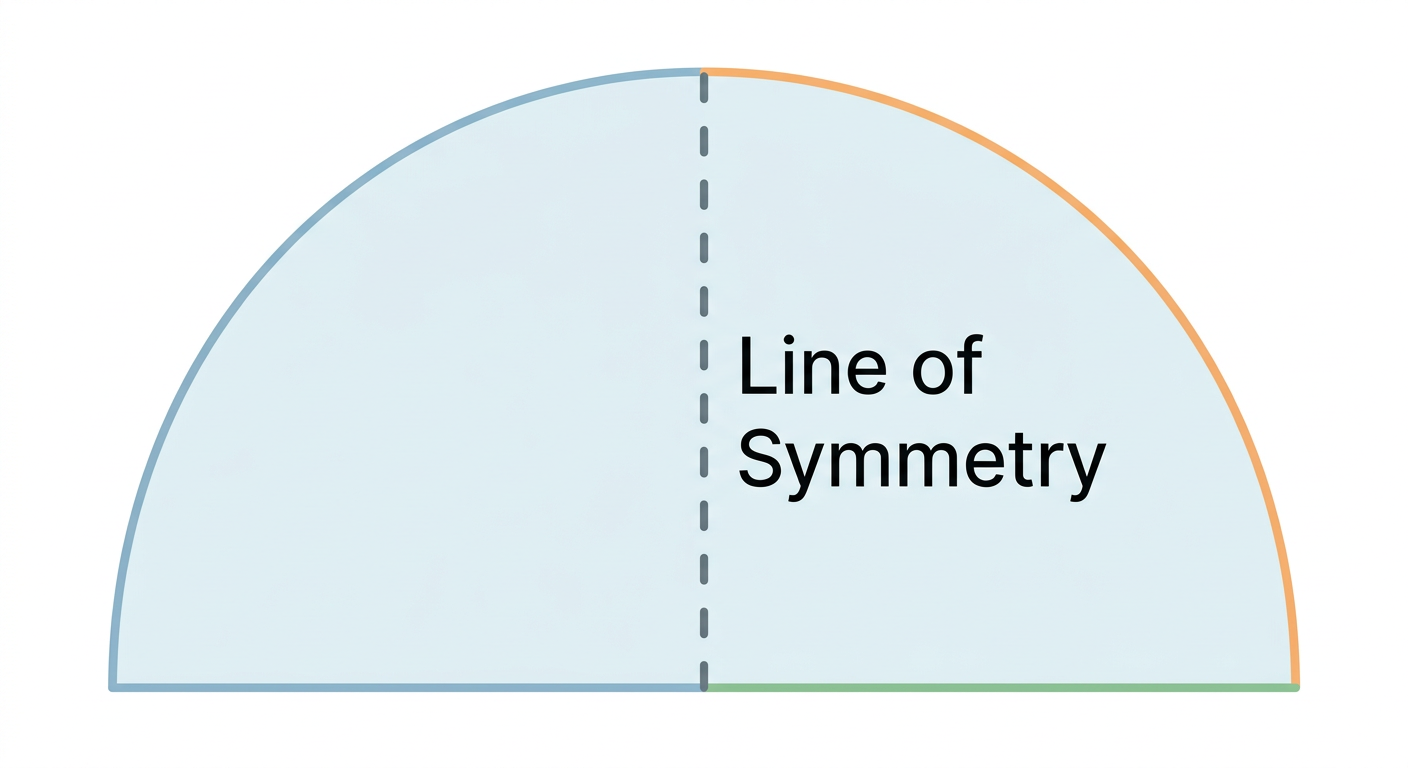
Let us draw a semicircle. A semicircle is half of a circle. It has one straight edge and one curved edge. We can draw a line down its middle. This line goes from the middle of the straight edge. It goes to the middle of the curved edge. If we fold the semicircle along this line, both halves will match. This is its only line of symmetry.
Step 2 — Drawing a figure with two lines of symmetry
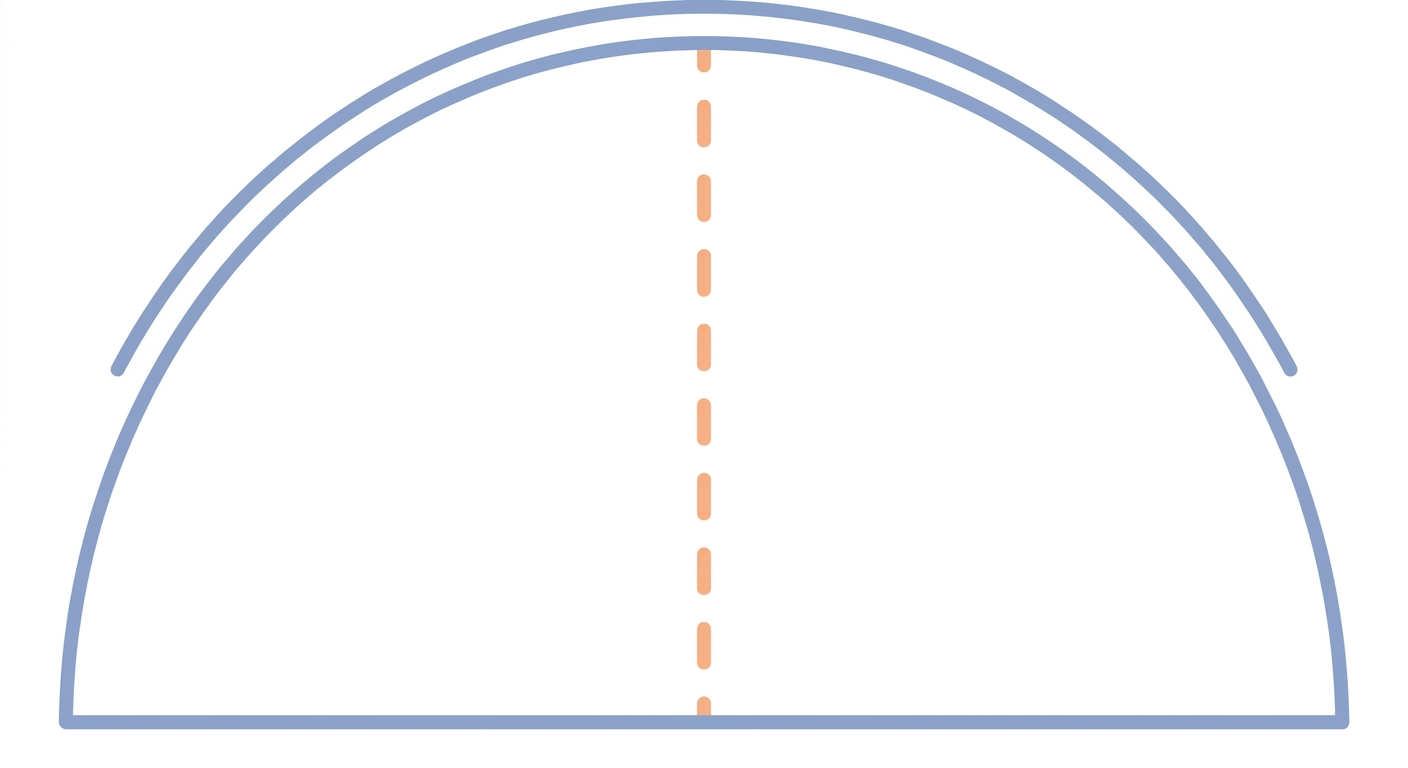
Let us draw an oval shape. An oval is also called an ellipse. It is a smooth, curved shape. It looks like a stretched circle. An oval has two lines of symmetry. One line goes through its longest part. The other line goes through its shortest part. Both lines cut the oval into two matching halves.
Step 3 — Drawing a figure with four lines of symmetry
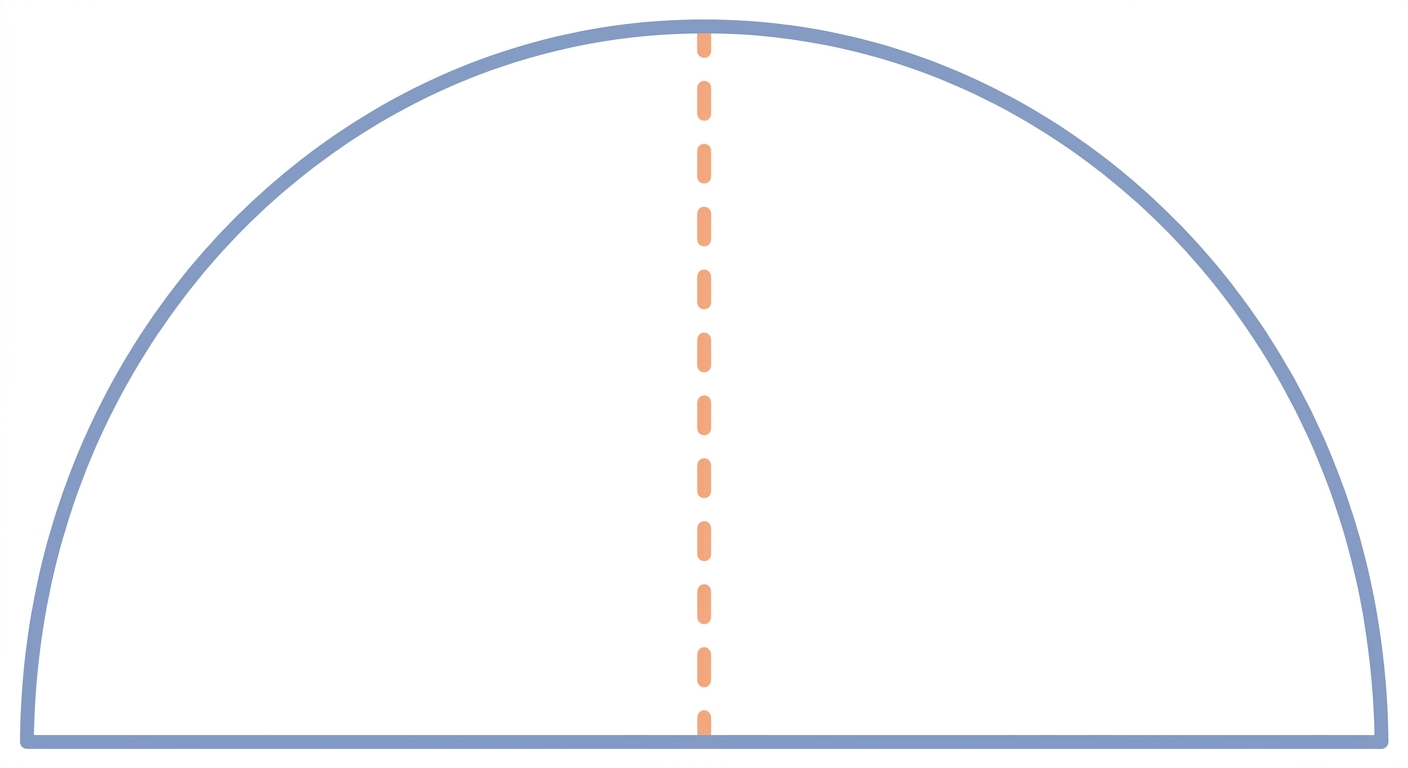
Let us draw a special curved shape. This shape looks like a flower with four petals. Or it looks like a square with curved sides. All its sides are curved. This shape has four lines of symmetry. Two lines go through the middle of opposite curved sides. The other two lines go through its corners. These lines are like the diagonals of a square. All four lines cut the shape into matching halves.
Answer
(a) A semicircle has exactly one line of symmetry. (b) An oval (ellipse) has exactly two lines of symmetry. (c) A star-like shape with four curved sides has exactly four lines of symmetry.
More questions in IT
What about the butterfly? No doubt, the colours are very attractive. But what else about the butterfly appeals to you?
Can you see what repeats in the beautiful rangoli figure?
What about the pinwheel? Can you spot which pattern is repeating?
Hint: Look at the hexagon first.
Now, can you say what figure repeats along each side of the hexagon? What is the shape of the figure that is stuck to each side? Do you recognise it? How do these shapes move as you move along the boundary of the hexagon? What about the other pictures—what is it about those structures that appeals to you and what are the patterns in those structures that repeat?
What are the symmetries that you see in these beautiful structures?
Is there any other way to fold the square so that the two halves overlap? How many lines of symmetry does the square shape have?
Thus, figures can have multiple lines of symmetry. The figures below also have multiple lines of symmetry. Can you find them all?
We saw that the diagonal of a square is also a line of symmetry. Let us take a rectangle that is not a square. Is its diagonal a line of symmetry?
First, see the rectangle and answer this question. Then, take a rectangular piece of paper and check if the two parts overlap by folding it along its diagonal. What do you observe?
Context: Consider a square with its corners labeled A, B, C and D, and its vertical line of symmetry as shown in the figure.
Q. What if we reflect along the diagonal from A to C? Where do points A, B, C and D go? What if we reflect along the horizontal line of symmetry?
In these two figures, a sheet of paper is folded and a cut is made along the dotted line shown. Draw a sketch of how the paper will look when unfolded.
Do you see a line of symmetry in this figure? What is it?
5 Suppose you have to get each of these shapes with some folds and a single straight cut. How will you do it?
a. The hole in the centre is a square.
b. The hole in the centre is a square.
Note: For the above two questions, check if the 4-sided figures in the centre satisfy both the properties of a square.
- How many lines of symmetry do these shapes have?
Find the lines of symmetry for the kolam below.
Draw the following.
a. A triangle with exactly one line of symmetry. b. A triangle with exactly three lines of symmetry. c. A triangle with no line of symmetry.
Is it possible to draw a triangle with exactly two lines of symmetry?
Draw the following. In each case, the figure should contain at least one curved boundary.
a. A figure with exactly one line of symmetry. b. A figure with exactly two lines of symmetry. c. A figure with exactly four lines of symmetry.
Copy the following on squared paper. Complete them so that the blue line is a line of symmetry. Problem (a) has been done for you.
Hint: For (c) and (f), see if rotating the book helps!
Copy the following drawing on squared paper. Complete each one of them so that the resulting figure has the two blue lines as lines of symmetry.
Do you know of any other shape that has exactly four angles of symmetry?
Consider this figure, a picture with 4 radial arms. How many angles of symmetry does it have? What are they? Note that the angle between adjacent central dotted lines is 90°.
Can you change the angles between the radial arms so that the figure still has 4 angles of symmetry? Try drawing it.
How will you modify the figure above so that it has only two angles of symmetry?
Can we get a figure having exactly 3 angles of symmetry? Can you use radial arms for this?
Let us try with 3 radial arms as in the figure below. How many angles of symmetry does it have and what are they?
However, can anything in the figure be changed to make it have 3 angles of symmetry?
Can you draw a figure with radial arms that has a) exactly 5 angles of symmetry, b) 6 angles of symmetry? Also find the angles of symmetry in each case.
Hint: Use 5 radial arms for the first case. What should the angle between two adjacent radial arms be?
Consider a figure with radial arms having exactly 7 angles of symmetry. What will be its smallest angle of symmetry? Is the number of degrees a whole number in this case? If not, express it as a mixed fraction.
In each case, the angles are the multiples of the smallest angle. You may wonder and ask if this will always happen. What do you think?
True or False
- Every figure will have 360 degrees as an angle of symmetry.
- If the smallest angle of symmetry of a figure is a natural number in degrees, then it is a factor of 360.
Like wheels, we can find other objects around us having rotational symmetry. Find them.