Question 5
Can you find a similar pictorial explanation?

We can see how adding numbers in a special way makes perfect squares.
Step 1 — Seeing numbers as dots
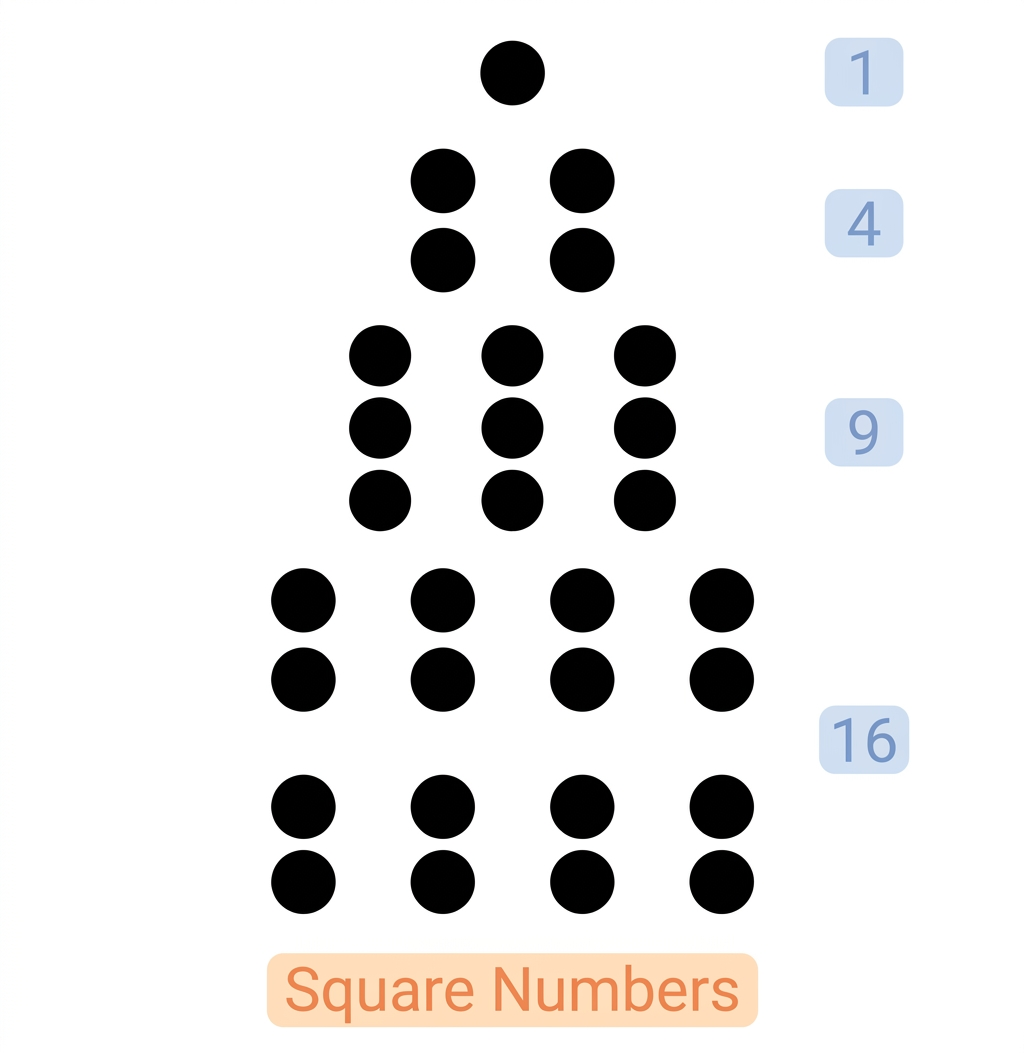
Let us imagine numbers as rows of dots. The number 1 is just one dot. The sum is 4 dots. We can arrange these 4 dots. They form a 2 by 2 square. The sum is 9 dots. We can arrange these 9 dots. They form a 3 by 3 square. The sum is 16 dots. We can arrange these 16 dots. They form a 4 by 4 square. The largest number in the sum tells us the square's side.
Step 2 — Explaining the given picture
Look at the picture provided. It shows many dots. Let us count the dots in one row. There are 6 dots in each row. Let us count the dots in one column. There are 6 dots in each column. This means it is a 6 by 6 square. The total number of dots is .
This picture shows the sum . This sum also equals 36. The dots are arranged symmetrically. The central line matches the largest number in the sum. Here, the largest number is 6. The square's side length is this largest number.
Answer
Pictorial Explanation: Imagine each number in the sequence as a row of dots. For example, 1 is one dot. The sum makes 4 dots, which form a 2 by 2 square. The sum makes 9 dots, forming a 3 by 3 square. The given picture shows 36 dots in a 6 by 6 square. This represents the sum . The dots are arranged symmetrically. The largest number in the sum tells us the side length of the square.
More questions in IT
Why does this happen? Do you think it will happen forever?
How can we partition the dots in a square grid into odd numbers of dots: 1, 3, 5, 7,... ?
By drawing a similar picture, can you say what is the sum of the first 10 odd numbers?
Now by imagining a similar picture, or by drawing it partially, as needed, can you say what is the sum of the first 100 odd numbers?
Can you find a similar pictorial explanation?