Question 3
By drawing a similar picture, can you say what is the sum of the first 10 odd numbers?
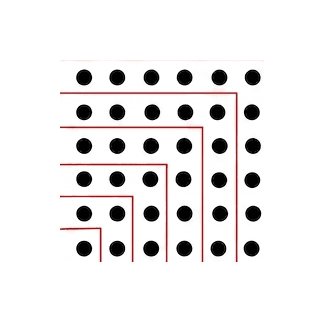
We can see a pattern when we add odd numbers.
Step 1 — Finding the pattern
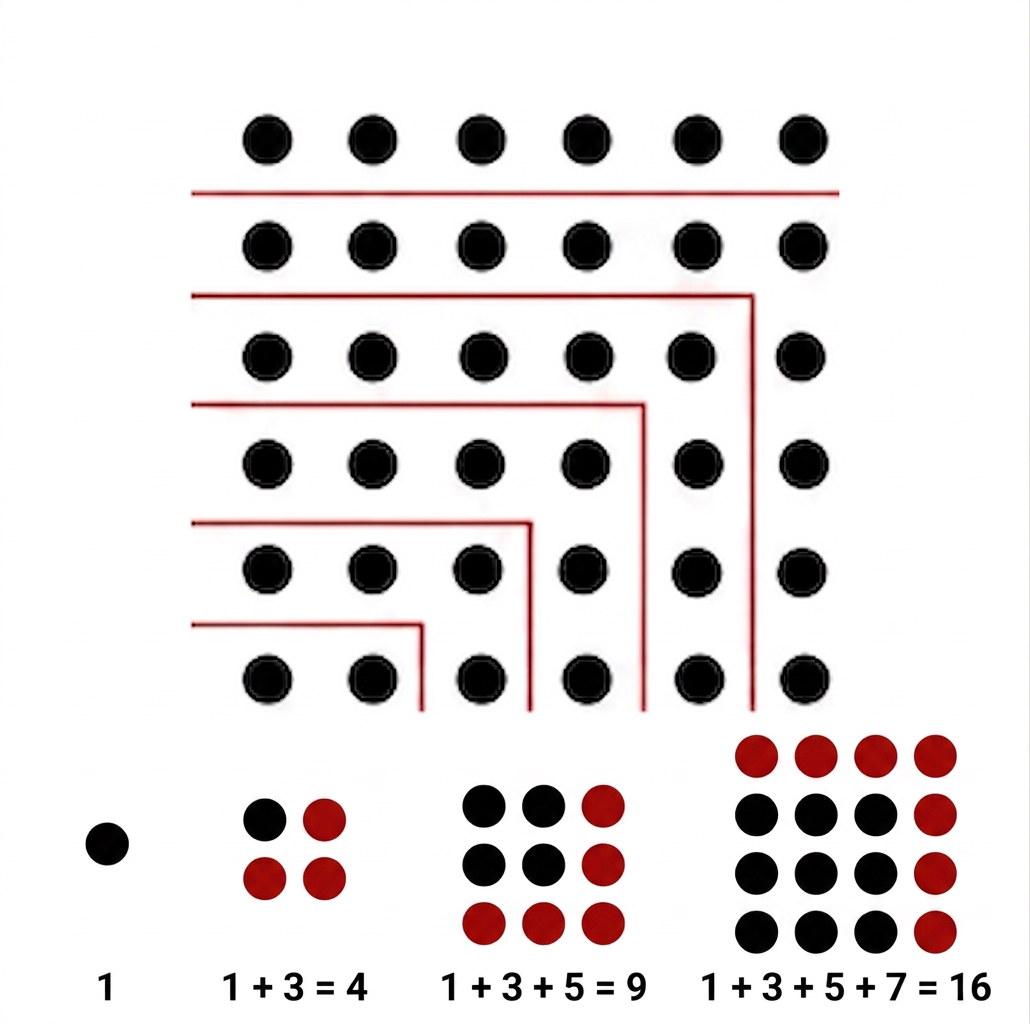
Look at the dots in the picture. The first odd number is 1. It makes a square of size .
Now, let us add the next odd number, which is 3. We add 3 dots to the 1 dot. This makes a square of size .
Next, let us add the odd number 5. We add 5 dots to the 4 dots. This makes a square of size .
Let us add the odd number 7. We add 7 dots to the 9 dots. This makes a square of size .
We can see a clear pattern. The sum of the first 'n' odd numbers is .
Step 2 — Sum of first 10 odd numbers
We need to find the sum of the first 10 odd numbers. The first 10 odd numbers are: 1, 3, 5, 7, 9, 11, 13, 15, 17, 19. Using our pattern, 'n' is 10. The sum will be .
Answer
The sum of the first 10 odd numbers is 100.
More questions in IT
Why does this happen? Do you think it will happen forever?
How can we partition the dots in a square grid into odd numbers of dots: 1, 3, 5, 7,... ?
By drawing a similar picture, can you say what is the sum of the first 10 odd numbers?
Now by imagining a similar picture, or by drawing it partially, as needed, can you say what is the sum of the first 100 odd numbers?
Can you find a similar pictorial explanation?