Question 13
Answer the following questions after looking at the fraction wall:
How many pieces of length will make a length of ?
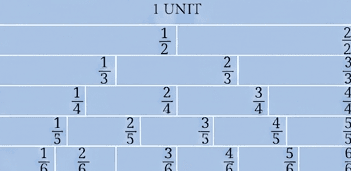
We use the fraction wall to find equivalent lengths.
Step 1 — Look at the fraction wall
The diagram shows a bar labeled 1 UNIT. Below it are many smaller bars. These bars show different fractions of 1 UNIT. Each row has pieces of the same size. For example, the bottom row shows pieces. Each of these pieces is long.
Step 2 — Find the length of 1/2
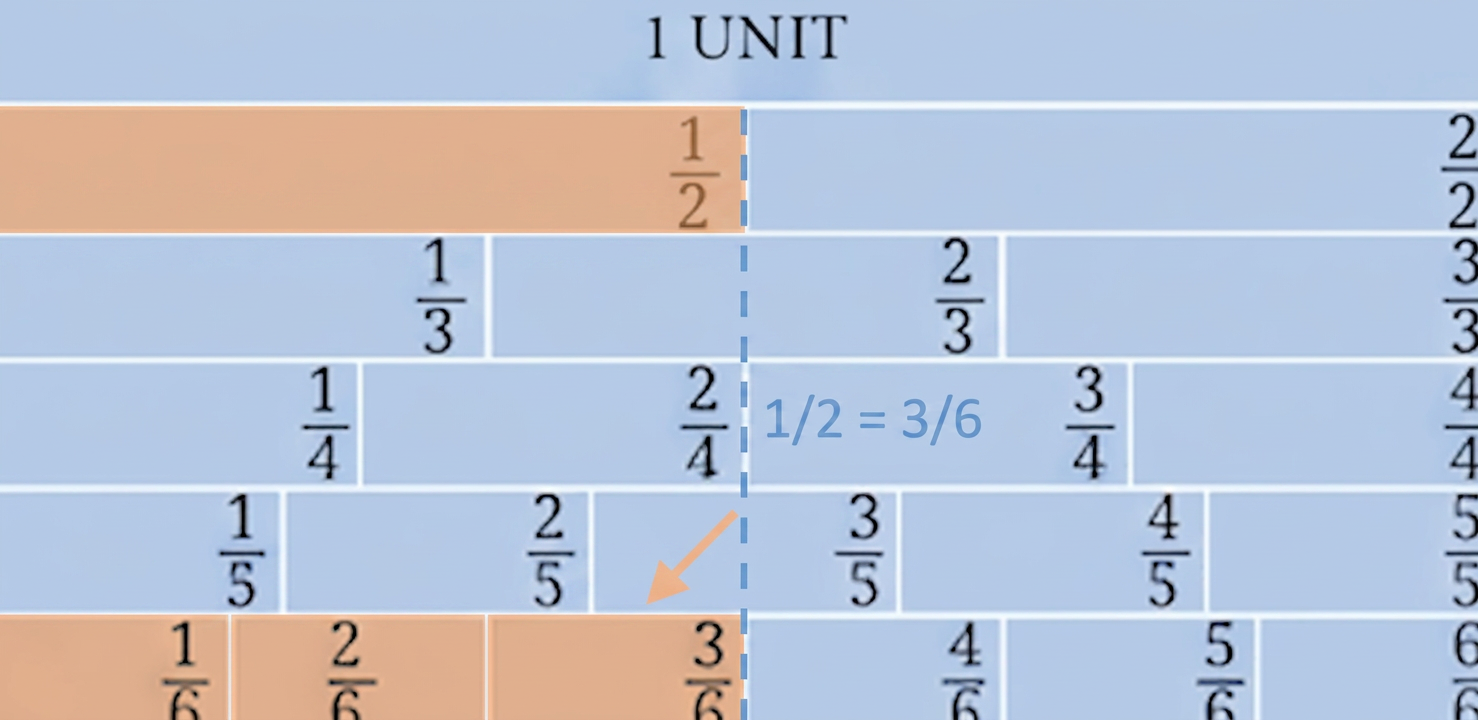
Locate the row that shows halves. The first piece in this row is . This piece covers half of the total length.
Step 3 — Find how many 1/6 pieces fit
Now, look at the row for sixths. These are the pieces of length . We want to find how many pieces fit. Imagine placing pieces side by side. Trace the end of the piece downwards. It lines up with the end of . So, is the same length as . The fraction means 3 pieces of . So, 3 pieces of make .
Let us confirm this with a calculation. We divide by . To divide fractions, we flip the second fraction. Then we multiply the fractions.
Answer
(iii) Three pieces of length will make a length of .
More questions in IT
Arrange these fraction words in order of size from the smallest to the biggest in the empty box below:
One and a half, three quarters, one and a quarter, half, quarter, two and a half.
By dividing the whole chikki into 6 equal parts in different ways, we get 1/6 chikki pieces of different shapes. Are they of the same size?
Do it once more! Fill in the blank boxes.
Now, can you find the lengths of the various blue lines shown below? Fill in the boxes as well.
- Here, the fractional unit is dividing a length of 1 unit into three equal parts. Write the fraction that gives the length of the blue line in the box or in your notebook.
Here, a unit is divided into 5 equal parts. Write the fraction that gives the length of the blue lines in the respective boxes or in your notebook.
Now, a unit is divided into 8 equal parts. Write the appropriate fractions in your notebook.
Write down all the fractions you marked on the number line earlier.
Now, let us classify these in two groups:
Did you notice something common between the fractions that are greater than 1?
What do you observe?
- Are the lengths and equal?
- Are the lengths and equal?
Now, check whether and are equivalent fractions or not, using paper strips.
Answer the following questions after looking at the fraction wall:
Are the lengths and equal?
Answer the following questions after looking at the fraction wall:
Are and equivalent fractions? Why?
Answer the following questions after looking at the fraction wall:
How many pieces of length will make a length of ?
Answer the following questions after looking at the fraction wall:
How many pieces of length will make a length of ?
Context: Anil was in a group where 2 cakes were divided equally among 5 children.
Q. Now, if there are 10 children in my group, how many cakes will I need so that they get same amount of cake as Anil?
Q. What if we put two such groups together? One group where 2 cakes are divided equally between 5 children, and another group again with 4 cakes and 10 children.
Find some more fractions equivalent to . Write them in the boxes here:
Equally divide the rotis in the situations shown below and write down the share of each child. Are the shares in each of these cases the same? Why?
Suppose the number of children is kept the same, but the number of units that are being shared is increased? What can you say about each child's share now? Why? Discuss how your reasoning explains , , and .
Now, decide in which of the two groups will each child get a larger share:
- Group 1: 3 glasses of sugarcane juice divided equally among 4 children. Group 2: 7 glasses of sugarcane juice divided equally among 10 children.
- Group 1: 4 glasses of sugarcane juice divided equally among 7 children. Group 2: 5 glasses of sugarcane juice divided equally among 7 children.
Which groups were easier to compare? Why?
Find equivalent fractions for the given pairs of fractions such that the fractional units are the same.
a. and
b. and
c. and
d. and
e. and
f. and
g. and
h. and
Context: Meena's father made some chikki. Meena ate of it and her younger brother ate of it.
Q. How much of the total chikki is remaining?
Try adding using a number line. Do you get the same answer?
Try doing this same exercise using the number line.
Puzzle!
-
Can you find three different fractional units that add up to 1?
It turns out there is only one solution to this problem (up to changing the order of the 3 fractions)! Can you find it? Try to find it before reading further.