Question 6
The length of a tangent from a point A at distance 5 cm from the centre of the circle is 4 cm. Find the radius of the circle.
Tangent: A line that touches a circle at exactly one point (point of contact B) without crossing through it.
Tangent-Radius Perpendicularity Theorem: The radius drawn to the point of tangency is always perpendicular to the tangent. So OB ⊥ AB, forming a right angle at B.
The radius of a circle is always perpendicular to the tangent at the point of contact.
Step 1 — Visualize the problem
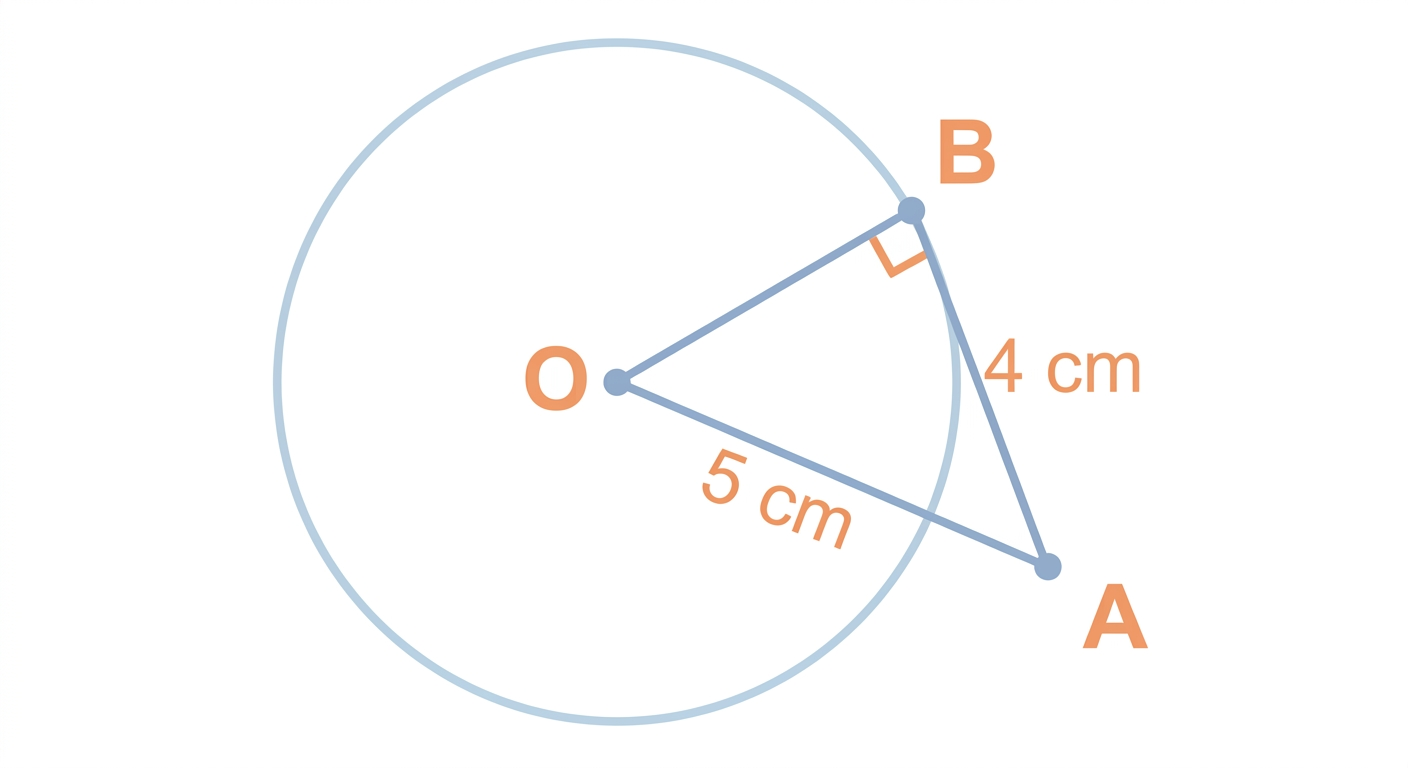
Let's draw a circle with its center O. Let A be the external point. Let B be the point where the tangent touches the circle. The line segment OB is the radius. The line segment AB is the tangent. The line segment OA connects the center to point A.
Step 2 — Apply the Pythagorean theorem
We know that OB is perpendicular to AB. So, triangle OBA is a right-angled triangle. The right angle is at B. OA is the hypotenuse. We are given OA = . We are given AB = . We need to find OB.
Pythagoras Theorem: In a right-angled triangle, the hypotenuse² equals the sum of squares of the other two sides:
We know OA (hypotenuse) = 5 cm and AB = 4 cm. We need to find OB (radius).
Let's substitute the given values.
The radius of the circle is .
Answer
The radius of the circle is .
More questions in Exercise 10.2
In Q.1 to 3, choose the correct option and give justification.
- From a point Q, the length of the tangent to a circle is 24 cm and the distance of Q from the centre is 25 cm. The radius of the circle is (A) 7 cm (B) 12 cm (C) 15 cm (D) 24.5 cm
In Q.1 to 3, choose the correct option and give justification.
- In Fig. 10.11, if TP and TQ are the two tangents to a circle with centre O so that , then is equal to (A) (B) (C) (D)
In Q.1 to 3, choose the correct option and give justification.
- If tangents PA and PB from a point P to a circle with centre O are inclined to each other at angle of , then is equal to (A) (B) (C) (D)
Prove that the tangents drawn at the ends of a diameter of a circle are parallel.
Prove that the perpendicular at the point of contact to the tangent to a circle passes through the centre.
The length of a tangent from a point A at distance 5 cm from the centre of the circle is 4 cm. Find the radius of the circle.
Two concentric circles are of radii 5 cm and 3 cm. Find the length of the chord of the larger circle which touches the smaller circle.
A quadrilateral ABCD is drawn to circumscribe a circle (see Fig. 10.12). Prove that
In Fig. 10.13, XY and are two parallel tangents to a circle with centre O and another tangent AB with point of contact C intersecting XY at A and at B. Prove that .
Prove that the angle between the two tangents drawn from an external point to a circle is supplementary to the angle subtended by the line-segment joining the points of contact at the centre.
Prove that the parallelogram circumscribing a circle is a rhombus.
A triangle ABC is drawn to circumscribe a circle of radius 4 cm such that the segments BD and DC into which BC is divided by the point of contact D are of lengths 8 cm and 6 cm respectively (see Fig. 10.14). Find the sides AB and AC.
Prove that opposite sides of a quadrilateral circumscribing a circle subtend supplementary angles at the centre of the circle.