Question 2
Take two consecutive odd numbers. Find the sum of their squares, and then add 6 to the result. Prove that the new number is always divisible by 8.
We will represent the consecutive odd numbers algebraically and simplify the expression.
Step 1 — Representing the numbers
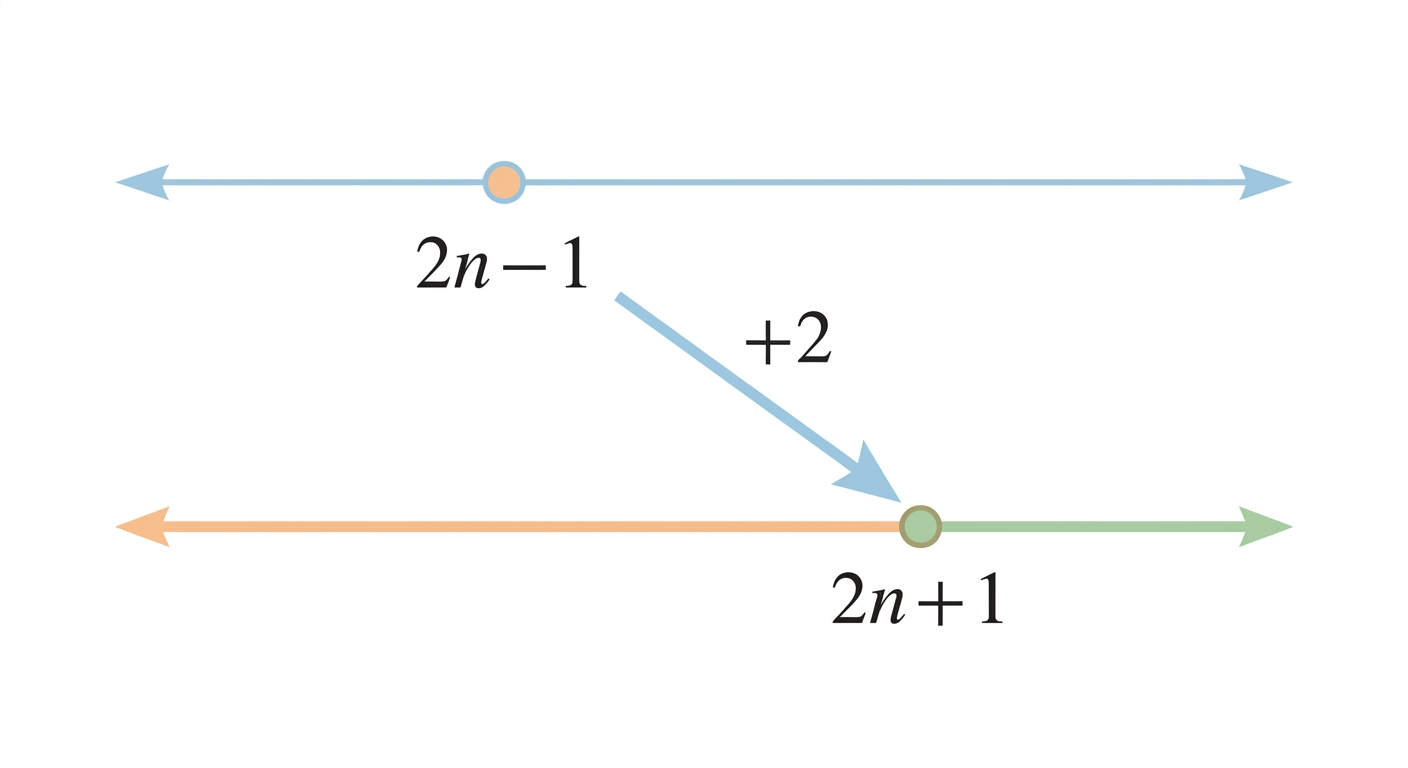
Let's pick an integer . We can write any odd number as . The next consecutive odd number is . We will use these two expressions.
Step 2 — Sum of their squares
First, we square the first odd number.
Next, we square the second odd number.
Now, we add these two squared results together.
Step 3 — Add 6 to the result
We take the sum of squares and add 6 to it.
Step 4 — Proving divisibility by 8
Let's look at the new number we found. We can factor out a common term.
Since is an integer, is an integer. So, is also an integer. This means the entire expression is 8 multiplied by an integer. Any number that can be written as 8 times an integer is divisible by 8.
Answer
(i) The algebraic representation of two consecutive odd numbers is and . (ii) The sum of their squares plus 6 is . (iii) Since the expression is multiplied by an integer, it is always divisible by .
More questions in A1.3
Prove that the sum of two consecutive odd numbers is divisible by 4.
Take two consecutive odd numbers. Find the sum of their squares, and then add 6 to the result. Prove that the new number is always divisible by 8.
If is a prime number, show that is divisible by 3.
[Hint: Use Example 11].
Let and be rational numbers. Show that is a rational number.
If and are positive integers, then you know that , where is a whole number. Prove that .
[Hint : Let . So, and , where and are coprime.]
A line parallel to side BC of a triangle ABC, intersects AB and AC at D and E respectively.
Prove that .