Appendix 1: Proofs in Mathematics | A1.3

Question 6

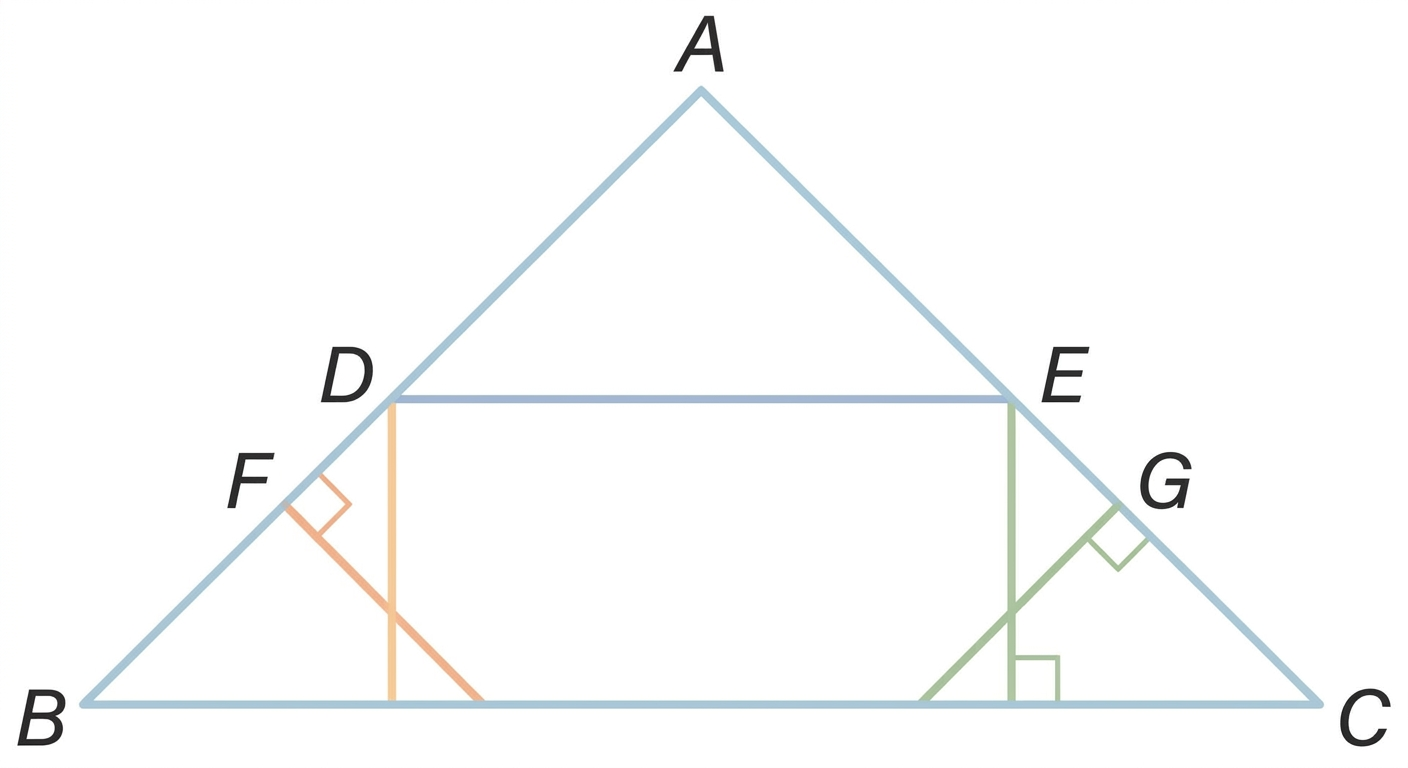
A line parallel to side BC of a triangle ABC, intersects AB and AC at D and E respectively.

Prove that ADDB=AEEC\frac{\text{AD}}{\text{DB}} = \frac{\text{AE}}{\text{EC}}.

Check your answer with HomiSolve it yourself, then let Homi check your steps and spot mistakes.
Solution

We will use the concept of areas of triangles to prove this.

Step 1 — Draw altitudes and find areas

Let's draw a line segment EFEF from E perpendicular to AB. So, EFEF is the height for ADE\triangle ADE and BDE\triangle BDE when their bases are on AB.

The area of ADE\triangle ADE is:

Area(ADE)=12×AD×EF\text{Area}(\triangle ADE) = \frac{1}{2} \times \text{AD} \times \text{EF}

The area of BDE\triangle BDE is:

Area(BDE)=12×DB×EF\text{Area}(\triangle BDE) = \frac{1}{2} \times \text{DB} \times \text{EF}

Now, let's draw a line segment DGDG from D perpendicular to AC. So, DGDG is the height for ADE\triangle ADE and CDE\triangle CDE when their bases are on AC.

The area of ADE\triangle ADE is also:

Area(ADE)=12×AE×DG\text{Area}(\triangle ADE) = \frac{1}{2} \times \text{AE} \times \text{DG}

The area of CDE\triangle CDE is:

Area(CDE)=12×EC×DG\text{Area}(\triangle CDE) = \frac{1}{2} \times \text{EC} \times \text{DG}

Diagram 1

Step 2 — Form ratios and conclude

Let's find the ratio of the areas of ADE\triangle ADE and BDE\triangle BDE.

Area(ADE)Area(BDE)=12×AD×EF12×DB×EF\frac{\text{Area}(\triangle ADE)}{\text{Area}(\triangle BDE)} = \frac{\frac{1}{2} \times \text{AD} \times \text{EF}}{\frac{1}{2} \times \text{DB} \times \text{EF}}

=ADDB= \frac{\text{AD}}{\text{DB}}

Next, let's find the ratio of the areas of ADE\triangle ADE and CDE\triangle CDE.

Area(ADE)Area(CDE)=12×AE×DG12×EC×DG\frac{\text{Area}(\triangle ADE)}{\text{Area}(\triangle CDE)} = \frac{\frac{1}{2} \times \text{AE} \times \text{DG}}{\frac{1}{2} \times \text{EC} \times \text{DG}}

=AEEC= \frac{\text{AE}}{\text{EC}}

Now, consider BDE\triangle BDE and CDE\triangle CDE. They share the same base, which is DE. They are between the same parallel lines, DE and BC. Triangles on the same base and between the same parallel lines have equal areas. So, we can say:

Area(BDE)=Area(CDE)\text{Area}(\triangle BDE) = \text{Area}(\triangle CDE)

Since Area(BDE\triangle BDE) equals Area(CDE\triangle CDE), we can equate the two ratios we found earlier.

ADDB=AEEC\frac{\text{AD}}{\text{DB}} = \frac{\text{AE}}{\text{EC}}

Answer

(i) We have proven that ADDB=AEEC\frac{\text{AD}}{\text{DB}} = \frac{\text{AE}}{\text{EC}}.

More questions in A1.3

Q1

Prove that the sum of two consecutive odd numbers is divisible by 4.

Q2

Take two consecutive odd numbers. Find the sum of their squares, and then add 6 to the result. Prove that the new number is always divisible by 8.

Q3

If p5p \ge 5 is a prime number, show that p2+2p^2 + 2 is divisible by 3.

[Hint: Use Example 11].

Q4

Let xx and yy be rational numbers. Show that xyxy is a rational number.

Q5

If aa and bb are positive integers, then you know that a=bq+r,0r<ba = bq + r, 0 \le r < b, where qq is a whole number. Prove that HCF(a,b)=HCF(b,r)\text{HCF}(a, b) = \text{HCF}(b, r).

[Hint : Let HCF(b,r)=h\text{HCF}(b, r) = h. So, b=k1hb = k_1h and r=k2hr = k_2h, where k1k_1 and k2k_2 are coprime.]

Q6

A line parallel to side BC of a triangle ABC, intersects AB and AC at D and E respectively.

Prove that ADDB=AEEC\frac{\text{AD}}{\text{DB}} = \frac{\text{AE}}{\text{EC}}.

← Back to Appendix 1: Proofs in Mathematics