Question 15
Show that the rational number lies between the rational numbers and .
We will use the given recurrence relation to find each term step by step.
Step 1 — Calculate
We are given the values for and . The formula for is . Let's find .
Step 2 — Calculate
We use the recurrence relation again. Let's find .
Step 3 — Calculate
We continue finding the terms. Let's find .
Step 4 — Calculate
Let's find the next term, .
Step 5 — Calculate
We find the value for .
Step 6 — Calculate
Finally, we find the value for .
Step 7 — List the sequence and identify it
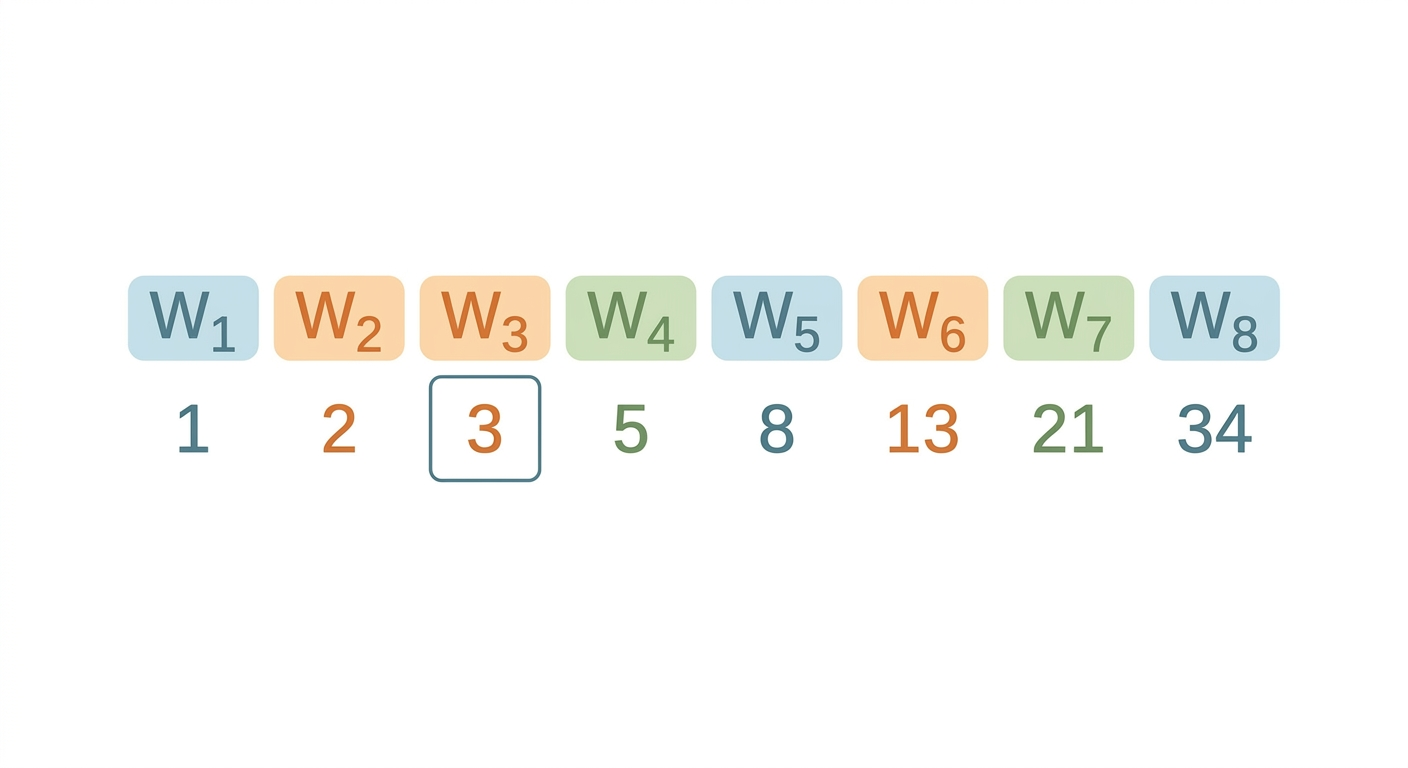
We have found all the required terms. The sequence starts with and . The calculated terms are , , , , , . This sequence follows a specific pattern. Each term is the sum of the previous two terms. For example, . This is a well-known sequence.
Answer
(i) The values of are 1, 2, 3, 5, 8, 13, 21, 34. (ii) Yes, this is the Virahanka-Fibonacci sequence.
More questions in EOT
Convert the following rational numbers in the form of a terminating decimal or non-terminating and repeating decimal, whichever the case may be, by the process of long division:
(i) (ii)
Prove that is an irrational number.
Convert the following decimal numbers in the form of .
(i) (ii) (iii) (iv) (v) (vi) (vii) (viii) (ix)
Locate the following rational numbers on the number line.
(i) (ii)
Find 6 rational numbers between 3 and 4.
Find 5 rational numbers between and .
Find 5 rational numbers between and .
If , find the rational number .
Let and be two non-zero rational numbers such that . Without assigning any numerical values, determine whether is positive or negative. Justify your answer.
A rational number has a terminating decimal expansion whose last non-zero digit occurs in the 4th decimal place. Show that such a number can be written in the form , where is an integer not divisible by 10. Is it necessary that the denominator of this rational number, when written in the lowest form, is divisible by or ? Give reasons.
Without performing division, determine whether the decimal expansion of is terminating or non-terminating. If it terminates, state the number of decimal places.
A rational number in its lowest form has denominator . How many decimal places will its decimal expansion have? Explain your answer.
Let and . Express both and in the form and where , and are integers and . Using the same denominator , write exactly five distinct rational numbers lying between and keeping an integer numerator. Explain why the condition is necessary to find such rational numbers between the two rational numbers and using this method.
Three rational numbers , , satisfy and . Show that all the rational numbers must be simultaneously zero.
Show that the rational number lies between the rational numbers and .
Find the lengths of the hypotenuses of all the right triangles in Fig. 3.14 which is referred to as the square root spiral.