Question 4
Explain, using a real-world example of debt, why subtracting a negative number is the same as adding a positive number (e.g., ).
We will use money to understand subtracting a negative number.
Step 1 — Understanding Debt
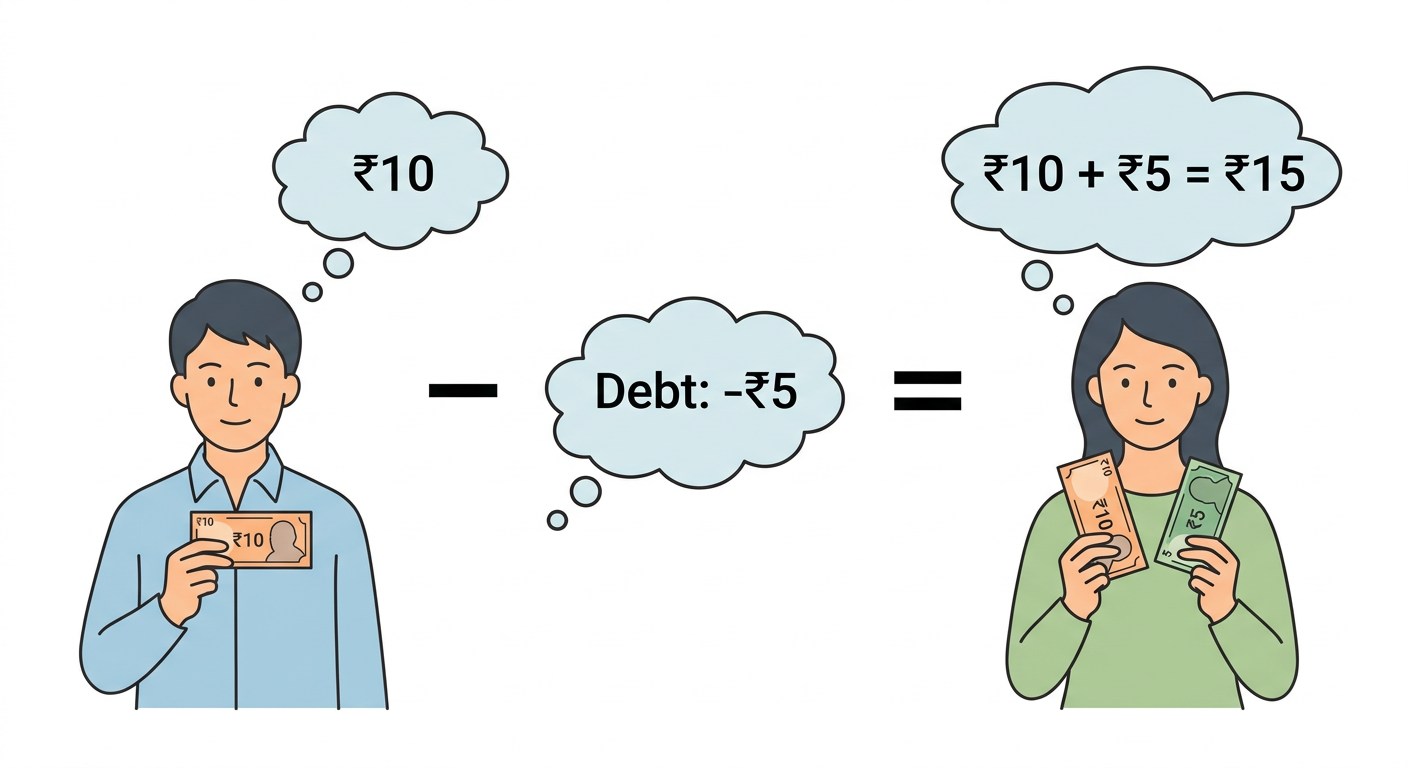
Let's think about money. Having money is a positive amount. Owing money is a negative amount. If you have ₹10, that is positive. If you owe ₹5, that is -₹5. This is your debt. We start with ₹10. Our initial amount is ₹10.
Step 2 — Removing Debt
Now, let's consider . The -₹5 means you owe ₹5. Subtracting a negative number means removing this debt. Removing a debt of ₹5 makes you richer. Your money increases by ₹5. So, means .
This shows subtracting a negative is adding a positive.
Answer
Subtracting a negative number, like removing a debt, increases your net worth, which is equivalent to adding a positive number.
More questions in Exercise 3.2
The temperature in the high-altitude desert of Ladakh is recorded as 4 °C at noon. By midnight, it drops by 15 °C. What is the midnight temperature?
A spice trader takes a loan (debt) of ₹850. The next day, he makes a profit (fortune) of ₹1,200. The following week, he incurs a loss of ₹450. Write this sequence as an equation using integers and calculate his final financial standing.
Calculate the following using Brahmagupta's laws:
(i)
(ii)
(iii)
(iv)
Explain, using a real-world example of debt, why subtracting a negative number is the same as adding a positive number (e.g., ).