Question 4
A tailor has metres of fine silk. If making one kurta requires metres of silk, exactly how many kurtas can he make?
We need to find how many kurtas the tailor can make from the given silk.
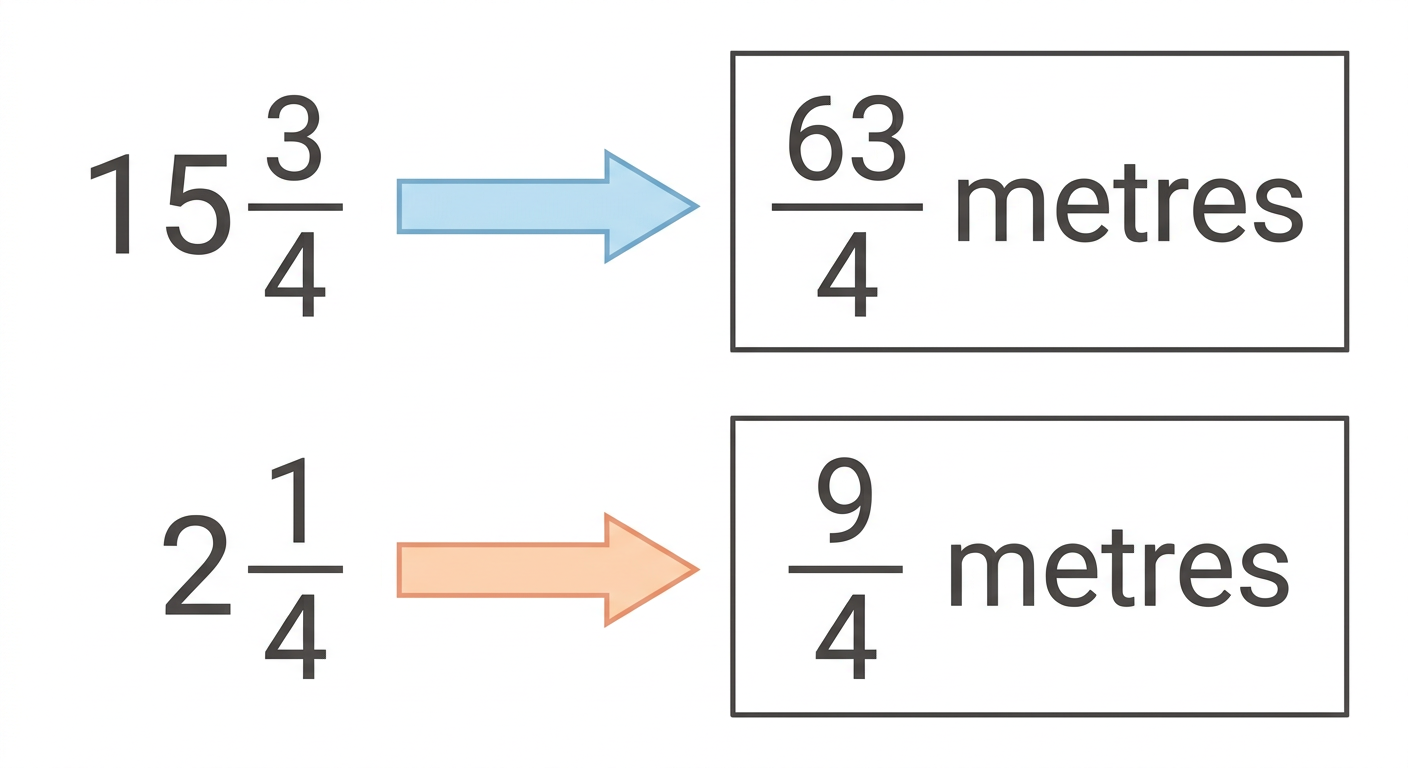
Step 1 — Convert to improper fractions
Let's change the mixed fractions to improper fractions. This makes calculations easier.
Total silk available is metres.
Silk needed for one kurta is metres.
Step 2 — Calculate number of kurtas
We will divide the total silk by the silk needed for one kurta. This gives us the number of kurtas.
Number of kurtas = Total silk Silk per kurta
Answer
The tailor can make exactly 7 kurtas.
More questions in Exercise 3.4
Represent the rational numbers , and on a single number line.
Find three distinct rational numbers that lie strictly between and .
Simplify the expression: .
A tailor has metres of fine silk. If making one kurta requires metres of silk, exactly how many kurtas can he make?
Find three rational numbers between 3.1415 and 3.1416.
Can you think of other way(s) to find a rational number between any two rational numbers?