Question 4
An AP consists of 50 terms in which the term is 12 and the last term is 106. Find the term.
(Hint: If 'a' is the first term and 'd' the common difference, then we arrive at the equations and . Solve this pair of linear equations for 'a' and 'd'.)
We need to find the 29th term of the arithmetic progression.
Step 1 — Find 'a' and 'd'
Let's define the first term as . Let's define the common difference as . The term of an AP is . We are given that the term is 12.
The AP has 50 terms. The last term is 106. So, the term is 106.
Now, let's solve these two equations. We will subtract Equation 1 from Equation 2.
Now, let's substitute into Equation 1.
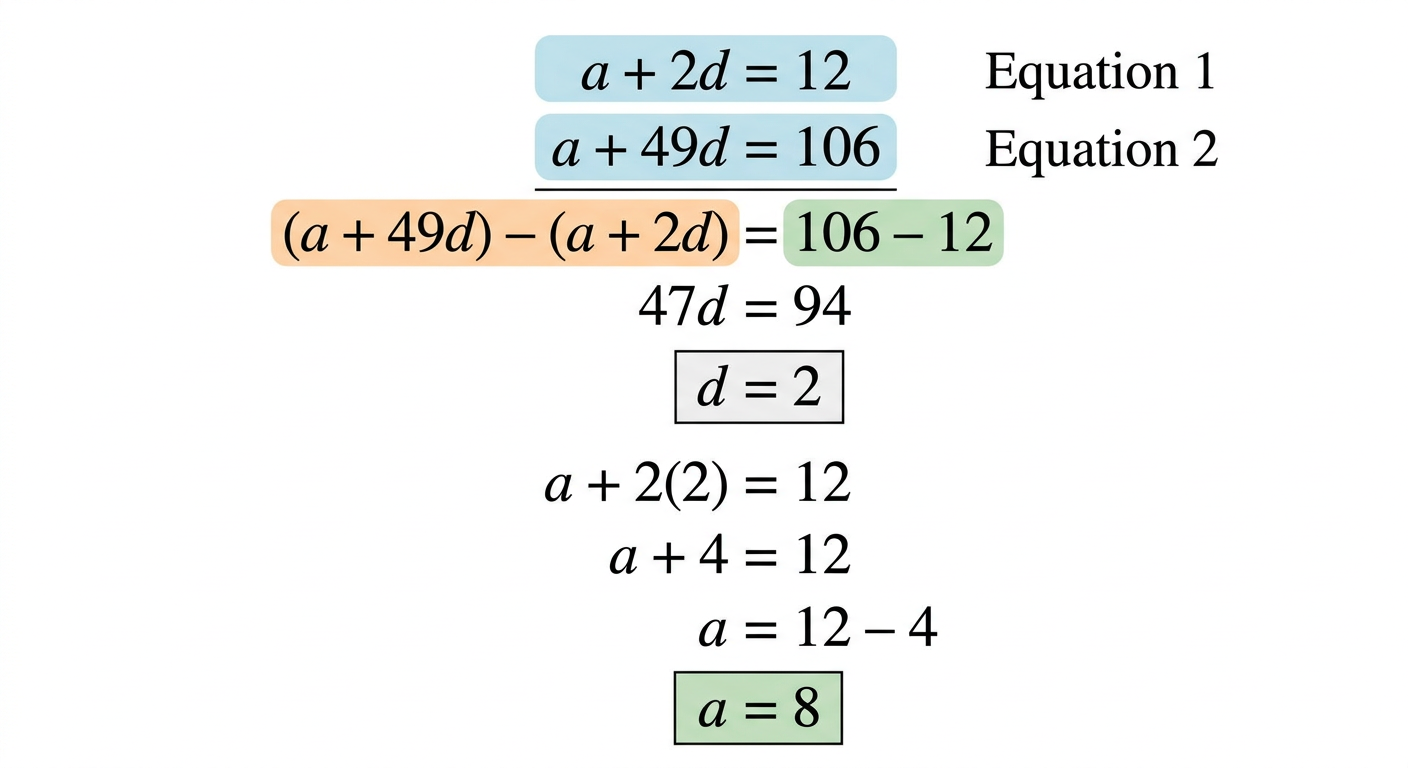
Step 2 — Find the 29th term
We need to find the term. We use the formula . We know and .
Answer
The 29th term is 64.
More questions in Exercise 8.2
Find the and terms of the AP: 3, 8, 13, 18, ....
Which term of the AP : 21, 18, 15, ... is ? Also, is 0 a term of this AP? Give reasons for your answer.
Find the term of the AP: 11, 8, 5, 2 ... Write the recursive rule for this AP.
An AP consists of 50 terms in which the term is 12 and the last term is 106. Find the term.
(Hint: If 'a' is the first term and 'd' the common difference, then we arrive at the equations and . Solve this pair of linear equations for 'a' and 'd'.)
How many 2-digit numbers are divisible by 3? What is the sum of all these 2-digit numbers?
Harish started work at an annual salary of ₹5,00,000 and received an increment of ₹20,000 each year. After how many years did his income reach ₹7,00,000?
A child arranges marbles in rows so that the first row has 1 marble, the second has 2 marbles, the third has 3, and so on up to 25 rows. How many marbles does the child use in all?