Question 7
Find the total perimeter of all the petals in each of the given flowers.
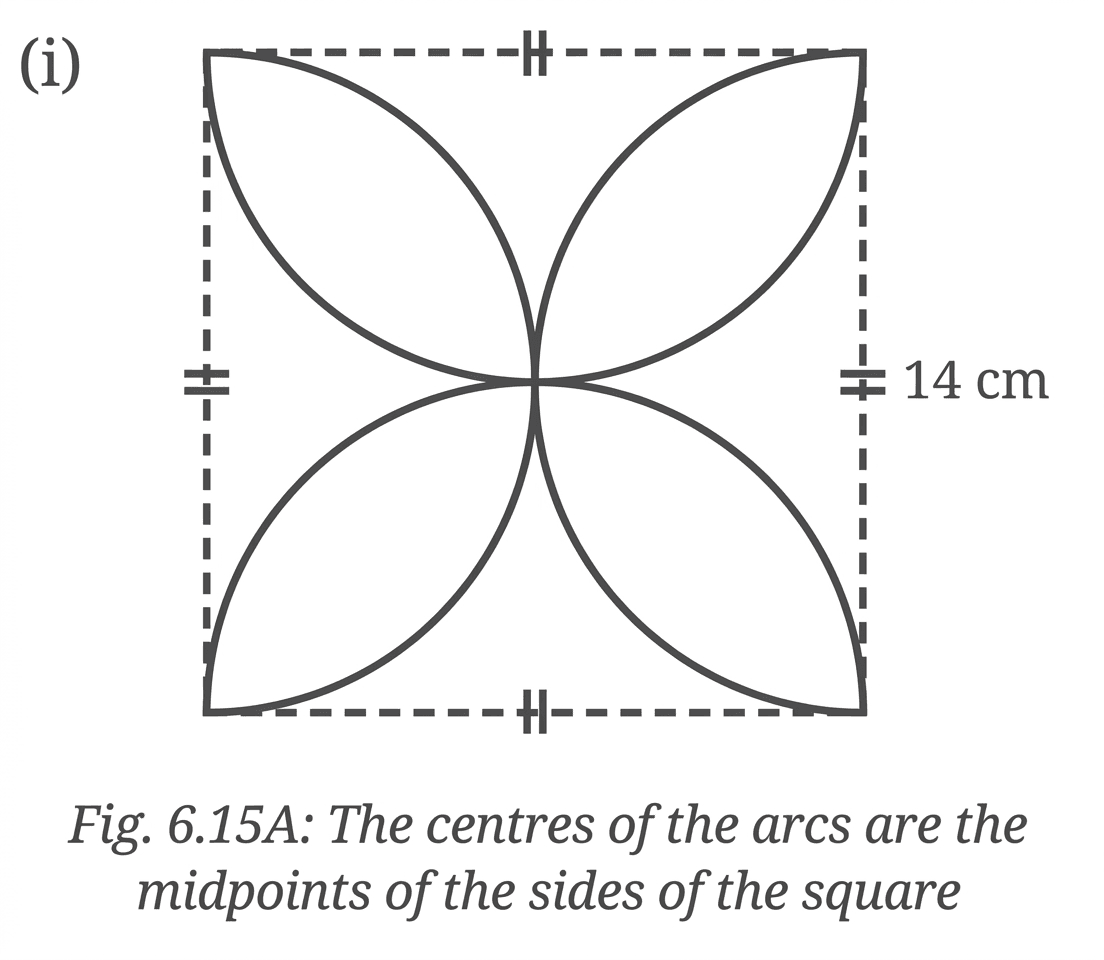
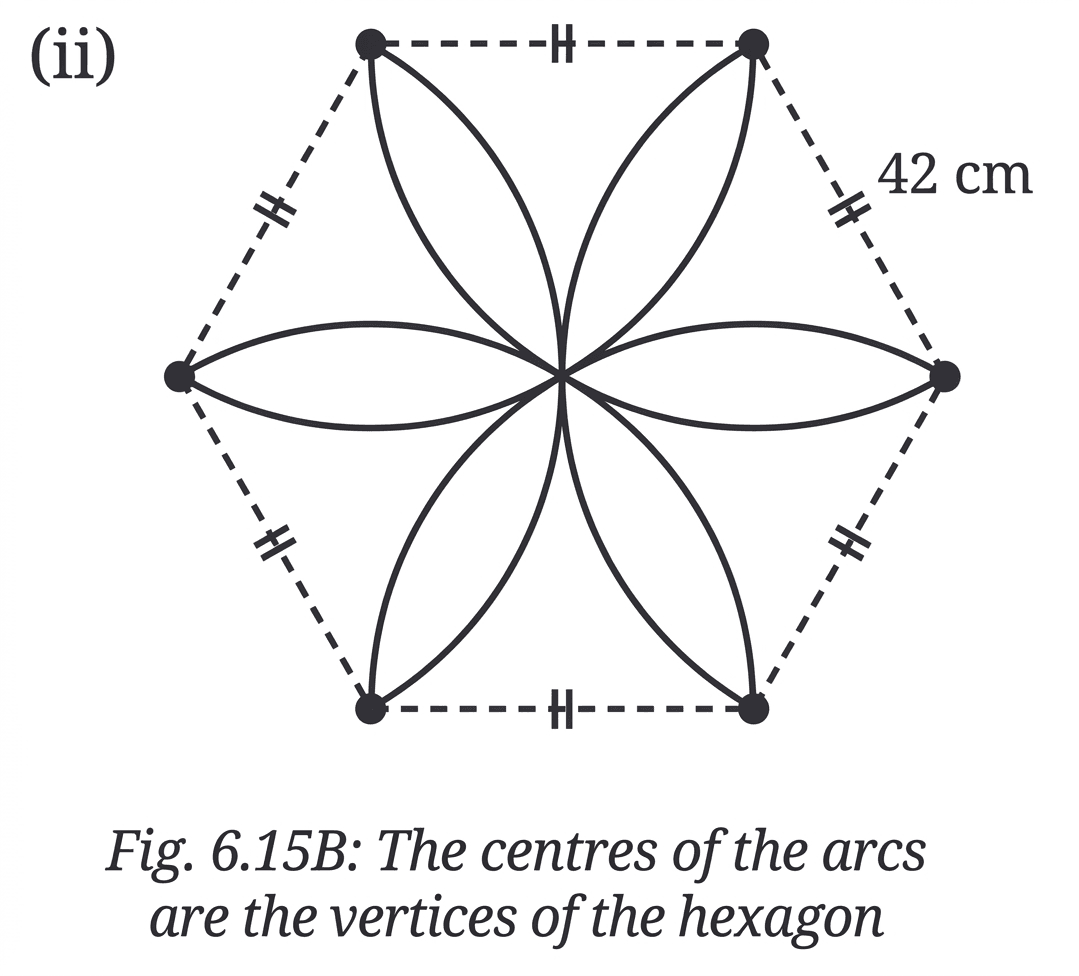
We need to find the total perimeter of all petals in each figure.
Step 1 — Calculate perimeter for Figure (i)
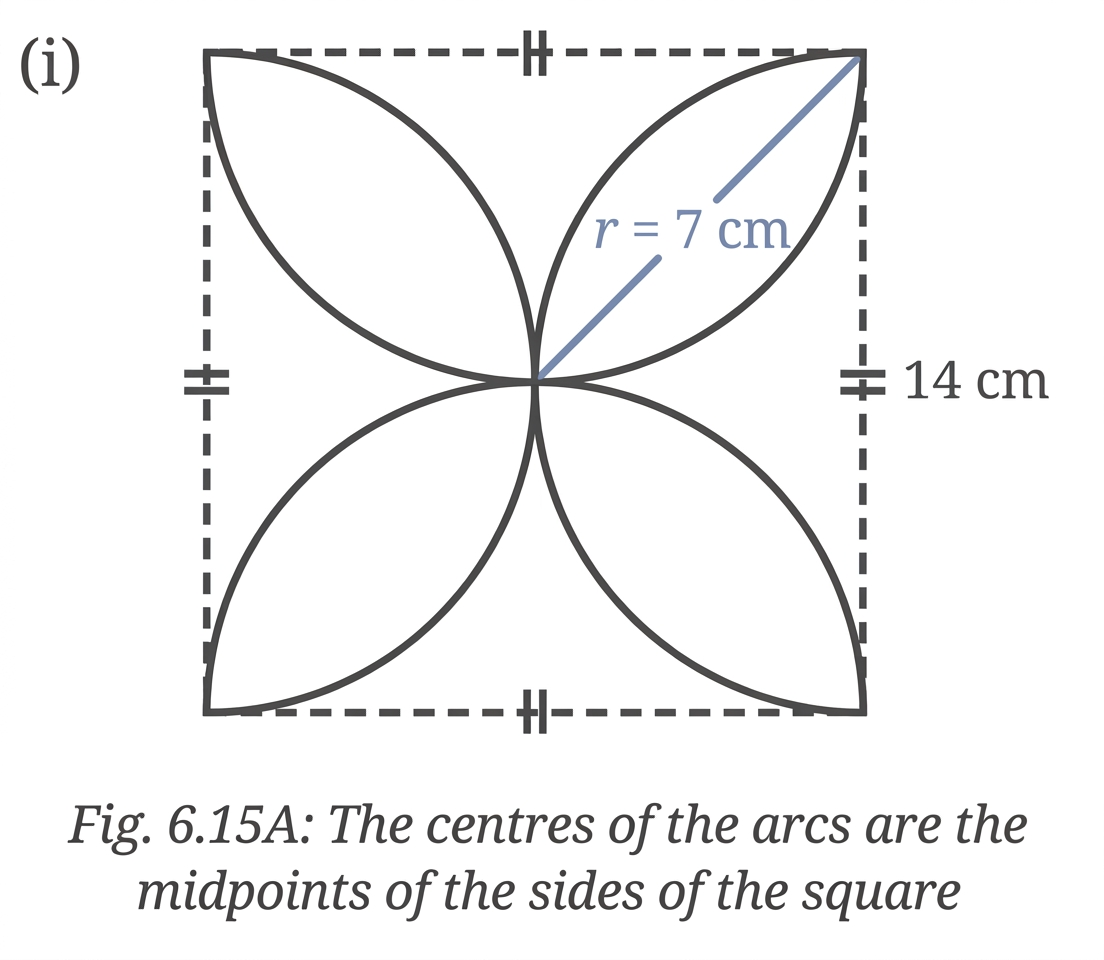
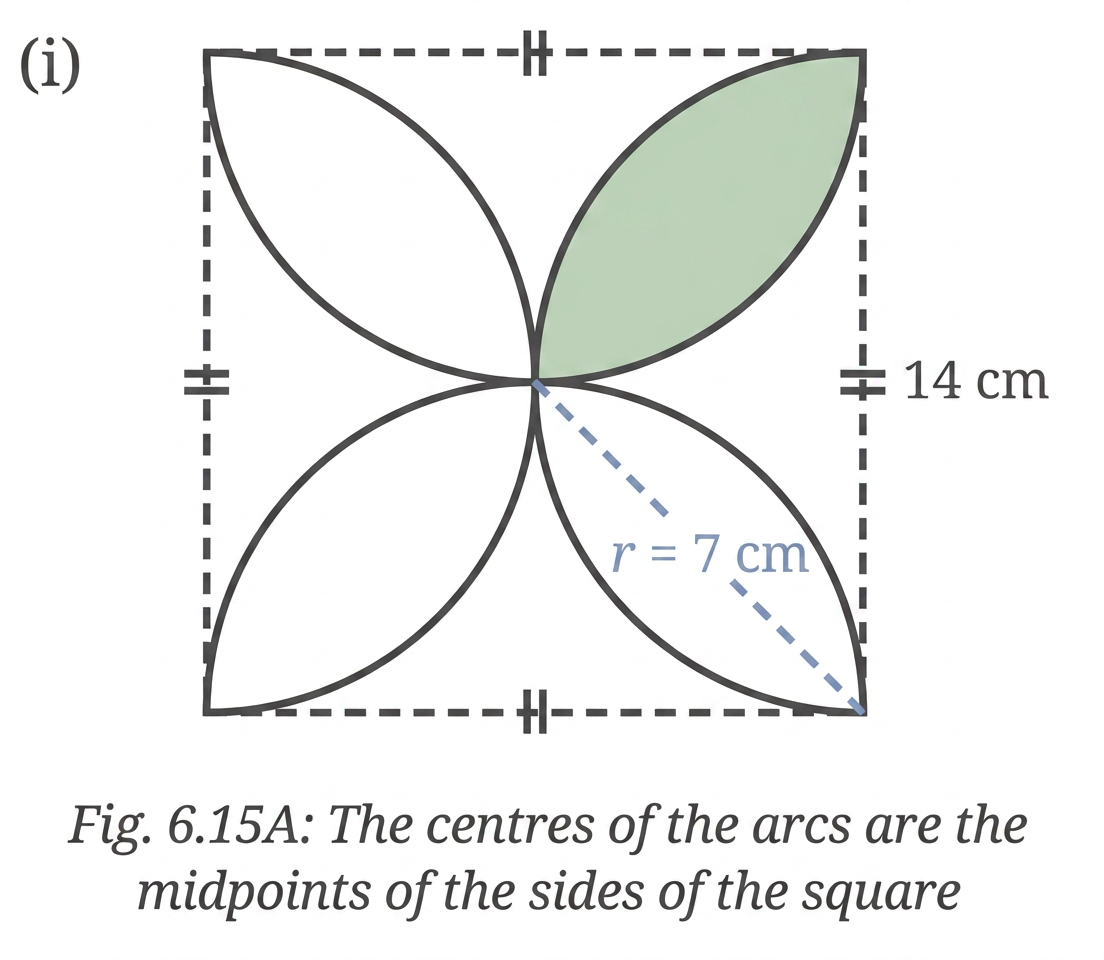
Let's analyze the first figure. The figure is a square. Its side length is 14 cm. The centers of the arcs are the midpoints of the sides. The radius of each arc is half the side length. So, the radius . Each petal consists of two quarter-circle arcs. The perimeter of one petal is the length of two quarter-circles. This is equal to the length of one semicircle. The length of a semicircle is . There are 4 petals in total. The total perimeter is 4 times the perimeter of one petal.
Step 2 — Calculate perimeter for Figure (ii)
Let's analyze the second figure. The figure is a regular hexagon. Its side length is 42 cm. The centers of the arcs are the vertices of the hexagon. The radius of each arc is the side length of the hexagon. So, the radius . Each petal consists of two arcs. Each arc subtends an angle of 60° at its center. This is because a regular hexagon can be divided into six equilateral triangles. The length of an arc is given by . For one arc, the length is . The perimeter of one petal is the length of two such arcs. So, the perimeter of one petal is . There are 6 petals in total. The total perimeter is 6 times the perimeter of one petal.
Answer
(i) The total perimeter of all the petals is 88 cm. (ii) The total perimeter of all the petals is 528 cm.
More questions in Exercise 6.1
Unless stated otherwise, use the approximation for .
- The perimeter of a circle is 44 cm. What is its radius?
Unless stated otherwise, use the approximation for .
- Calculate, correct to 3 significant figures, the circumference of a circle with: (i) radius 7 cm
(ii) radius 10 cm
(iii) radius 12 cm.
Unless stated otherwise, use the approximation for .
- Calculate the length of the arc of a circle if:
(i) the radius is and the angle at the centre is , and
(ii) the radius is and the angle at the centre is .
Unless stated otherwise, use the approximation for .
- Find the perimeter of a sector (i.e., the curved portion as well as the two straight portions) of a circle of radius 14 cm and sector angle 75°.
Unless stated otherwise, use the approximation for .
- Find the perimeters of the following shapes (taking the arcs to be quarter or half or three-quarters of a circle, as appropriate) (Fig. 6.14i to 6.14ix):
If the diameter of a car tyre is 56 cm, then:
(i) How far does the car need to travel for the tyre to complete one revolution?
(ii) How many revolutions does the tyre make if the car travels 10 km?
Find the total perimeter of all the petals in each of the given flowers.
The ratio of the perimeters of two circles is 5:4. What is the ratio of their radii?