Question 2
Explain why the following statement is true: If the perpendicular distance of a chord from the centre is and the radius is , then the chord length is .
We will use the properties of a circle and the Pythagorean theorem to find the chord length.
Step 1 — Setting up the geometry
Let's draw a circle. The center is O. Let AB be a chord. We draw a line from O to AB. This line is perpendicular to AB. Let it meet AB at point M. So, OM is the perpendicular distance. This distance is given as d. OA is the radius of the circle. The radius is given as r. A perpendicular from the center bisects the chord. So, M is the midpoint of AB. This means AM = MB. Also, is a right-angled triangle. The right angle is at M.
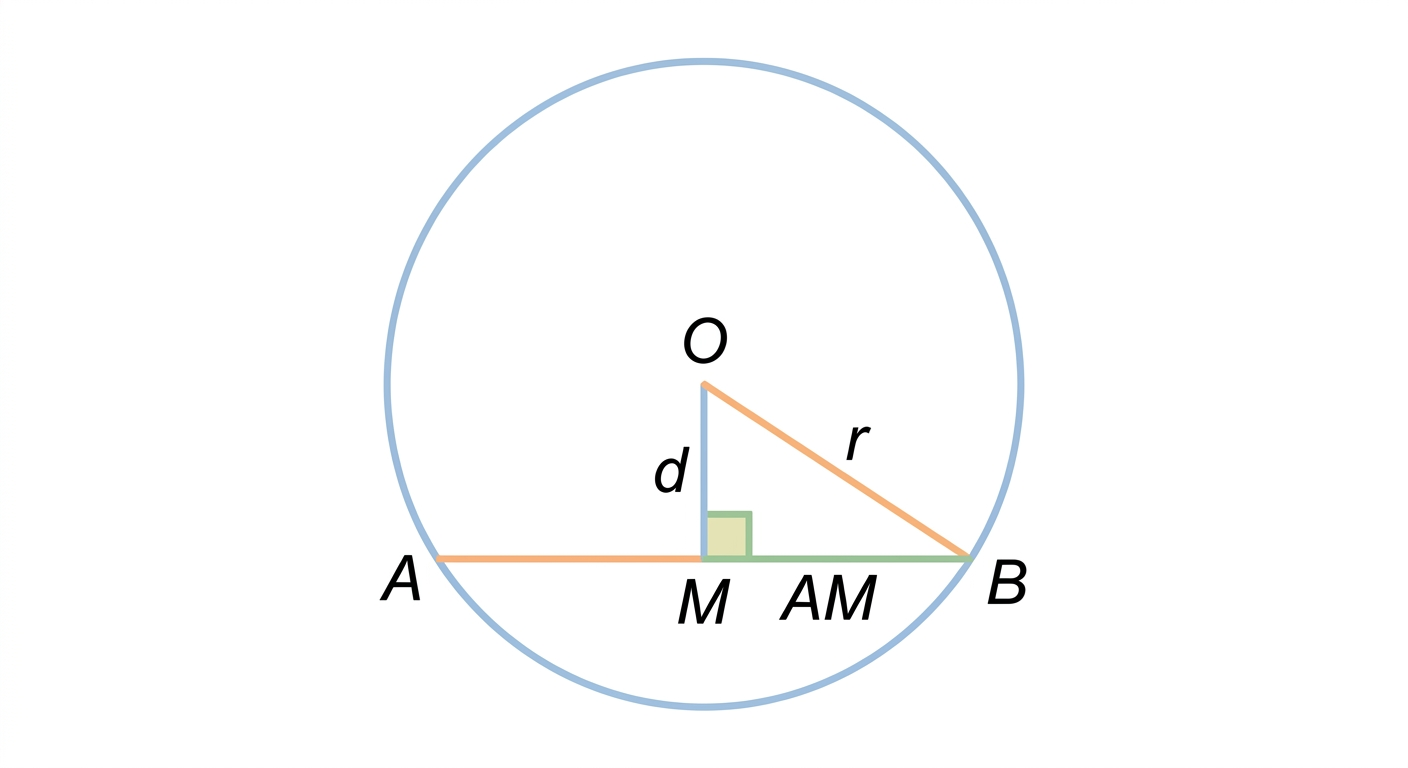
Step 2 — Applying Pythagoras theorem
In right triangle OMA, we use Pythagoras theorem.
We substitute the known values.
Now, we solve for .
Then, we find AM.
The chord length AB is .
Answer
The statement is true because the perpendicular from the centre to a chord bisects the chord, forming a right-angled triangle with the radius as the hypotenuse, the perpendicular distance as one leg, and half the chord length as the other leg. Applying the Pythagorean theorem, we find that half the chord length is , so the full chord length is .
More questions in Exercise 5.5
Find the length of the chord of a circle where the radius is 7 cm and perpendicular distance is 6 cm.
Explain why the following statement is true: If the perpendicular distance of a chord from the centre is and the radius is , then the chord length is .
In a circle, if the distance of chord AB from the centre is twice the distance of another chord CD from the centre, then can we conclude that CD = 2 AB? Give reasons for your answer.