Question 3
Will the square having half the sidelength have half the area? Why not? How many such squares will fill the original square?
Fold the square paper inward, as shown, such that the crease lines pass through the midpoints of the sides. PQRS is the required square with half the area.
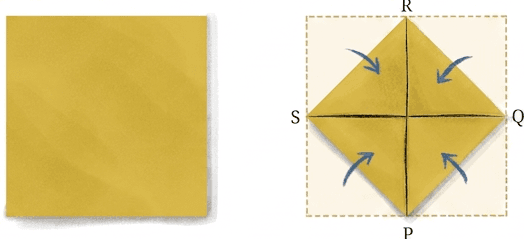
To solve this, we will compare the areas of squares with different side lengths and analyze the effect of the given folding method.
Step 1 — Area of a square with half the sidelength
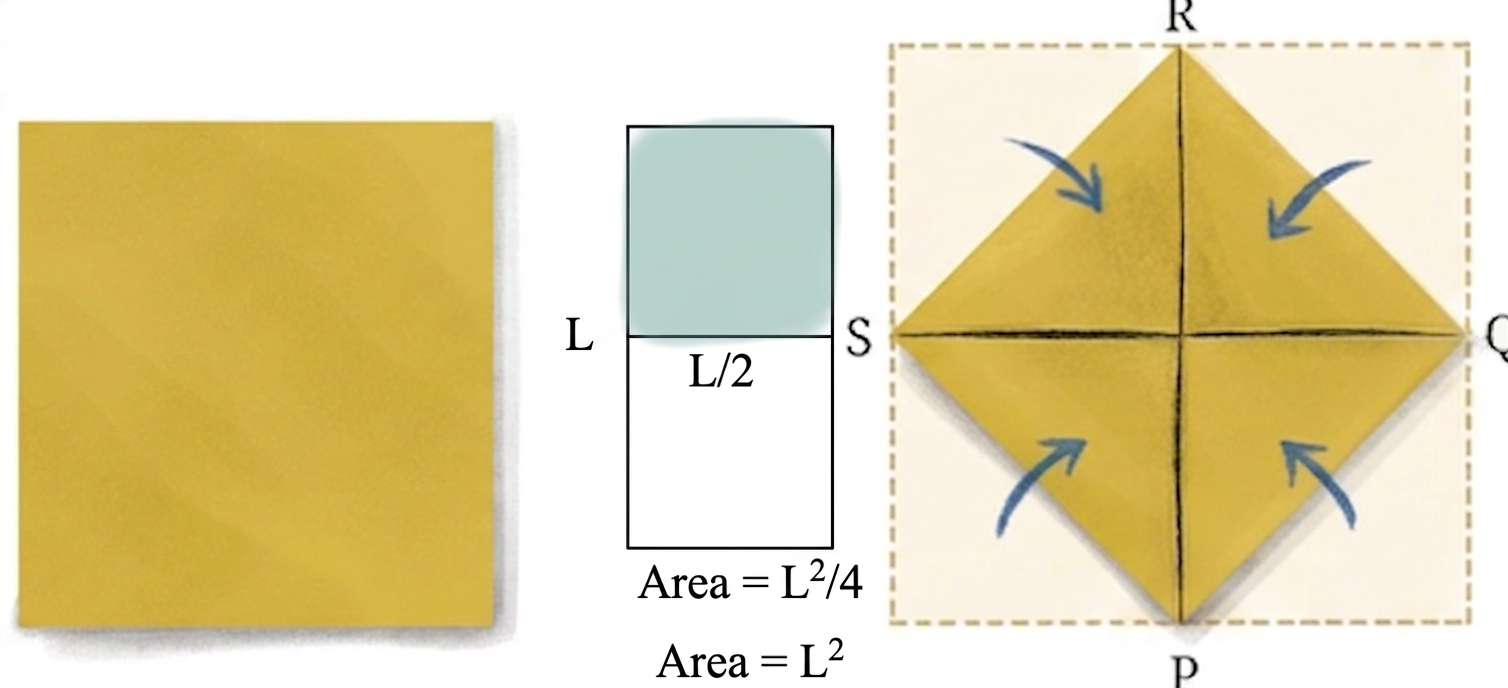
Let us take an original square. Let its side length be . The area of this original square is . Now, let us consider a new square. Its side length is half of the original square's side length. So, the new side length is . The area of this new square is . We can see that is one-fourth of . It is not half of .
Step 2 — Why the area is not half
The area of the original square is . The area of the square with half the sidelength is . This means the area becomes one-fourth, not one-half. This happens because we are multiplying the side length by itself. When we halve the side length, we are effectively halving both dimensions (length and width). So, the area reduces by a factor of .
Step 3 — Number of smaller squares to fill the original
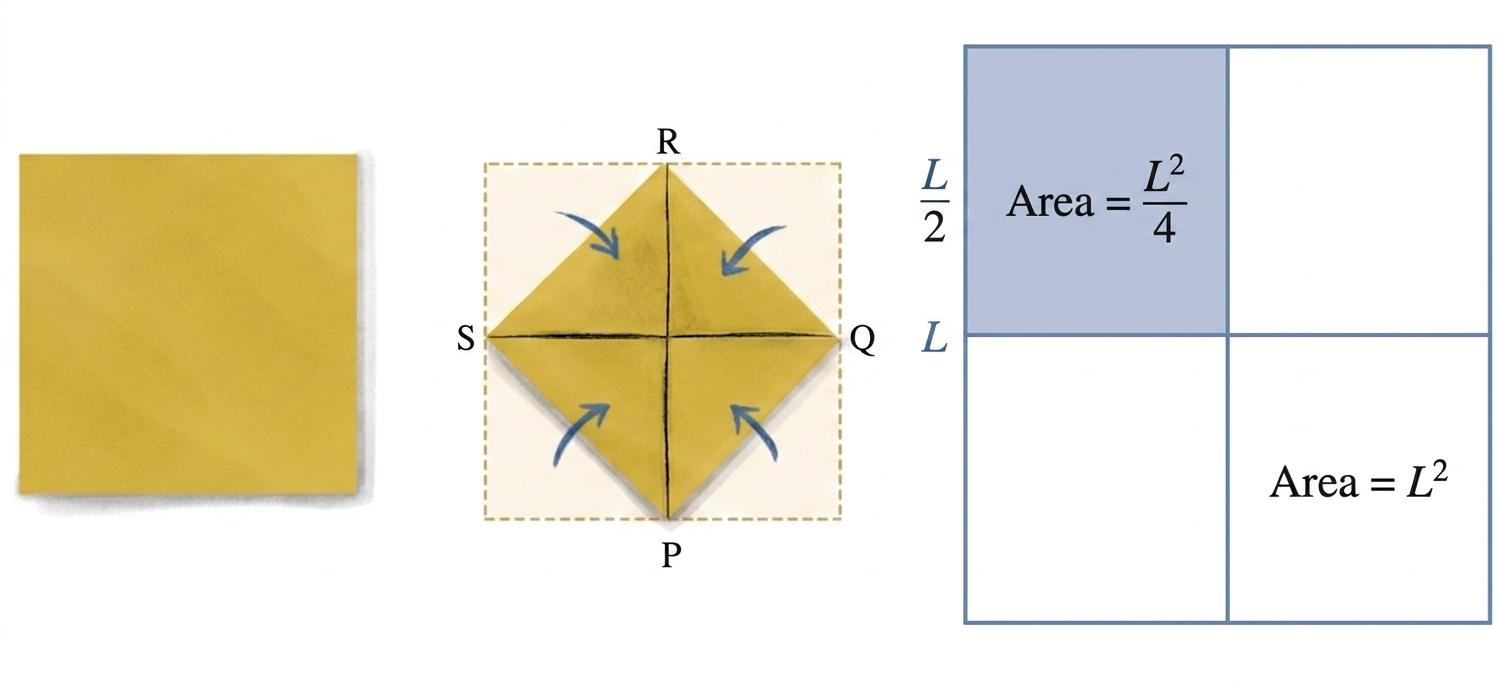
The area of the original square is . The area of a square with half the sidelength is . To find how many smaller squares fit into the original square, we divide the areas. So, four such squares will fill the original square.
Step 4 — Understanding the folding process and area of PQRS
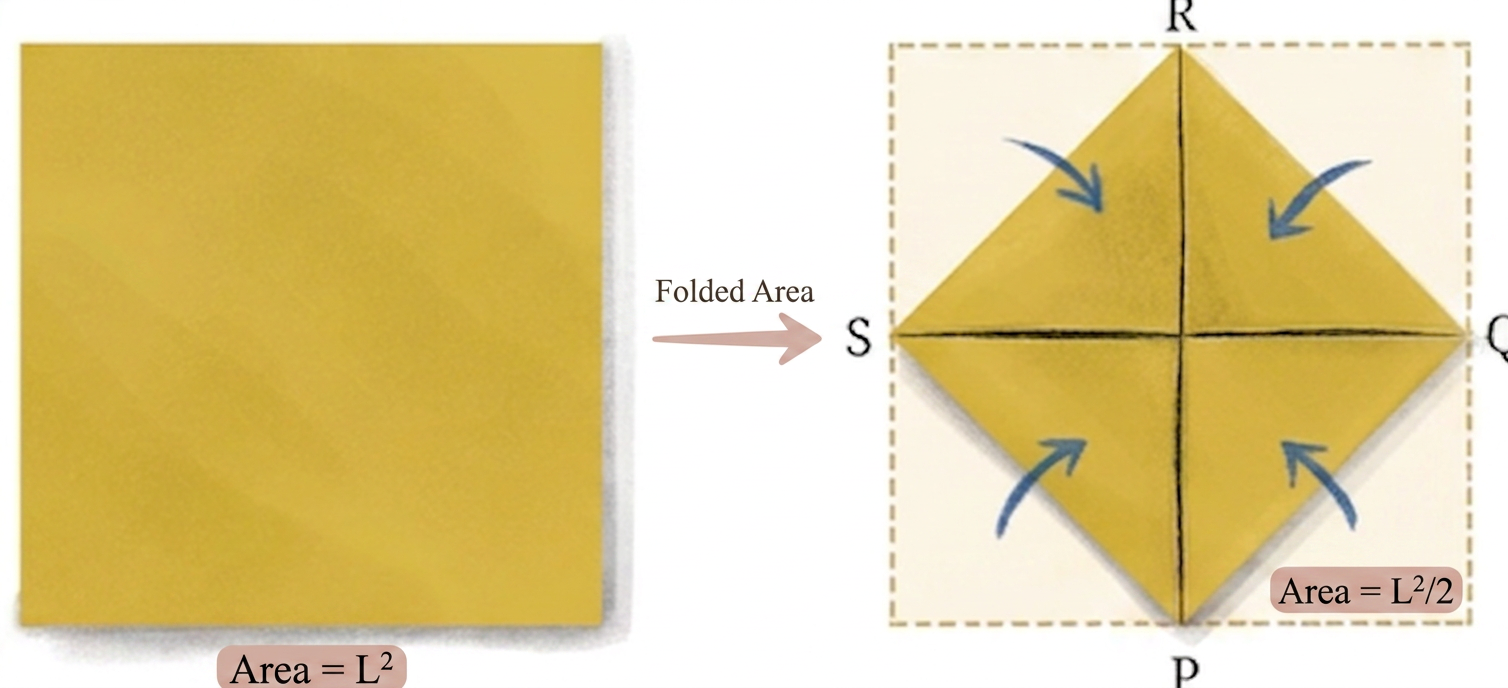
Let us consider the original square paper. Let its side length be . The area of this original square is . The diagram shows that we fold the corners of the original square inwards. The crease lines pass through the midpoints of the sides. This means the points P, Q, R, S are the midpoints of the sides of the original square. Let the original square be named ABCD. Let R be the midpoint of side AB, Q be the midpoint of side BC, P be the midpoint of side CD, and S be the midpoint of side DA. When we connect these midpoints (P, Q, R, S), we form a new square inside the original square. This is the square PQRS. We can find the area of square PQRS by subtracting the areas of the four corner triangles from the area of the original square. Look at one corner, for example, the top-right corner. The triangle formed by folding this corner has sides of length (half the side length of the original square). This is a right-angled triangle. The area of one such corner triangle is . There are four such corner triangles that are folded inwards. The total area of these four corner triangles is . The area of the square PQRS is the area of the original square minus the total area of the four corner triangles. So, the square PQRS has exactly half the area of the original square.
Answer
(i) No, a square having half the sidelength will not have half the area. (ii) A square with half the sidelength will have one-fourth of the original area. This is because the area depends on the square of the side length. If the side length is , the area is . If the side length is , the area is . (iii) Four such squares (with half the sidelength) will fill the original square.
More questions in A
Cut out two identical squares of paper. Draw, label, and cut as follows:
Now place the pieces 5, 6, 7, and 8 around Square 1 to get a square with double the area.
Halving a Square Using Paper
Cut out a square from a piece of paper. Now make a square whose area is half the area of the first square.
Will the square having half the sidelength have half the area? Why not? How many such squares will fill the original square?
Fold the square paper inward, as shown, such that the crease lines pass through the midpoints of the sides. PQRS is the required square with half the area.
There are 3 closed boxes—one containing only red balls, the second containing only blue balls and the third containing only green balls. The boxes are labelled RED, BLUE and GREEN such that ‘no’ box has the correct label. We need to find which label goes with which box. How can this be done if we are allowed to open only one box?