Question 4
Solve the following Binairo puzzles:
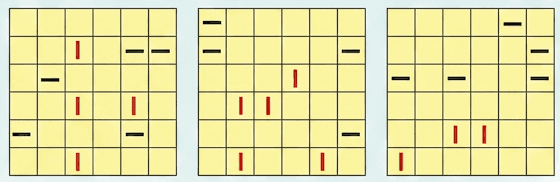
Binairo puzzles require us to fill a grid such that each row and column has an equal number of two symbols, and no more than two identical symbols are adjacent horizontally or vertically. For a 6x6 grid, this means each row and column must contain three black dashes ('0') and three red vertical lines ('1').
Step 1 — Solving Grid 1
Let us represent black dashes as '0' and red vertical lines as '1'. We start by applying the rules to the initial grid.
We observe cells (1,5) and (1,6) are '0 0'. So, cell (1,4) must be '1'. We observe cells (1,3) and (1,4) are '1 1'. So, cell (1,2) must be '0'. Row 1 now has '0' at (1,2), '1' at (1,3), '1' at (1,4), '0' at (1,5), '0' at (1,6). It has two '1's and three '0's. To balance the row, cell (1,1) must be '1'.
Column 3 has '1' at (1,3), '1' at (3,3), and '1' at (5,3). This column already contains three '1's. Therefore, cells (2,3), (4,3), and (6,3) must all be '0'.
Column 2 has '0' at (1,2) and '0' at (2,2). So, cell (3,2) must be '1'. Row 3 has '1' at (3,2), '1' at (3,3), and '1' at (3,5). This row already contains three '1's. Therefore, cells (3,1), (3,4), and (3,6) must all be '0'.
Row 2 has '0' at (2,2) and '0' at (2,3). So, cell (2,1) must be '1'. Row 2 now has '1' at (2,1), '0' at (2,2), and '0' at (2,3). So, cell (2,4) must be '1'.
\boxed{\text{R2: 1 0 0 1 _ _}}
Column 1 has '1' at (1,1), '1' at (2,1), '0' at (3,1), and '0' at (4,1). It has two '1's and two '0's. Cell (5,1) cannot be '0' because (3,1) and (4,1) are '0 0'. So, (5,1) must be '1'. Column 1 now has '1' at (1,1), '1' at (2,1), '0' at (3,1), '0' at (4,1), and '1' at (5,1). It has three '1's and two '0's. Therefore, cell (6,1) must be '0'.
Row 6 has '0' at (6,1), '0' at (6,3), and '1' at (6,4). It has one '1' and two '0's. Cell (6,2) cannot be '0' because (6,1) and (6,3) are '0 0'. So, (6,2) must be '1'.
\boxed{\text{R6: 0 1 0 1 _ _}}
Row 4 has '0' at (4,1) and '0' at (4,3). So, cell (4,2) must be '1'. Column 2 now has '0' at (1,2), '0' at (2,2), '1' at (3,2), '1' at (4,2), and '1' at (6,2). It has two '0's and three '1's. Therefore, cell (5,2) must be '0'.
Column 4 has '1' at (1,4), '1' at (2,4), '0' at (3,4), '0' at (5,4), and '1' at (6,4). It has three '1's and two '0's. Therefore, cell (4,4) must be '0'.
Row 4 has '0' at (4,1), '1' at (4,2), '0' at (4,3), and '0' at (4,4). It has three '0's and one '1'. Cell (4,5) cannot be '0' because (4,3) and (4,4) are '0 0'. So, (4,5) must be '1'. Row 4 now has '0' at (4,1), '1' at (4,2), '0' at (4,3), '0' at (4,4), and '1' at (4,5). It has three '0's and two '1's. Therefore, cell (4,6) must be '1'.
Column 5 has '0' at (1,5), '1' at (3,5), and '1' at (4,5). It has one '0' and two '1's. Cell (2,5) cannot be '1' because (3,5) and (4,5) are '1 1'. So, (2,5) must be '0'. Column 5 now has '0' at (1,5), '0' at (2,5), '1' at (3,5), and '1' at (4,5). It has two '0's and two '1's. Cell (5,5) cannot be '1' because (3,5) and (4,5) are '1 1'. So, (5,5) must be '0'. Column 5 now has '0' at (1,5), '0' at (2,5), '1' at (3,5), '1' at (4,5), and '0' at (5,5). It has three '0's and two '1's. Therefore, cell (6,5) must be '1'.
Row 2 has '1' at (2,1), '0' at (2,2), '0' at (2,3), '1' at (2,4), and '0' at (2,5). It has two '1's and three '0's. Therefore, cell (2,6) must be '1'.
Row 5 has '1' at (5,1), '0' at (5,2), '1' at (5,3), '0' at (5,4), and '0' at (5,5). It has two '1's and three '0's. Therefore, cell (5,6) must be '1'.
Row 6 has '0' at (6,1), '1' at (6,2), '0' at (6,3), '1' at (6,4), and '1' at (6,5). It has three '1's and two '0's. Therefore, cell (6,6) must be '0'.
All cells are now filled, and all rules are satisfied.
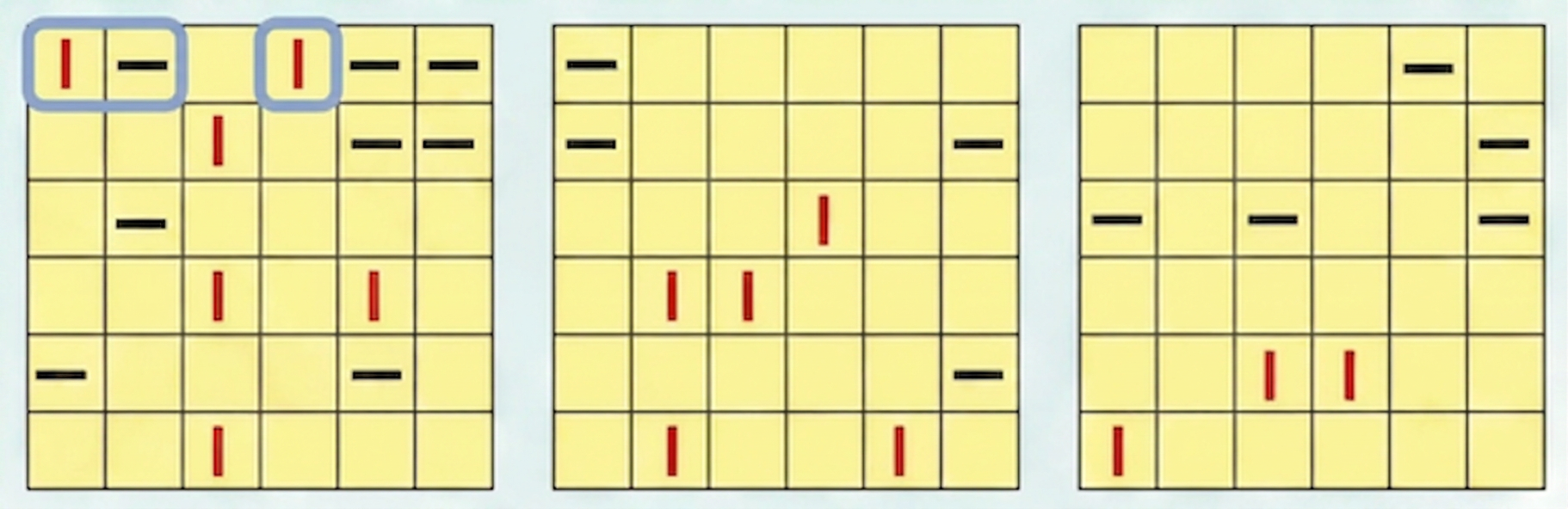
Step 6 — Solving Grid 2
Let us represent black dashes as '0' and red vertical lines as '1'. We apply the rules to the initial grid.
Column 1 has '0' at (1,1) and '0' at (2,1). So, cell (3,1) must be '1'.
\boxed{\text{C1: 0 0 1 _ _ _}}
Row 3 has '1' at (3,1), '1' at (3,3), and '1' at (3,5). This row already contains three '1's. Therefore, cells (3,2), (3,4), and (3,6) must all be '0'.
Column 3 has '1' at (3,3), '1' at (4,3), and '1' at (6,3). This column already contains three '1's. Therefore, cells (1,3), (2,3), and (5,3) must all be '0'.
Row 1 has '0' at (1,1) and '0' at (1,3). So, cell (1,2) must be '1'.
\boxed{\text{R1: 0 1 0 _ _ _}}
Row 2 has '0' at (2,1) and '0' at (2,3). So, cell (2,2) must be '1'.
\boxed{\text{R2: 0 1 0 _ _ _}}
Row 4 has '1' at (4,3) and '1' at (4,5). So, cell (4,4) must be '0'.
\boxed{\text{R4: _ _ 1 0 1 _}}
Row 5 has '0' at (5,3) and '0' at (5,6). So, cell (5,4) must be '1'.
\boxed{\text{R5: _ _ 0 1 _ 0}}
Row 6 has '1' at (6,3) and '1' at (6,6). So, cell (6,5) must be '0'.
\boxed{\text{R6: _ _ 1 _ 0 1}}
Column 5 has '1' at (3,5), '1' at (4,5), and '0' at (6,5). It has two '1's and one '0'. Cell (5,5) cannot be '1' because (3,5) and (4,5) are '1 1'. So, (5,5) must be '0'.
\boxed{\text{C5: _ _ 1 1 0 0}}
Row 5 has '0' at (5,3), '1' at (5,4), '0' at (5,5), and '0' at (5,6). It has three '0's and one '1'. Cell (5,2) cannot be '0' because (5,3) is '0'. So, (5,2) must be '1'. Row 5 now has '1' at (5,2), '0' at (5,3), '1' at (5,4), '0' at (5,5), and '0' at (5,6). It has two '1's and three '0's. Therefore, cell (5,1) must be '1'.
Column 1 has '0' at (1,1), '0' at (2,1), '1' at (3,1), and '1' at (5,1). It has two '0's and two '1's. Cell (4,1) cannot be '1' because (3,1) and (5,1) are '1 1'. So, (4,1) must be '0'. Column 1 now has '0' at (1,1), '0' at (2,1), '1' at (3,1), '0' at (4,1), and '1' at (5,1). It has three '0's and two '1's. Therefore, cell (6,1) must be '1'.
Column 2 has '1' at (1,2), '1' at (2,2), '0' at (3,2), and '1' at (5,2). It has three '1's and one '0'. Cell (4,2) cannot be '1' because (2,2) and (5,2) are '1 1'. So, (4,2) must be '0'. Column 2 now has '1' at (1,2), '1' at (2,2), '0' at (3,2), '0' at (4,2), and '1' at (5,2). It has three '1's and two '0's. Therefore, cell (6,2) must be '0'.
Row 4 has '0' at (4,1), '0' at (4,2), '1' at (4,3), '0' at (4,4), and '1' at (4,5). It has three '0's and two '1's. Therefore, cell (4,6) must be '1'.
Column 4 has '1' at (1,4), '0' at (3,4), '0' at (4,4), and '1' at (5,4). It has two '1's and two '0's. Cell (2,4) cannot be '0' because (3,4) and (4,4) are '0 0'. So, (2,4) must be '1'. Column 4 now has '1' at (1,4), '1' at (2,4), '0' at (3,4), '0' at (4,4), and '1' at (5,4). It has three '1's and two '0's. Therefore, cell (6,4) must be '0'.
Row 1 has '0' at (1,1), '1' at (1,2), '0' at (1,3), and '1' at (1,4). It has two '0's and two '1's. Cell (1,5) cannot be '1' because (1,4) is '1'. So, (1,5) must be '0'. Row 1 now has '0' at (1,1), '1' at (1,2), '0' at (1,3), '1' at (1,4), and '0' at (1,5). It has three '0's and two '1's. Therefore, cell (1,6) must be '1'.
Column 6 has '1' at (1,6), '0' at (3,6), '1' at (4,6), '0' at (5,6), and '1' at (6,6). It has three '1's and two '0's. Therefore, cell (2,6) must be '0'.
Row 2 has '0' at (2,1), '1' at (2,2), '0' at (2,3), '1' at (2,4), and '0' at (2,6). It has two '1's and three '0's. Therefore, cell (2,5) must be '1'.
All cells are now filled, and all rules are satisfied.
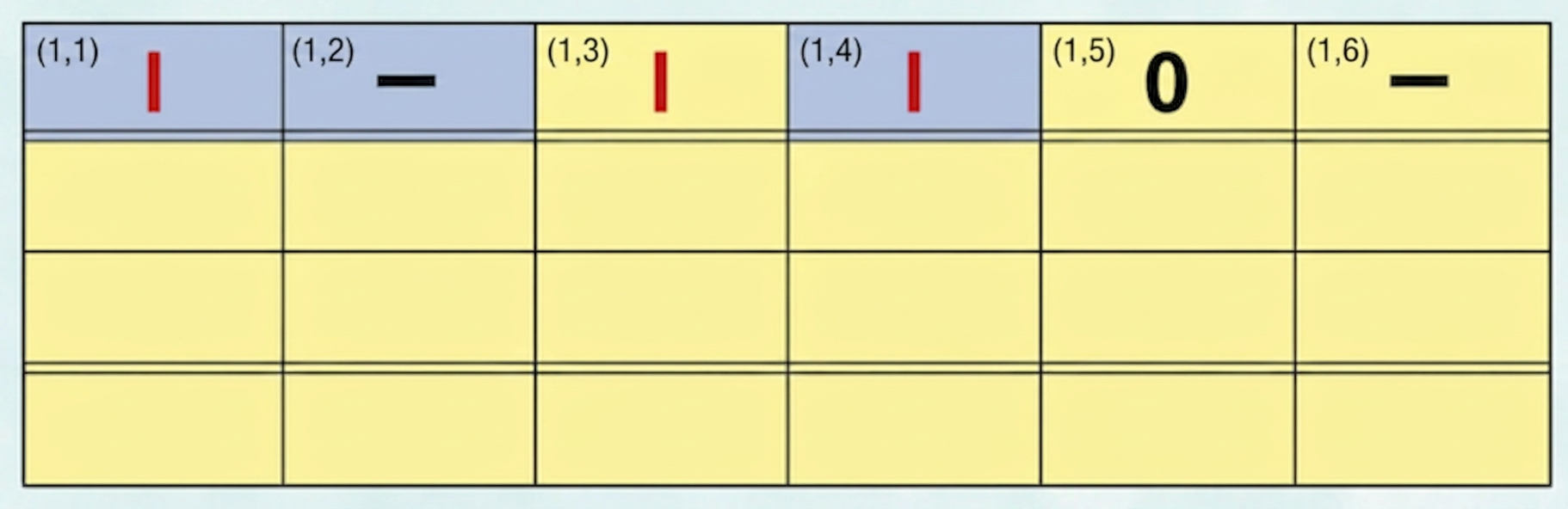
Step 7 — Solving Grid 3
Let us represent black dashes as '0' and red vertical lines as '1'. We apply the rules to the initial grid.
Column 6 has '0' at (2,6) and '0' at (3,6). So, cell (1,6) must be '1'.
\boxed{\text{C6: _ _ _ _ _ 1 0 0}}
Row 1 has '0' at (1,5) and '1' at (1,6). Cell (1,4) cannot be '0' because (1,5) is '0'. So, (1,4) must be '1'.
\boxed{\text{R1: _ _ _ 1 0 1}}
Row 3 has '0' at (3,2) and '0' at (3,6). Cell (3,1) cannot be '0' because (3,2) is '0'. So, (3,1) must be '1'.
\boxed{\text{R3: 1 0 _ _ _ 0}}
Column 1 has '1' at (3,1) and '1' at (6,1). It has two '1's. Cell (1,1) cannot be '1' because (3,1) is '1'. So, (1,1) must be '0'. Cell (2,1) cannot be '1' because (3,1) is '1'. So, (2,1) must be '0'.
\boxed{\text{C1: 0 0 1 _ _ 1}}
Row 2 has '0' at (2,1) and '0' at (2,6). Cell (2,5) cannot be '0' because (2,6) is '0'. So, (2,5) must be '1'.
\boxed{\text{R2: 0 _ _ _ 1 0}}
Column 5 has '0' at (1,5) and '1' at (2,5). Cell (3,5) cannot be '1' because (2,5) is '1'. So, (3,5) must be '0'.
\boxed{\text{C5: 0 1 0 _ _ _}}
Row 3 has '1' at (3,1), '0' at (3,2), '0' at (3,5), and '0' at (3,6). It has one '1' and three '0's. Cell (3,3) cannot be '0' because (3,2) and (3,5) are '0 0'. So, (3,3) must be '1'. Row 3 now has '1' at (3,1), '0' at (3,2), '1' at (3,3), '0' at (3,5), and '0' at (3,6). It has two '1's and three '0's. Therefore, cell (3,4) must be '1'.
Column 3 has '1' at (1,3), '1' at (3,3), and '1' at (5,3). This column already contains three '1's. Therefore, cells (2,3), (4,3), and (6,3) must all be '0'.
Column 4 has '1' at (1,4) and '1' at (3,4). Cell (2,4) cannot be '1' because (1,4) and (3,4) are '1 1'. So, (2,4) must be '0'. However, if (2,4) is '0', then Row 2 would be '0 _ 0 0 1 0', which has two '1's and four '0's, violating the rule. Therefore, (2,4) must be '1'. Column 4 now has '1' at (1,4), '1' at (2,4), and '1' at (3,4). This column already contains three '1's. Therefore, cells (4,4), (5,4), and (6,4) must all be '0'.
Row 2 has '0' at (2,1), '0' at (2,3), '1' at (2,4), '1' at (2,5), and '0' at (2,6). It has three '0's and two '1's. Cell (2,2) cannot be '0' because (2,1) is '0'. So, (2,2) must be '1'.
Column 2 has '0' at (1,2), '1' at (2,2), '0' at (3,2), and '1' at (5,2). It has two '0's and two '1's. Cell (4,2) cannot be '0' because (3,2) is '0'. So, (4,2) must be '1'. Column 2 now has '0' at (1,2), '1' at (2,2), '0' at (3,2), '1' at (4,2), and '1' at (5,2). It has two '0's and three '1's. Therefore, cell (6,2) must be '0'.
Row 1 has '0' at (1,1), '0' at (1,2), '1' at (1,4), '0' at (1,5), and '1' at (1,6). It has three '0's and two '1's. Cell (1,3) cannot be '0' because (1,1) and (1,2) are '0 0'. So, (1,3) must be '1'.
Row 4 has '0' at (4,1), '1' at (4,2), '0' at (4,3), and '0' at (4,4). It has three '0's and one '1'. Cell (4,5) cannot be '0' because (4,3) and (4,4) are '0 0'. So, (4,5) must be '1'. Row 4 now has '0' at (4,1), '1' at (4,2), '0' at (4,3), '0' at (4,4), and '1' at (4,5). It has three '0's and two '1's. Therefore, cell (4,6) must be '1'.
Row 5 has '1' at (5,1), '1' at (5,2), '1' at (5,3), and '0' at (5,4). It has three '1's and one '0'. Cell (5,5) cannot be '1' because (5,3) and (5,4) are '1 0'. Cell (5,5) must be '0' because (5,4) is '0'. Row 5 now has '1' at (5,1), '1' at (5,2), '1' at (5,3), '0' at (5,4), and '0' at (5,5). It has three '1's and two '0's. Therefore, cell (5,6) must be '0'.
Row 6 has '1' at (6,1), '0' at (6,2), '0' at (6,3), and '0' at (6,4). It has one '1' and three '0's. Cell (6,5) cannot be '0' because (6,2), (6,3), and (6,4) are '0 0 0'. So, (6,5) must be '1'. Row 6 now has '1' at (6,1), '0' at (6,2), '0' at (6,3), '0' at (6,4), and '1' at (6,5). It has two '1's and three '0's. Therefore, cell (6,6) must be '1'.
All cells are now filled, and all rules are satisfied.

Answer
(i) The completed Grid 1 is: | - | | - - | - - | - |
- | | - | -
- | - - | | | - | - - |
- | - | | -
(ii) The completed Grid 2 is:
- | - | - |
- | - | | - | - | - | -
- | - | | | | - | - - | - | - - |
(iii) The completed Grid 3 is:
- | | - |
- | - | | - | - | | - -
- | - - | | | | | - - - | - - - | |
More questions in A
Take your favourite dish. Find out all the ingredients and their respective quantities needed to make the dish for your family. Suppose you are celebrating a festival and you want to invite 15 guests. Find out the quantities of the ingredients required to cook the same dish for them.
Go to the market and collect the prices of different sizes of shampoo containers of the same shampoo and create a table like the one given below. See if the volume of shampoo is proportional to the price.
Activity 3: Form a pair. Collect 12 countable objects or counters (it can be coins, seeds, or pebbles). Now, share them between the two of you in different ways.
Solve the following Binairo puzzles: