Question 1
How many times can you fold it over and over?
Estu says “I heard that a sheet of paper can’t be folded more than 7 times”.
Roxie replies “What if we use a thinner paper, like a newspaper or a tissue paper?”
Try it with different types of paper and see what happens.
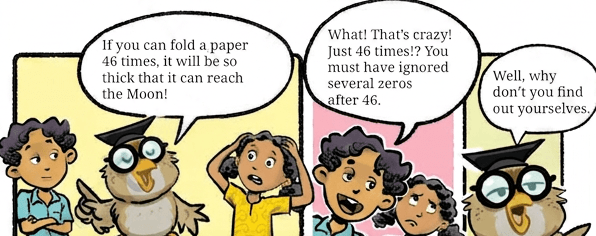
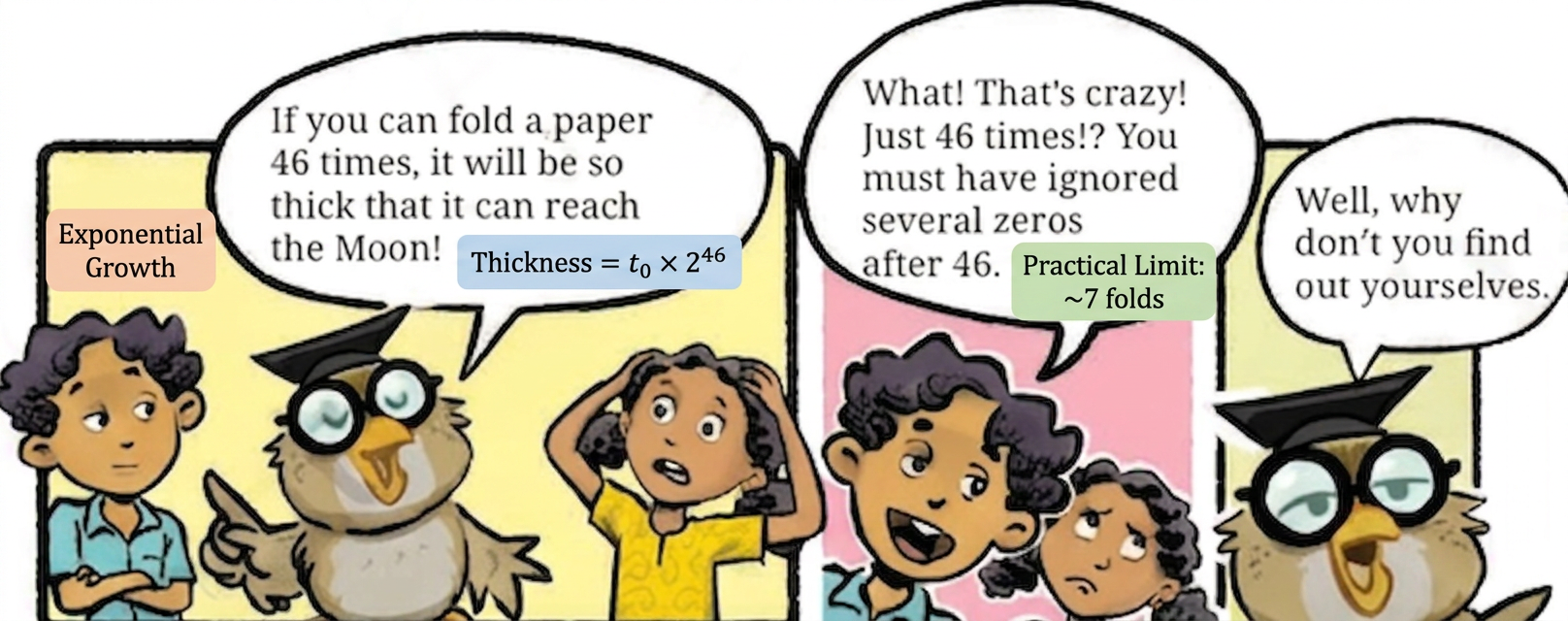
Folding paper repeatedly doubles its thickness, leading to very rapid growth, but physical limits prevent many folds.
Step 1 — The Power of Folding
When we fold a piece of paper, its thickness doubles with each fold. This is an example of exponential growth.
Let us assume a standard paper thickness is about .
After 1 fold, the thickness becomes:
After 2 folds, the thickness becomes:
After 3 folds, the thickness becomes:
After 4 folds, the thickness becomes:
We can see the thickness grows very quickly.
Step 2 — Reaching the Moon (Theoretically)
Let us use the initial paper thickness . We need to convert this to meters: .
The average distance to the Moon is about . We convert this to meters: .
The thickness after folds is given by . We want to find if is greater than or equal to the Moon's distance.
Let us calculate the thickness after 46 folds:
We know that is approximately . So, .
Since is much larger than , the owl's statement is theoretically correct.
Step 3 — Practical Limitations of Folding
While theoretically possible, folding paper many times is practically impossible due to several reasons:
The paper becomes too thick. Each fold doubles the thickness, making it harder to bend.
The paper's area shrinks. Each fold halves the paper's surface area, making it too small to fold further.
The force required increases. As the paper gets thicker and smaller, more force is needed to make a crease.
For a standard sheet of paper, like A4 size, the maximum number of folds is typically 7 or 8 times. This is a common observation.
If we use thinner paper, like newspaper or tissue paper, we can fold it a few more times. Thinner paper is more flexible and takes up less space per fold. For example, a very large sheet of thin paper has been folded up to 12 times in experiments. However, even with very thin and large paper, there is still a physical limit.
Answer
(i) Theoretically, a paper can be folded about 42 to 46 times to reach the Moon's distance, as its thickness grows exponentially. (ii) Practically, a standard sheet of paper can be folded a maximum of 7 to 8 times. (iii) Using thinner paper, like newspaper or tissue paper, allows for a few more folds, typically up to 9 to 12 times, before it becomes too thick and small to fold further.
More questions in A
How many times can you fold it over and over?
Estu says “I heard that a sheet of paper can’t be folded more than 7 times”.
Roxie replies “What if we use a thinner paper, like a newspaper or a tissue paper?”
Try it with different types of paper and see what happens.
Think about how many combinations are possible in different contexts. Some examples are—
(i) Pincodes of places in India—The Pincode of Vidisha in Madhya Pradesh is 464001. The Pincode of Zemabawk in Mizoram is 796017.
(ii) Mobile numbers.
(iii) Vehicle registration numbers.
Try to find out how these numbers or codes are allotted/generated.
Tremendous in Ten!
Find a partner to play this game with. In 10 seconds, the person who writes a number or an expression, using only the digits 0-9 and arithmetic operations, that gives a number that is the larger between the two wins the round.
Below are some conditions that you may consider for different rounds.
(i) Exponents are not allowed. Only addition is allowed.
(ii) Exponents are not allowed. Only addition and multiplication are allowed.
(iii) Exponents are allowed. Only addition is allowed.
(iv) Exponents are allowed. Any arithmetic operation is allowed.
You can create your own conditions and/or involve more people to play together.