Question 3
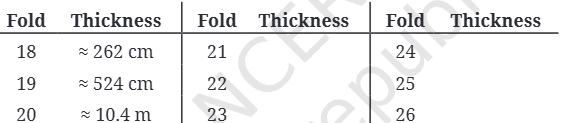
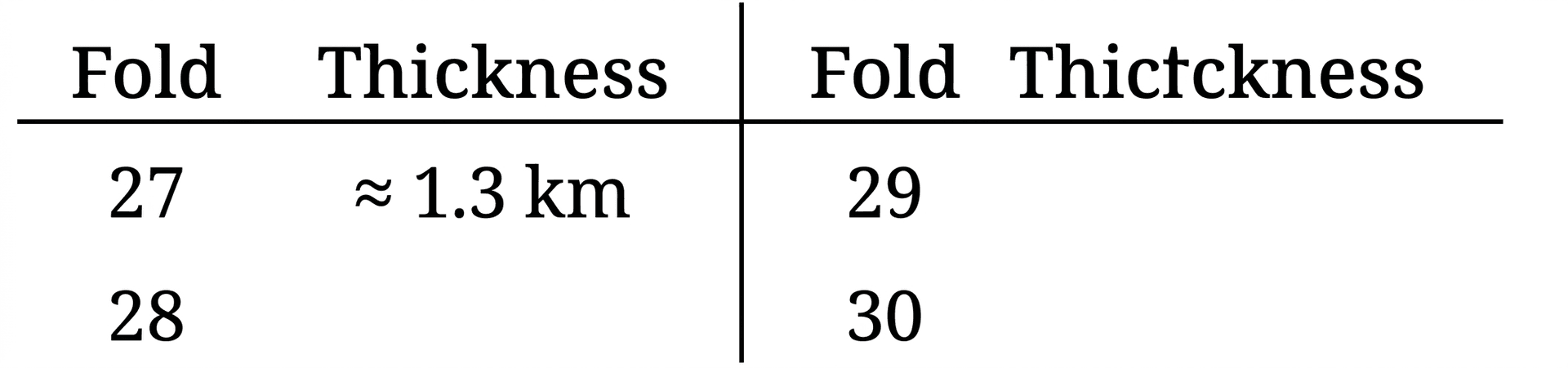
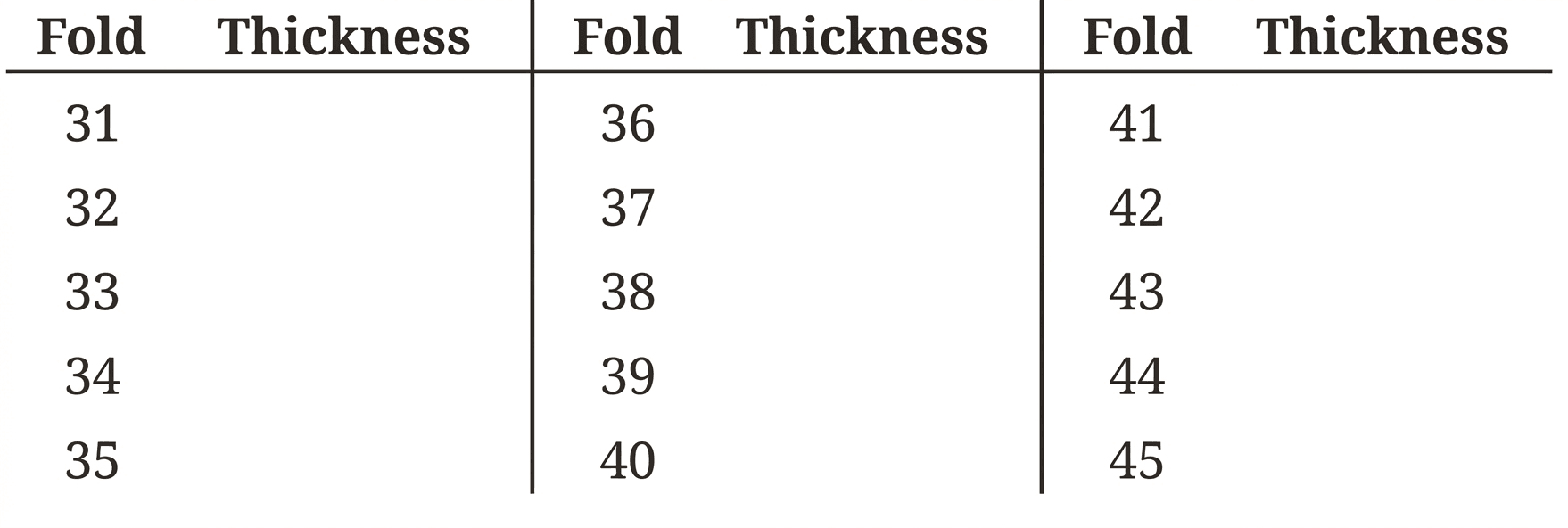
Fill the table below.
IT-3
Chapter: POWER PLAY (EXPONENTS)
Class: 8 (Class 8)
Category: in_text
Question
Fill the table below.
Question diagram(s):
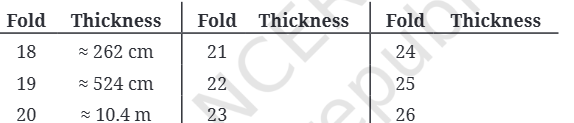
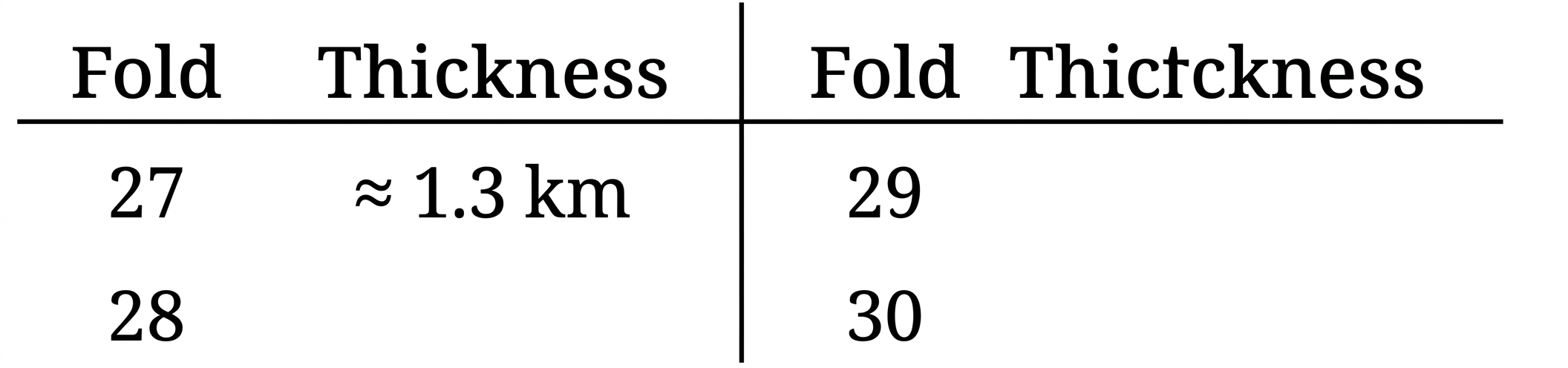
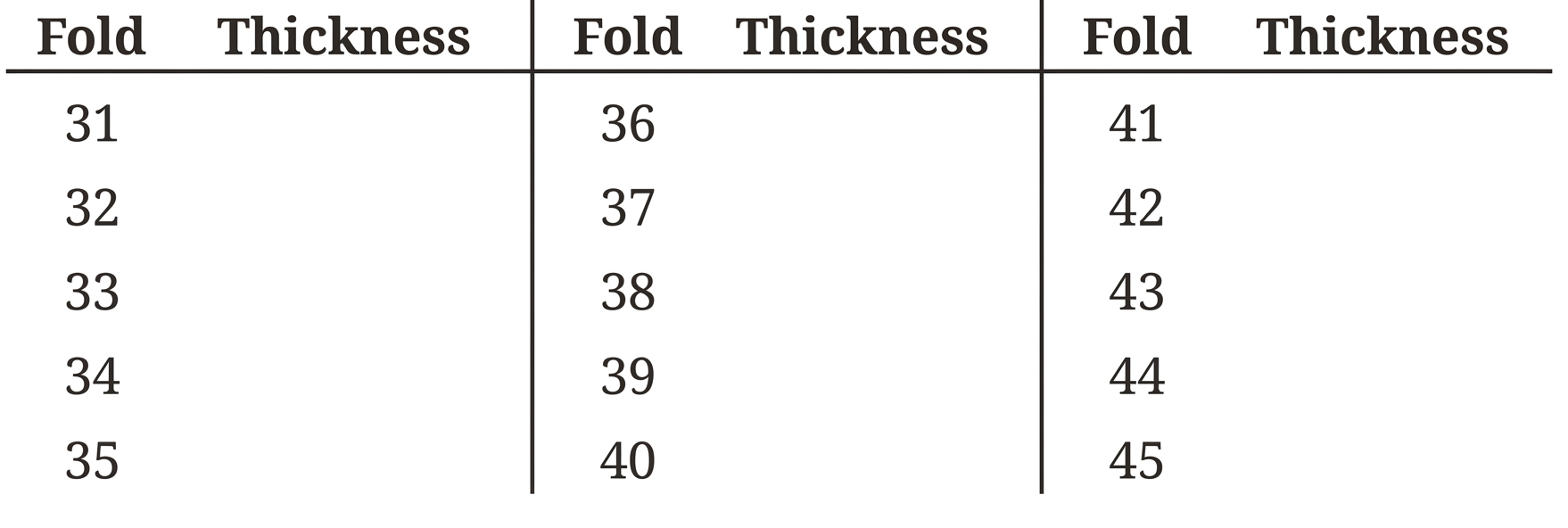
The thickness of the paper approximately doubles with each fold.
Step 1 — Identify the pattern
We are given the thickness for several folds. Let be the thickness for Fold . The thickness for Fold 18 is . The thickness for Fold 19 is . We observe that is . The thickness for Fold 20 is . Let us convert to centimeters for comparison. If we double the thickness of Fold 19, we get . The given value for Fold 20 () is approximately . This confirms that the thickness approximately doubles with each fold. We will use the given approximate values for subsequent calculations, rounding to one decimal place for meters and kilometers.
Step 2 — Calculate thickness for Folds 21 to 26
We start with the thickness for Fold 20, which is .
Step 3 — Calculate thickness for Folds 28 to 30
We are given the thickness for Fold 27, which is . Let us verify this value with our previous calculation. . We convert to kilometers. Rounding to one decimal place gives . This matches the given value. So, we will use for Fold 27 for the next calculations.
Step 4 — Calculate thickness for Folds 31 to 35
We continue doubling the previous thickness.
Step 5 — Calculate thickness for Folds 36 to 40
We continue doubling the previous thickness.
Step 6 — Calculate thickness for Folds 41 to 45
We continue doubling the previous thickness.
Answer
Fold 21: Fold 22: Fold 23: Fold 24: Fold 25: Fold 26: Fold 28: Fold 29: Fold 30: Fold 31: Fold 32: Fold 33: Fold 34: Fold 35: Fold 36: Fold 37: Fold 38: Fold 39: Fold 40: Fold 41: Fold 42: Fold 43: Fold 44: Fold 45:
More questions in IT
Say you can fold a sheet of paper as many times as you wish. What would its thickness be after 30 folds? Make a guess.
Now, what do you think the thickness would be after 30 folds? 45 folds? Make a guess.
Fill the table below.
Notice the change in thickness after two folds. By how much does it increase?
After any 3 folds, the thickness increases 8 times (= 2 × 2 × 2). Check if that is true.
Which expression describes the thickness of a sheet of paper after it is folded 10 times? The initial thickness is represented by the letter-number .
(i)
(ii)
(iii)
(iv)
(v)
(vi)
What is ? Is it positive or negative? What about ?
Is ? Verify.
What is , ? What is ?
can also be written as . Can you reason out why?
Use this observation to compute the following:
(i) (ii) (iii)
Write the following expressions as a power of a power in at least two different ways:
(i)
(ii)
(iii)
(iv)
Context: In the middle of a beautiful, magical pond lies a bright pink lotus. The number of lotuses doubles every day in this pond. After 30 days, the pond is completely covered with lotuses.
Q. Write the number of lotuses (in exponential form) when the pond was —
(i) fully covered (ii) half covered
Use the observation to compute the value of .
Simplify and write it in exponential form.
Roxie has 7 dresses, 2 hats, and 3 pairs of shoes. How many different ways can Roxie dress up?
Hint: Try drawing a diagram like the one above.
Context: Estu says, "Next time, I will buy a lock that has 6 slots with the letters A to Z. I feel it is safer."
Q. How many passwords are possible with such a lock?
What is in powers of 2?
Why can't be 0?
Can we write ?
We had required and to be counting numbers. Can and be any integers? Will the generalised forms still hold true?
Write equivalent forms of the following.
(i)
(ii)
(iii)
(iv)
(v)
Simplify and write the answers in exponential form.
(i)
(ii)
(iii)
(iv)
(v)
How many times larger than is ?
Use the power line for 7 to answer the following questions.
Write these numbers in the same way:
(i) 172 (ii) 5642 (iii) 6374
Context: (i) The Sun is located 30,00,00,00,00,00,00,00,00,00,00,000 m from the centre of our Milky Way galaxy. (ii) The number of stars in our galaxy is 1,00,00,00,00,000. (iii) The mass of the Earth is 59,76,00,00,00,00,00,00,00,00,00,00,000 kg.
Q. Write the large-number facts we read just before in this form.
Context: The distance between the Sun and Saturn is . The distance between Saturn and Uranus is . The distance between the Sun and Earth is .
Q. Can you say which of the three distances is the smallest?
The number line below shows the distance between the Sun and Saturn (). On the number line below, mark the relative position of the Earth. The distance between the Sun and the Earth is .
Express the following numbers in standard form.
(i) 59,853
(ii) 65,950
(iii) 34,30,000
(iv) 70,04,00,00,000
Roxie wonders, “Instead of jaggery if we use 1-rupee coins, how many coins are needed to equal my weight?”. How can we find out?
Context: Roxie wonders, "Instead of jaggery if we use 1-rupee coins, how many coins are needed to equal my weight?".
Q. Would the number of coins be in hundreds, thousands, lakhs, crores, or even more? Make an instinctive guess.
Context: Roxie wonders, "Instead of jaggery if we use 1-rupee coins, how many coins are needed to equal my weight?".
Q. Find the answer by making necessary and reasonable assumptions and approximations for the unknowns. Remember, we are not looking for an exact answer but a reasonably close estimate.
How about measuring to find out the weight of a 1-rupee coin?
Context: Estu asks, "What if we use 5-rupee coins or 10-rupee notes instead? How much money could it be?".
Q. Make an instinctive guess first. Then find out (make necessary and reasonable assumptions about the unknown details and find the answers).
Context: Estu says, "When I become an adult, I would like to donate notebooks worth my weight every year". Roxie says, "When I grow up, I would like to do annadāna (offering grains or meals) worth my weight every year".
Q. How many people might benefit from each of these offerings in a year? Again, guess first before finding out.
Context: Roxie and Estu overheard someone saying—"We did padayātra for about 400 km to reach this place! We arrived early this morning."
Q. How long ago would they have started their journey?
Context: Roxie and Estu overheard someone saying—"We did padayātra for about 400 km to reach this place! We arrived early this morning."
Q. Find answers by making necessary assumptions and approximations. Do guess first before calculating to check how close your guess was!
How many times can a person circumnavigate (go around the world) the Earth in their lifetime if they walk non-stop? Consider the distance around the Earth as 40,000 km.
Context: Roxie tells Estu about a science-fiction novel she is reading where they build a ladder to reach the moon, "... I wonder if we actually had a ladder like that, how many steps would it have?".
Q. What do you think? Make an instinctive guess first.
Context: Roxie tells Estu about a science-fiction novel she is reading where they build a ladder to reach the moon, "... I wonder if we actually had a ladder like that, how many steps would it have?".
Q. Would the number of steps be in thousands, lakhs, crores, or even more?
Can you come up with some examples of linear growth and of exponential growth?
With a global human population of about and about African elephants, can we say that there are nearly 20,000 people for every African elephant?
Calculate and write the answer using scientific notation:
(i) How many ants are there for every human in the world?
(ii) If a flock of starlings contains 10,000 birds, how many flocks could there be in the world?
(iii) If each tree had about leaves, find the total number of leaves on all the trees in the world.
(iv) If you stacked sheets of paper on top of each other, how many would you need to reach the Moon?
A different way to say your age!
"How old are you?" asked Estu. "I completed 13 years a few weeks ago!" said Roxie. "How old are you?" asked Estu again. "I'm 4840 days old today!" said Roxie. "How old are you?" asked Estu again. "I'm ______ hours old!" said Roxie.
Make an estimate before finding this number.
Estu: "I am 4070 days old today. Can you find out my date of birth?"
If you have lived for a million seconds, how old would you be?
seconds days and seconds days. Think of some events or phenomena whose time is of the order of: (i) seconds (ii) seconds
Write them in scientific notation.
A fossil of Kelenken Guillermoi, a type of terror bird, is dated to 15 million years ago.
Plants on land started 47 crore/470 million years ago ( _________________ seconds).
Calculate and write the answer using scientific notation:
(i) If one star is counted every second, how long would it take to count all the stars in the universe? Answer in terms of the number of seconds using scientific notation. (ii) If one could drink a glass of water (200 ml) every 10 seconds, how long would it take to finish the entire volume of water on Earth?
Context: Observe the names million (), billion (), trillion (), quadrillion (), quintillion (), sextillion (), septillion (), octillion (), nonillion (), decillion ().
Q. What does the first part of each name denote?