Question 6
Using this observation, mentally calculate how much 15% of the values in the table would be.
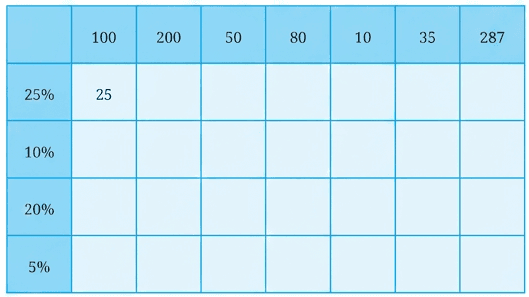
We can find 15% of a number by adding 10% of the number and 5% of the number.
Step 1 — Finding 10% of a number
To find 10% of a number, we divide it by 10. This moves the decimal point one place to the left.
For example, let us find 10% of 100.
Step 2 — Finding 5% of a number
To find 5% of a number, we take half of its 10% value.
For example, let us find 5% of 100.
Step 3 — Calculating 15% for each value
We add the 10% and 5% values to get 15%.
For 100:
For 200:
For 50:
For 80:
For 10:
For 35:
For 287:
Answer
(i) 15% of 100 is 15 (ii) 15% of 200 is 30 (iii) 15% of 50 is 7.5 (iv) 15% of 80 is 12 (v) 15% of 10 is 1.5 (vi) 15% of 35 is 5.25 (vii) 15% of 287 is 43.05
More questions in IT
Can you tell what percentage of the colour was made using yellow?
Try completing Method 3 by filling the boxes.
Try to calculate (without using pen and paper) the indicated percentages of the values shown in the table below. Write your answers in the table.
How did you find these values? Discuss the methods with the class. Do you find anything interesting in the table?
Using this understanding, mentally calculate how much 40% of the values in the table above would be.
What relationship do you observe among 20%, 5%, and 25% of a value?
Using this observation, mentally calculate how much 15% of the values in the table would be.
Suppose you have to mentally calculate the following percentages of some value: 75%, 90%, 70%, 55%. How would you do it? Discuss.
Similarly, to find 10% of a quantity, what decimal value should be multiplied?
Complete the following table:
Context: Kishanlal's daily sales target is ₹5000.
Q. On Days 5 and 6 his sales were ₹7800 and ₹9550 respectively. Calculate the percentage of the target achieved on these days.
Context: Kishanlal's daily sales target is ₹5000.
Q. On Day 7, he achieved 150% of his target. On Day 8, he achieved 210% of his target. Find the sales made on these days.
Complete the table below. Mark the approximate locations in the following diagram.
Complete this table by calculating the percentages to answer the questions:
- Which product has a larger share of badam?
- Which product uses a smaller proportion of food chemicals?
Check if the percentages of each product add up to 100.
Find the profit percentage of the wholesaler and the manufacturer.
Shambhavi owns a stationery shop. She procures 200 page notebooks at ₹36 per book. She sells them with a profit margin of 20%. Find the selling price.
She sells crayon boxes at ₹50 per box with a profit margin of 25%. How much did Shambhavi buy them from the wholesaler?
Context: Raghu purchased rice at ₹35 per kg and sold 10 kg of it for ₹300.
Q. Could we have just calculated the loss percentage per kg instead? Would it be the same?
Context: Shyamala had procured decorative vases at ₹2650 per piece. One of the pieces was slightly damaged. She decides to sell it at a loss of 18%.
Q. Try making an estimate. Draw a rough diagram depicting the given situation.
Due to heavy rains, Snehal could not transport strawberries to Hyderabad from his farm in Panchgani. He sells some of his stock at ₹80 per kg with a 12% loss. What is the cost price?
A utensil store is offering a 35% discount on the cooker with an MRP ₹1800. What is the selling price? If the cost price was ₹900, what is the percentage profit made after the sale?
Check if the calculations are correct in the bill shown.
You may share any bills you have at home with the class. Observe the different elements present in the bills. Are there any similarities or differences in these bills?
Suppose we want to know the expression/formula to find the total interest amount gained at the end of the maturity period. What would be the formula for each of the two options?
Tricky Percentages
Would You Rather?
You have won a contest. The organisers offer you two options to choose from: Option A: You deposit ₹100 and you get back ₹300. Option B: You deposit ₹1000 and you get back ₹1500. What is the percentage gain each option gives? You can choose any option only once. Which option would you choose? Why?
A provision store is offering a stock clearance sale. Customers can choose one of the two options — 20% discount or ₹50 discount—for any purchase above ₹150. Which option would you choose if you want to:
(i) buy items worth ₹180 (ii) buy items worth ₹225 (iii) buy items worth ₹300
Ariba and Arun have some marbles. Ariba says, “The number of marbles with me is 120% of the marbles Arun has”. What would be an appropriate statement Arun could make comparing the number of marbles he has with Ariba’s?